Category Archives: Making Of

How 3DO Creates Video Games – By: Jeff Tyson

Article from howstuffworks.com – Nov 17, 2008

Original source

https://electronics.howstuffworks.com/3do3.htm

3DO is one of the top video game companies in the U.S. with dozens of popular titles. Go behind the scenes and learn how 3DO creates a new game!

Lots of us play video games. In fact, the number of people playing video games only seems to increase — the number of consoles in American homes exploded in 2007, rising more than 18 percent [source: Cheng]. If you’ve played video games before, you may have wondered what goes into making them. You may even want to get into the business yourself. Here are some of the questions that you may be wondering about:

  Where do game ideas come from?

  • How many people are involved in making a game and what do they do?
  • How is a game developed?
  • How does a game get to my local store?

The video game industry, like most technology, moves quickly and rarely looks back. It seems like every few years brings a fresh new batch of video game consoles, each vying for a place at the top of every gamers’ heart. And over the years, gaming has become enormously popular all over the world, bringing in more than $1 billion in revenue and even surpassing the music industry in retail sales [source: Fritz].

To understand the entire process of video game development, we went to the folks at The 3DO Company. Also known as simply 3DO, the company was both a console developer and a third-party publisher of video games, with several titles for the Nintendo 64 and other game consoles, as well as PC and Mac computer systems. 3DO was founded in 1991 and released the 3DO Interactive Multiplayer (also known as simply the 3DO) in 1993. After poor sales and reception, the company dropped the console and shifted focus to developing video games (similar to what Sega currently does for the Nintendo Wii). 3DO declared bankruptcy in 2003, however, and no longer makes video games.

When 3DO was still around, we followed the development of Portal Runner, a game 3DO made for the Nintendo 64. In the process, we looked at the development of the game itself, as well as ­the process of getting a game off the ground and onto the shelves. On the next few pages, you’ll learn about basic game technology, how an idea is developed and how a game is distributed.

Where the Game Comes From

All games start with an idea. But where that idea originates can be traced to one of several sources:

  • An original concept presented by an employee
  • An original concept pitched to the company by an outsider
  • A sequel to an existing game
  • A spinoff based on a character from an existing game
  • A game based on an existing character or story (such as movie, TV or comic characters)
  • A simulation of another game medium (such as board games and card games)
  • A game targeted to a specific demographic
  • A simulation of a real world event
  • A game designed to take advantage of a specific game platform (such as the Internet or an advanced interactive game system).

Once the idea is accepted by the company as a viable game, then a preproduction team is assembled to begin developing the idea into a fully realized game. How the game develops depends greatly on what type of game it is. The story line and design of a game based on an existing movie or comic character are going to be much more restricted than those for a completely original game concept. Likewise, a simulation based on a real world event, such as a baseball game, usually has definite boundaries in what can be done.

Video games can be vastly different from one another. And while there is a huge variety of games available, most fall into certain broad categories:

  • Sports (Madden NFL, Tony Hawk)
  • Strategy/Role-playing/Adventure (Zelda, Final Fantasy)
  • Fighting (Mortal Kombat, Soul Caliber)
  • Puzzle (Tetris)
  • Shooter (Halo, Call of Duty)
  • Platform (Super Mario Brothers, Sonic the Hedgehog)
  • Racing (Mario Kart, Tokyo Xtreme Racer)
  • Conversion (American Arcade Pinball, Who Wants to Be a Millionaire?)

Of course, a lot of games include aspects from more than one of these categories, and a few games are in a category all their own.

In the case of Portal Runner, 3DO took a character from one of its more popular franchises and gave her a spinoff title of her own that falls into the platform category. The character, Vikki Grimm, has figured prominently in the company’s Army Men universe. Portal Runner is not considered a sequel because 3DO took one character and built an entirely new game universe around her. As you learn about the development of Portal Runner, remember that many of the steps in the process can change significantly for a different title based on the nature of the game being developed.

Planning the Game

The preproduction team generally includes each of the following people:

  • Director
  • Designer
  • Software Engineer/Programmer
  • Artist
  • Writer

Sometimes a team won’t have every one of these people and other times it will have more than one person in a particular category. Another person assigned to the game from the outset is the producer. While the director provides the overall vision and direction for the game and is in charge of managing all the team members, the producer is in charge of the business side. For example, the producer maintains the production and advertising budgets and makes sure that the game stays within the limits of those budgets.

The first thing that the preproduction team does is develop the story line for the game. Think of this like writing the outline for a novel. The story line identifies the theme of the game, the main characters and the overall plot. Also, areas in the game where a full motion video (FMV) sequence would help the story along are established. An important part of developing the story line is knowing the nature of the game. This means that the game designer is typically involved from the very beginning; he or she is responsible for things like:

  • Identifying traits and features of the game
  • The type of gameplay and user interaction that is developed
  • How the game will use the technology available on a particular platform (video game system or computer)

Portal Runner is a linear game. This means that you follow a predetermined path and accomplish specific goals to complete the game. The pattern of the game is: FMV1, Play1, FMV2, Play2, FMV3, Play3 and so on until the end. Each play portion has a different look, theme and goal, all of which combine to form the game world. Linear play makes the story line much easier to create than it would be for a game that branches or has multiple endings. Branching games can contain a series of paths that all lead to the same ending. Even more difficult are branching games that can result in one of several different endings, depending on the path taken. Of course, the type of game largely determines what the story line and style can be. A puzzle or sports game would not require as detailed a story line as a 3D action or role-playing game.

Once the story line is developed, the team creates a set of storyboards. A storyboard is a collection of still drawings, words and technical instructions that describe each scene of the game. These include storyboards for the FMV sequences that introduce the story and continue it between the periods of actual gameplay. Here’s an example:

In addition to storyboarding the game, the designers will map out the different worlds, or levels of play, within the game during the preproduction phase. The attributes of each world and the elements contained within it are pulled directly from the story line.

Developing the Game

Once the storyboards and overall game level designs are complete, the game enters the production phase. The preproduction team expands as needed to include additional artists, programmers and designers.

3DO’s artists began developing the 3D models that will make up the worlds of Portal Runner using a software application called 3D Studio Max. Richly detailed texture maps were created for each object. While the game developers at 3DO created the actual game environment using these models and textures, another division of the company, PlayWorks, used the same models to develop the animated full-motion video (FMV) sequences for the game.

Meanwhile, the programmers wrote custom code in C programming language that provided the framework for the game objects. A lot of code was pulled from the company’s library, a bank of predeveloped code that could be repurposed for different games.

Some of the code for a game involves the 3D engine, an application that generates all the polygons, shadows and textures that you see. Another piece of code is the artificial intelligence component. This is the logic of any game. It establishes the physics of the game, detects interaction and collisions of objects and controls movement of the characters. Development of the game code is done using a special development version of the particular game system that has increased memory, an SVGA monitor connection, a network connection and a hard drive.

All the bits and pieces — objects, textures and code — are fed into a special utility called a tool chain that combines the pieces into one big piece of code. The tool chain makes code that is executable on a specific platform, which basically means that the game code will actually run on the game system that it was designed for. To test the game, Portal Runner director John Salera used another specialized game console built for debugging games.

The Game World

If you can find a copy of Portal Runner and play the game, you’ll see that it used an over-the-shoulder perspective. When you’re playing, you seem to be hovering in the air slightly behind the character you are controlling. As your character moves around, you see the world of the game stretch out into the distance. But what you are really seeing is a very clever illusion reminiscent of the backlots of Hollywood.

The world that the character actually interacts with in Portal Runner is a very defined area. If you could pull the camera view up in the air, you would see that the play area is completely self-contained. Other parts of the world that you can see in the distance are actually two-dimensional images mapped onto a flat surface that surrounds the play area like a barrel. The sky was created in the same way, by mapping the sky image onto a large dome or cylinder that fits over everything else. Look at the example below to get a better idea of how this works.

A production team constantly looks for ways to add realistic effects without degrading the performance of the game. A good example of this is the reflections of objects on shiny surfaces, like the chess board in the medieval world of Portal Runner. The chess pieces and characters moving around on the chess board appear to have detailed reflections on the polished surface of the chess board. What’s actually happening is that a second version of each object is positioned upside-down just below the semi-transparent surface of the chess board. The upside-down version moves in concert with the “real” version of the object, providing an illusion of reflection.

Polygons and Shading

The vast majority of 3-D objects created for computer games are made up of polygons. A polygon is an area defined by lines. To have a polygon, you must have at least three lines.

The lines connect a series of coordinates in the three-dimensional “space” the computer creates. The point where the lines connect is known as a vertex. Each vertex has XY and Z coordinates.

  • X determines the position relative to right or left in the virtual space
  • Y determines the position relative to top or bottom in the virtual space
  • Z determines the position relative to front or back in the virtual space

Once each polygon has a set of vertices to define its shape, it needs information that tells it what to look like. There are four common ways to do this:

  • Flat shading
  • Gouraud shading
  • Phong shading
  • Texture mapping

Flat shading simply assigns a single color to a polygon. It is very simple and fast, but makes the object look artificial. Gouraud shading is more complex. Colors are assigned to each vertex and then are blended across the face of the polygon. Since each vertex is typically associated with at least three distinct polygons, this makes the object look natural instead of faceted. Look at this example:

You will notice that the ball with Gouraud shading appears much smoother than the flat shaded one. But look closely at the outlines of the two balls. That’s where you can tell that both balls have the exact same number of polygons.

An even more complex version of shading, Phong, improves upon Gouraud shading. Whereas Gouraud shading interpolates colors by averaging between the vertices, Phong shading averages each pixel based on the colors of the pixels adjacent to it to create smooth surfaces.

Another common technique for determining the appearance of a polygon is to use texture mapping. Think of texture mapping as wrapping a present. Each side of the box you are wrapping is a blank polygon. You could paint the box, but it would be very difficult to make it match all the designs on the wrapping paper. However, if you take the wrapping paper and tightly cover the box with it, you have completely transformed the box with just a little effort.

Texture mapping works the same way. Mapping requires the use of another image. Essentially, this other image is stretched over the object like a skin. Most video game consoles and computer graphics adapters contain a special chip and dedicated memory that store the special images used for texture mapping and apply them to each polygon on the fly. This allows games such as Portal Runner to have incredibly detailed 3-D environments that you can interact with in real time.

Character Skeletons

The characters in a game have skeletons. Similar to our own skeleton, this is a hidden series of objects that connect with and move in relation to each other. Using a technique called parenting, a target object (the child) is assigned to another object (the parent). Every time the parent object moves, the child object will follow according to the attributes assigned to it. A complete hierarchy can be created with objects that have children and parents. Here’s an example for a human character:

Once the skeleton is created and all of the parenting controls put in place, the character is animated. Probably the most popular method of character animation relies on inverse kinematics. This technique moves the child object to where the animator wants it, causing the parent object and all other attached objects to follow. Another method that’s popular for games is motion capture, which uses a suit of sensors on a real person to transmit a series of coordinates to a computer system. The coordinates are mapped to the skeleton of a game character and translated into fluid, realistic motion.

Each character’s range of motion is programmed into the game. Here’s a typical sequence of events:

  • You press a button on the controller to make the character move forward.
  • The button completes a circuit, and the controller sends the resulting data to the console.
  • The controller chip in the console processes the data and forwards it to the game application logic.
  • The game logic determines what the appropriate action at that point in the game is (move the character forward).
  • The game logic analyzes all factors involved in making the movement (shadows, collision models, change of viewing angle).
  • The game logic sends the new coordinates for the character’s skeleton, and all other changes, to the rendering engine.
  • The rendering engine renders the scene with new polygons for each affected object, redrawing the scene about 60 times each second.
  • You see the character move forward.

Finishing Touches

After the basics are in place, the production team begins to refine the game. Part of this refinement involves optimizing the game code, polygon count and logic, including adjusting the clipping planes and culling. The polygon count (number of polygons on screen at the same time) is a major factor in the smooth rendering and quick response of a game.

Clipping planes determine whether or not polygons in the field of view will be rendered. This depends on how close to the camera the polygons are. Typically, the near clipping plane will not render polygons that are close enough to intersect the plane of the camera. This keeps your viewpoint in the game from intersecting another object and thus blanking out. And the far clipping plane is normally set at the point where the screen resolution causes the details to become impossible to see. There is no need to render objects that you cannot see.

This leads to another area of optimization. While the far clipping plane does not render entire objects that are too far away, culling means that the video game system does not render the parts of objects that are outside your viewing area. For example, when you look at a building, you normally only see one or two sides of the building. In a game, you can increase performance by not rendering the other sides of the building until you move around to the point that you can see them. And as you move, the game can stop rendering the things you can no longer see.

One of the refinements that John Salera said 3DO wanted to make to Portal Runner was to determine where they could eliminate polygons through culling in order to increase the polygon count for Vikki, from 1,500 polygons to 3,000. They want to do this without increasing the overall number of polygons onscreen. By increasing the polygon count of a specific object (like Vikki), the object can be made to look smoother and more realistic.

Periodically during the development of the game, 3DO sends builds (partially complete versions) of the game to the game console maker. This is done to keep the console maker informed about how the game is developing and to ensure that there are no surprises that the manufacturer might take issue with.

As the game nears completion, it enters the post-production phase. This phase has several parts:

  • Game versions
  • Product testing
  • ESRB review
  • Marketing and advertising
  • Distribution

Once the game is done, an alpha version is sent to designated game testers. This preliminary version is a first pass meant to find any major flaws in the game. The problems are identified and the game is released again in beta form. The beta version is tested exhaustively to find any bugs and discover ways to further optimize the game. After the items found in the beta version are fixed, the final candidate is released.

Sometime during this period, the game is sent to the Entertainment Software Rating Board (ESRB) to be given a rating. If the game is released before a final rating is set, it will have an RP (Rating Pending) in the rating box.

Distributing the Game

During post-production, the marketing engine begins to ramp up. The game is advertised in print, on the Web and oftentimes on TV. Quite often, a game that is a hit or has a very memorable character provides the company with opportunities for merchandising and licensing. Comic books, cartoons, movies and amusement park rides have all spun out of the popularity of certain video game characters. Products such as clothing, toys and board games often display characters from the game. A popular video game character can be a marketing gold mine for the parent company.

A major difference in creating a video game for a console versus building a game for a PC is the approval and distribution process. Console manufacturers normally require strict licensing agreements between themselves and companies that wish to develop games for their systems. We will outline the process that 3DO goes through with the game console makers they work with.

Every company that develops games for a video game system manufacturer is considered a third-party licensee. Here’s how it breaks down.

A third-party developer:

  • Develops the game idea
  • Creates the game
  • Tests the game
  • Markets the game
  • Distributes the game

Console maker:

  • Approves the game idea
  • Tests the game
  • Reviews and approves the game
  • Manufactures the game

When a developer submits the game to the console maker, the testing and review process can be very rigorous. The game may be sent back to the developer with requests to change certain parts before resubmitting it.

Many people mistakenly assume that the cost per game to the parent company is minimal and the profit huge. This is seldom the case. While the actual material costs for the game duplication, box and manuals may only be a few dollars per unit, there are a lot of other costs incurred:

  • Console licensing royalties (about $3 to $10 per unit for the console maker)
  • Game development costs (typically several millions of dollars)
  • Advertising (anywhere from $1 million to $4 million for most games)
  • Salaries for the production team (a typical game might employ 40 people for a year or more)
  • Other licensing fees (particularly in sports titles, where the professional sports organization and any featured athletes tend to receive royalties for each unit sold)
  • Operational costs (the costs of running the company must be split between the various games sold)

Game companies also have to take into account the short lifespan that most games enjoy. Since the technology that video games thrive on is continually improving, the games that are cutting edge today will seem slow and outdated in just a year or two.
Combat in the Skies. Interview with director Kudo Tsunoda. By Matt Casamassina – ign64.com – Jan 7, 2000

Original source

https://www.ign.com/articles/2000/01/08/combat-in-the-skies

IGN64 brings you an interview with Army Men: Air Combat’s director plus the first-ever N64 screens.

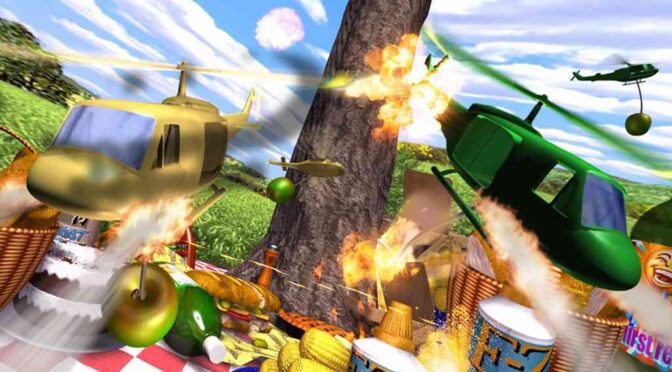
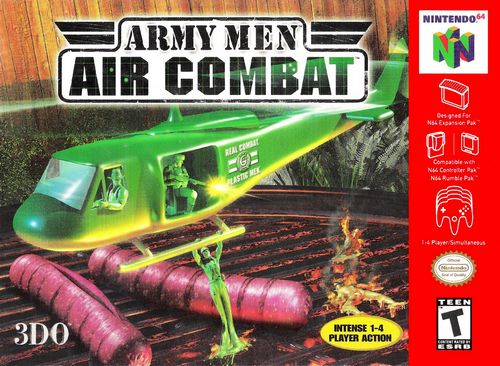
The Army Men franchise has proved to be most profitable for 3DO. The company recently released Army Men: Air Attack, a polygonal 3D top-down shooter similar to the Nuclear Strike series. Now Nintendo 64 owners get their own take on the experience with Army Men: Air Combat. IGN64 recently chatted with project director Kudo Tsunoda about the toy-based shooter.

IGN64: 3DO recently released Army Men: Air Attack for PlayStation. Now Nintendo 64 owners are getting Army Men: Air Combat, a very similar game. Can you explain the idea behind it for those who are not familiar with the PlayStation title?

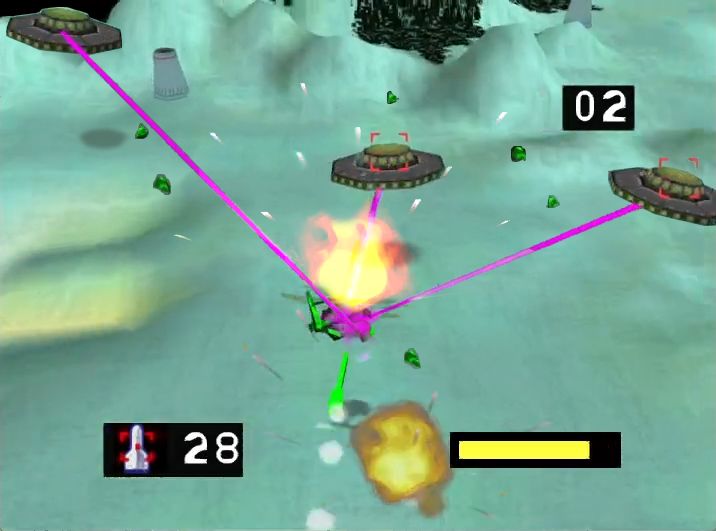
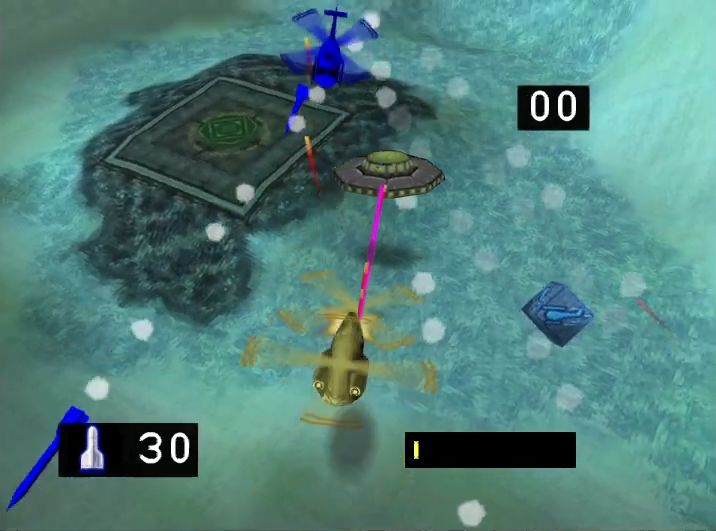
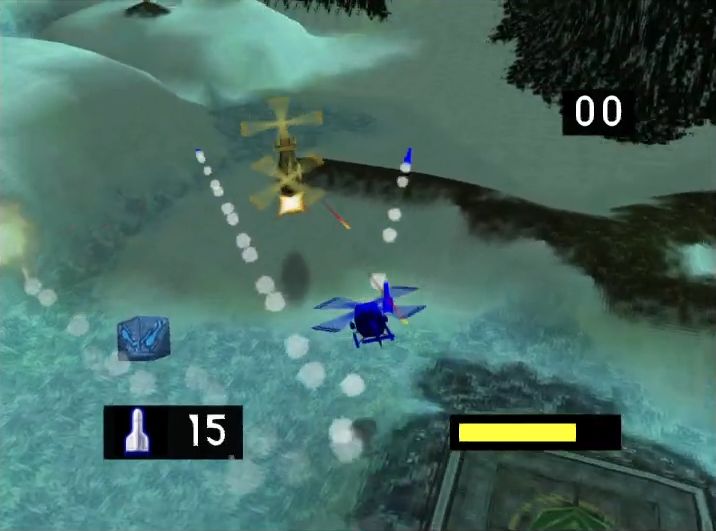
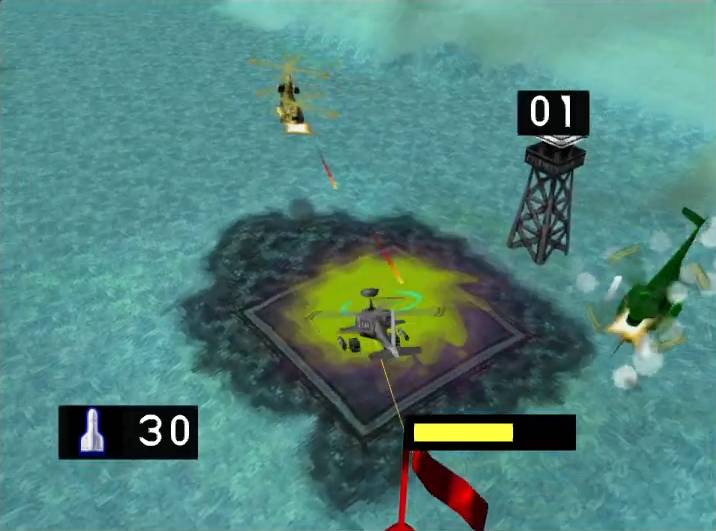
Kudo Tsunoda: Yes. Air Combat is helicopter combat in the Army Men universe where you fly a little toy helicopter through these giant, oversized worlds. We’re really trying to focus more on the playing with toy aspects of the franchise for the Nintendo 64 version. We’re really playing up that it’s a little plastic toy helicopter so, for example, instead of firing off missiles you’ll be firing off bottle rockets.

Like other Army Men games, it’s the Green Army versus the Tan Army. But we’re also throwing in a lot more neutral environmental enemies so you’ll have bees that swarm out and attack you and mutant bugs that you have to fight against. A lot of the missions are based more on using your helicopter’s winch and interacting with the environments than they are on flying around and blowing things up.

IGN64: What are the differences between Army Men: Air Attack for PlayStation and Army Men: Air Combat for N64?

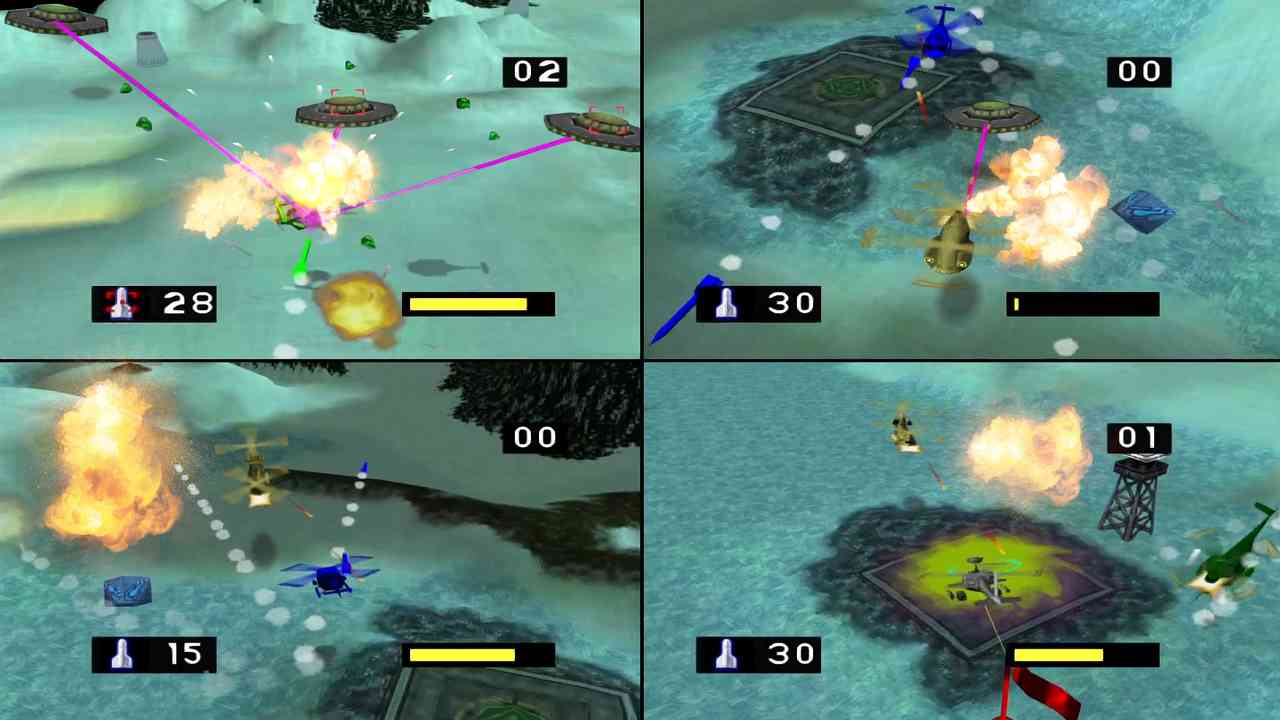
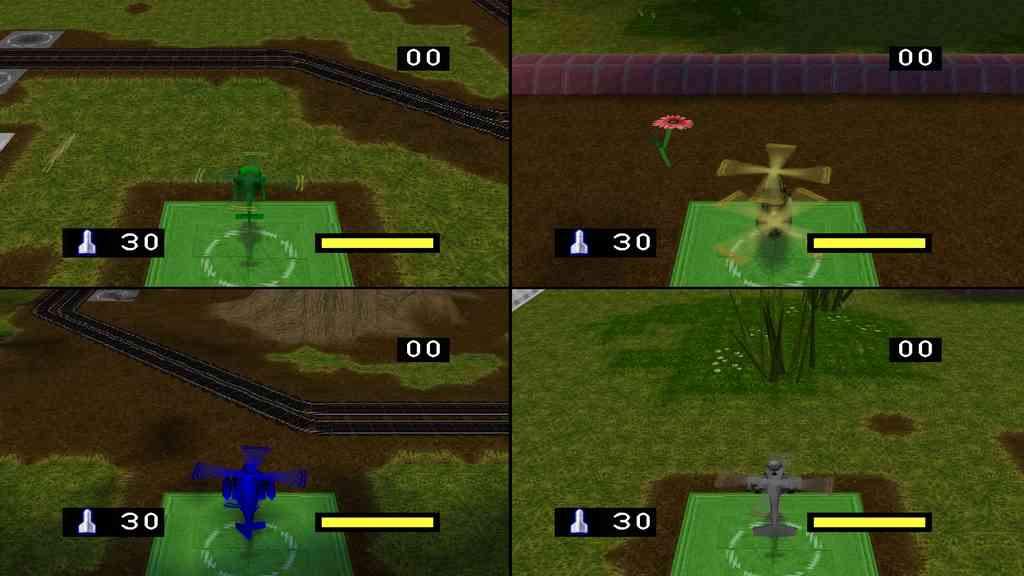
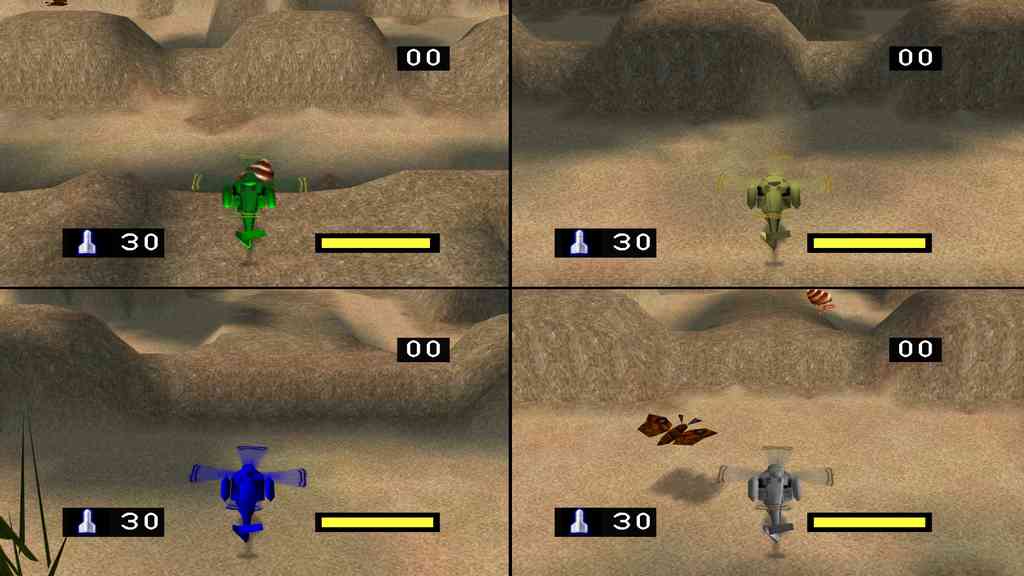
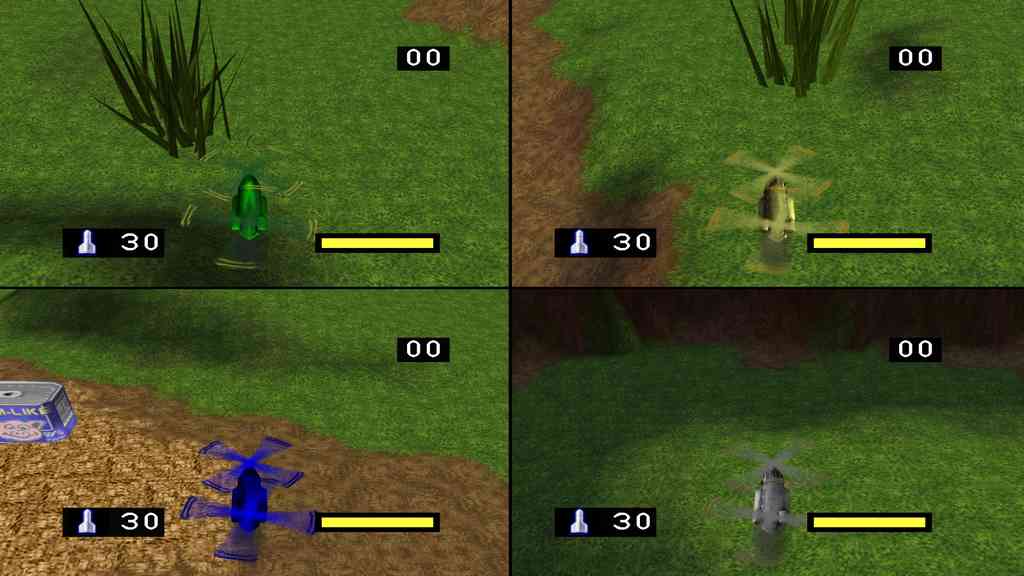
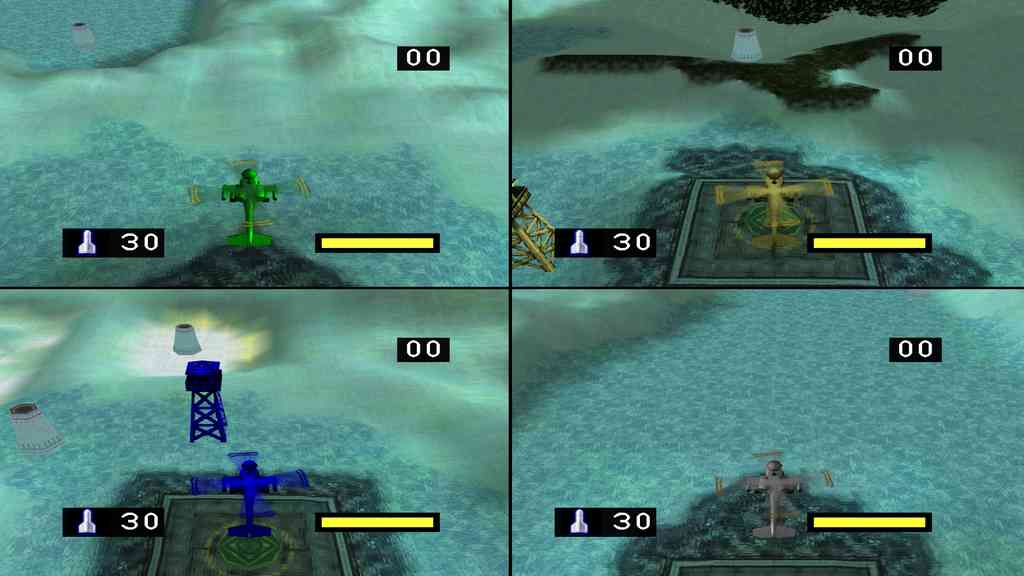
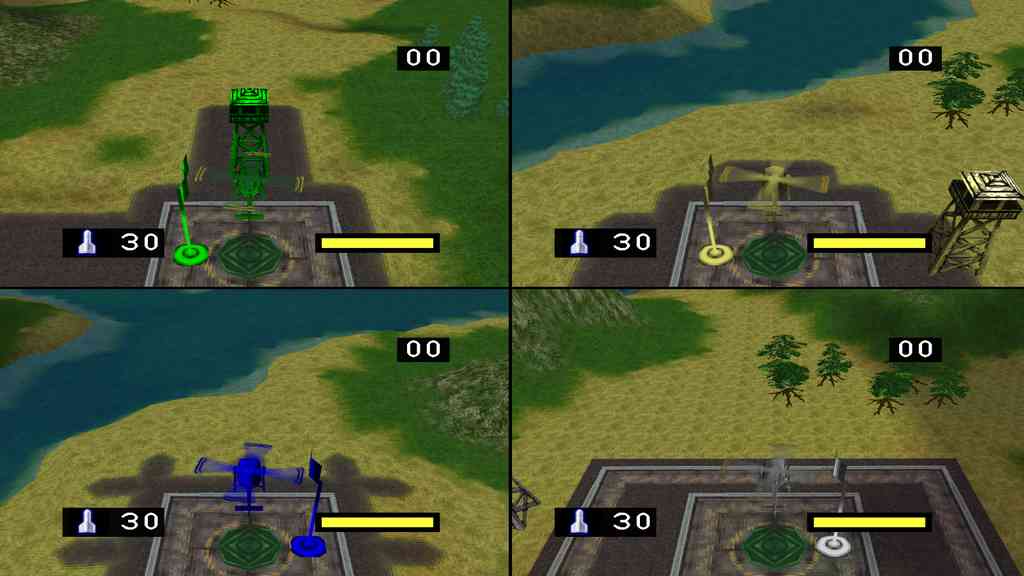
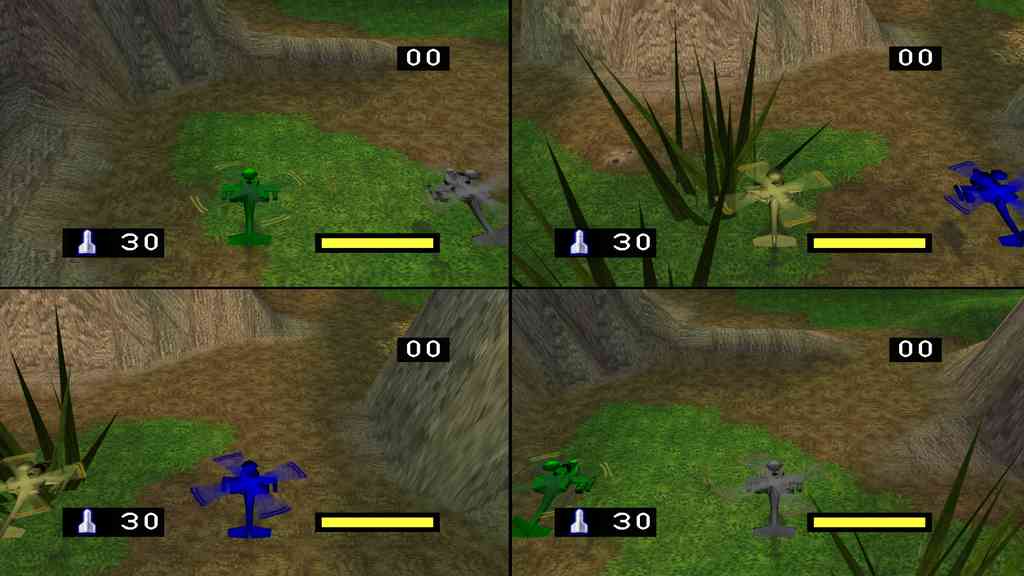
Kudo: There are some parts of the engines that are similar, but obviously for the Nintendo 64 we’re doing a lot more hardware-specific stuff. They’re definitely different systems so you want to max out the potential for each. We rewrote a lot of the code for the Nintendo 64 version, we’re doing new missions and we’re playing up a lot more of the multiplayer stuff. We don’t have a four-player mode for PlayStation, but Nintendo 64 does. So, we’ve really worked on that. Besides the campaign missions, we’ve got cooperative ones. We’ve got four different four-player head-to-head games.

IGN64: How is the framerate in four-player mode?

Kudo: It’s doing great. We’ve always got lots of stuff on screen, too. One of the problems about making a game like this is that you can pick up everything in the world [with the helicopter winch] and put it down somewhere. People tend to pick up stuff and build a little encampment with all of the different world objects — pile up all of the soda cans and things like that and then have a huge battle with it all. It’s difficult technology-wise. I mean, it’s great for the gamers, but when I talk to the programmers about what we want to do with the game they look at me like, “I’d like to kill you.”

We did have a lot of time to work on the technology though, so even in multiplayer we still have all of the objects on-screen, everything still looks as good graphically and it all runs at a good speed. So we’re pretty happy with that.

IGN64: Are you using the 4MB Expansion Pak for the game?

Kudo: Yeah, we will be, mostly for different [presumably high-resolution] graphic modes.

IGN64: Can you give us a few examples of the different missions in the game?

Kudo: Most of the missions are based on using things in the world or capturing toys that you can take into different missions. In Army Men there are the “Our World” missions and the “Their World” missions. The “Our World” is more of playing with toys in these huge environments and the “Their World” is more of the normal scale, military based missions. So, one example is in the “Our World” missions you can go and collect some toy that doesn’t animate. But once you get into the “Their World” missions we tried to keep a lot of the fun of playing with toys alive, so instead of having it straight military based, we’ve added in a giant, for example, a giant toy that walks around and blows up Tan units.

Air Combat N64 Multiplayer
Army Men: Air Combat N64 Multiplayer

We’ve also got ways of using things in the world to manipulate different insects. So there are bees in the world that you can control by moving flowers around. You pick up a flower, drop it off somewhere else and it’ll attract all of the bees to that area and they’ll help you take out the Tan units.

IGN64: How do play mechanics work?

Kudo: One of the interesting things about making an Army Men title is that it’s such a mass-market license. Because of that it’s hard to make a game that’s going to be fun for a six or seven year old to play as well as advanced players — you know, people our age who played with Army Men as a kid. So we made the helicopter mechanics as simple as possible so that gamers can get into quickly and start flying around shooting stuff. Even a little kid can play, but you still have the added depth of game play like figuring out what every object in the world can do. For example, you can pick up a soda can and then pull the helicopter behind it where it will act as a shield. You can drop it on stuff and squish guys or you can build barricades. You can take a bunch of pinecones and lay them down around an anthill so that the ants are trapped. Then you could remove one pinecone and the ants will drum out in that direction. You can essentially guide where you want the ants to go.

IGN64: How does it control?

Kudo: Since we don’t have any vertical control, you can just use the analog stick to move the actual helicopter around. After that you’ve got a simple winch mechanic buttons, some strafing buttons — it’s very simple.

Air Combat N64
Multiplayer Army Men: Air Combat
IGN64: Tell us about the multiplayer modes.

Kudo: There is a two-player split-screen cooperative mode. Plus we’ve got four different four-player modes. We’ve got a mode called Flag Nabbit, which is basically Capture the Flag. We’ve got Food Fight where you going around collecting different food items and seeing how you can use them to take your enemy out. We have a bug hunt kind of game where you get points for killing each different type of bug. You can use items in this mode to lure insects your way, where you can kill them all. This mode is pretty cool because you’ve got everybody not only trying to kill the bugs, but also swooping into each other’s areas trying to retrieve various items that will lure the bugs their way. The last mode is Air Rescue, where you go head-to-head trying to rescue little Army Men guys while trying to kill the competition’s guys.

IGN64: What sort of 3D environments do you get to play in?

Kudo: We’ve got a backyard environment with a patio and everything. We’ve got a beach area with lots of big sandcastles that you can fly through. We’ve got a park where you can fly up on the Jungle Jim, through a slide and a park-type environment. We’ve also got a campground area with lots of little picnic blankets. We’ve also got military environments like an alpine forest and an Arctic level.

IGN64: What sort of weapons does the game feature?

Kudo: In the “Our World” missions we’ve got bottle rockets, Roman candles, different swarm rockets that’ll come out like a four-pack, machine guns and napalm that you can use to melt guys with. But even more, everything in the environment can be used as a weapon. You can pick up the soda can, pinecones — whatever, and drop it on enemies.

Army Men Air Combat
Multiplayer Army Men: Air Combat in Nintendo 64
IGN64: In your opinion, why is this game better than Nuclear Strike?

Kudo: To me Nuclear Strike is pretty much a straightforward military shooter. The Army Men franchise is based around playing with toys — out in your backyard building a sense of nostalgia of stuff you used to do as a kid. Back at the office we get busted all of the time by security late at night because we’re out in the parking lot lighting Army Men up and firing Roman candles at them. Or when we first started development we had this huge ant farm that we expensed to the company to help develop our “realistic ant AI engine.” But we’d come and take Army Men, dip them in honey, drop them in the ant farm and watch the ants go to town on them. To me, there is only so much of the “Hey, I’m going to go pick up an oil drum and save the POW” missions before it starts to get taxing.

Plus, in Air Combat you can interact with everything in the environment as opposed to the Strike games where you fly around and blow stuff up. Having the depth of game play where it’s not just flying around and shooting stuff, but also learning what you can do with the environment and interacting with it, adds a whole lot.

IGN64: When can we expect Army Men: Air Combat on retail shelves?

Kudo: The end of the first-quarter 2000.

Army Men Air Combat N64
Multiplayer Army Men: Air Combat on Nintendo 64
IGN64: Finally, can we look forward to more Army Men games for Nintendo’s upcoming Dolphin system?

3DO: You can pretty much expect that 3DO will be bringing all of its major franchises over to the next-generation of machines. We support Nintendo. They like us.

Sarge’s Hero. We talk with Michael Mendheim. By Dean Austin ign64.com Sep 24, 1999 / Jun 20, 2012

Original source

https://ign.com/articles/1999/09/25/sarges-hero

IGN64 talked with Michael Mendheim, Creative Director on Sarge’s Heroes, about the game & the industry.

IGN64: How did you get into the industry and what were the first titles you worked on?

Michael Mendheim: I started in advertising and eventually became a freelance illustrator. I got involved in the industry by designing and painting box covers for video games, that led to character design and eventually game design. The first title I ever designed was Fester’s Quest (NES). The game was a hit and I decided creating and designing video games was incredibly satisfying and fun, so I started a company that specialized in character and game design. I had a small team and we designed numerous games from Tazmania (SNES) to the Mutant League Series (Sega Genesis).

IGN64: What was your most satisfying product to work on and why?

MM: Tough question since I have enjoyed the majority of products I’ve worked on. I can’t pick one but I can pick my 3 favorites.

1). Mutant League Football (Genesis):

This product was a dream for me because I love football, mutants, and carnage. Every aspect of this game was fun to work on from character and field design to testing. The game was quite successful and spawned one of the first video game animated television shows and a toy line.

2). BattleTanx (N64):

This was the first product I designed at 3DO. Trip Hawkins spent a lot of time working with me on this product. The team was great and incredibly talented, our Technical Director Robert Zdybel bent over backwards for the designers. We finished the product from start to finish in under a year. It was touch and go there for a while but the product came together over the last two months. I remember having to plead with the team to stop playing it so we could finish it.

3). Sarge’s Heroes (N64 / PSX):

This game is wonderful to work on because of the dynamic character design and overall strength of the brand. The development teams are probably the hardest working and determined people I have ever worked with. The Technical Director on the N64, Dan Geisler is a God. Bob Smith is the Technical Director on the PSX and he is a Gods’ God. It’s a very good feeling to be working on a product that you know has the potential to be a big hit and you are being supported by strong engineering, strong art direction, and strong marketing.

IGN64: Please tell us the story for Army Men: Sarge’s Heroes.

MM: General Plastro and his evil Tan Army have discovered mysterious Portals. These portals offer passage to an alternate reality, a dimension that holds the secret to ultimate power. General Plastro is currently in possession of the Portals and has sent his soldiers through them to find new weapon technologies which, when brought back to the plastic dimension, can be used to destroy the Green Army.

Fortunately, for the Green Army it has Sgt. Hawk, aka “Sarge,” a one-man wrecking ball, trained and guided by Colonel Grimm to be the leader of the most elite squad in the Green army… The Bravo Company Commandos. The Tan Army is now in possession of the most diabolical weapons ever created and General Plastro has mounted a full-scale attack on the Green Nation. With the capture of his entire squad and Colonel Grimm’s daughter Vikki, Sarge has a one in a million chance to save the Green Nation from the clutches of defeat.

One of the first weapons of mass destruction General Plastro’s forces bring back is a giant magnifying glass. Needless to say, General Plastro loves the smell of burnt plastic in the morning! One of the coolest weapons of Plastro’s army, is the dreaded “V-Bot,” which is a toy robot that comes to life once it is brought back from “Our World” into “Their World.” Any inanimate plastic object that is brought back (using the Portal) from “Our World” into “Their World” becomes animate.

IGN64: What did you learn from your experience of making the first Army men?

MM: First and foremost, Sarge’s Heroes is not a sequel to Army Men 3D it is a line extension from the Army Men brand. Army Men 3D is about plastic army men waging real combat, it is a game of tactics and gritty combat and it does it better than most. Sarge’s Heroes is a much lighter and funnier game, it is a character (Sarge) -based action game with an entertaining and compelling story that evolves from mission to mission.

I was not involved in Army Men 3D (PSX) but I thought the team did a very good job. The three main areas where we wanted to differentiate ourselves from Army Men 3D:

Real world environments:

We wanted to take the game player into our world environments like the kitchen, bathroom, and backyard sandbox. The thought of kitchen counter warfare sounded like an absolute blast and it was something that hasn’t really been done before in an action shooter.

Animations:

Nina Stanley (the game’s Art Director) and I set out at the start of this project to focus on the character animations. Our goal was to create some of the finest animations ever seen in a video game. We wanted to bring Sgt. Hawk to life. All the animations in Sarge’s Heroes are hand drawn and the reason for this was to allow the artists to interpret motion and to exaggerate gesture, in the end the character’s personality comes to life through motion and artistic expression. This cannot be achieved using motion capture.

Plastic soldiers that look plastic:

Another goal that we set out to achieve was to create an effect that would make Plastic Army Men look like plastic. Dan Geisler, the game’s Technical Director, came up with a technique for mathematically approximating the effects of light reflecting on a plastic material surface. He calls it Plastosheen (Plast O Sheen).

IGN64: How many levels and/or missions are in the game? Can you describe some of the missions and the environments they take place in?

MM: There are 14 missions in Sarge’s Heroes, 7 that take place in “Their World” and 7 that take place in “Our World.” We also have 7 multi-player levels, and of course this wouldn’t be an Army Men game without Boot Camp.

When playing in “Their World” the player will experience everything from treacherous mountain terrain to arctic wastelands, forests, towns, and heavily defended enemy army bases. When playing in “Our World” the player will experience giant terrains that take place on the inside and outside of one particular house in Suburbia, USA. The player will experience warfare like never before as he fights the dreaded Tan Army in the backyard garden (complete with giant insects and flowers), the living room, and the kitchen. The designers of Army Men: Sarge’s Heroes have even included a massive bathroom.

IGN64: Could you describe the game engine?

MM: The engine was built by a very talented corp. of engineers, led by industry-vet and Technical Director, Dan Geisler. The engine and its supporting technology was built to fully accommodate the ambitious Sarge’s Heroes design. Some of the challenges were to build an engine that would support very large worlds with a fast frame rate and an incredible viewing distance. Missions like the Living Room and Bathroom well demonstrate this success. Additionally, the engine supports a high-resolution mode with the Expansion Pak. Sarge’s Heroes also shows all characters in a 3rd person perspective in 4-player deathmatch, which is rare.

IGN64: How would you describe the player view and how does the interface work?

MM: The game is primarily played from a third-person, over-the-shoulder perspective. The camera does have some dynamic elasticity to it and allows the player to view Sarge from the front. A quick tap of the R-Button, resets the view to directly behind the character. Another view we have comes via the sniper lens. While in this view, the player can survey the land and manually zoom in and out to take out enemy troops from long range. It’s a very effective method for the more patient player.

The interface was truly designed with the action gamer in mind. It is very intuitive and easy to navigate. Here we allow the player to choose items like resolution (w/Exp. Pak), view type (normal or letterbox) as well as configure their controller to their liking. Players should also find the multi-player setup very user-friendly. Many players will get well into game play without ever reviewing the manual.

IGN64: We understand that the game features both two player and four player modes. How do these work from both a game play and graphical standpoint?

MM: Sarge’s Heroes actually supports two, three or four players in a competitive capacity. We have also included a Family Mode that was introduced in the original BattleTanx game. This mode levels the playing field between all players. It removes an oft-found intimidation between parents and kids by presenting them with startup weapons and a more forgiving difficulty level. This has proven successful and has been well received by the customers. From a graphical standpoint, we opted to display all the characters in a 3rd person perspective. While this presents its own challenges, we felt that this was the best way to introduce the various characters and get players to connect with them. Watching the Sarge’s Heroes characters battle it out in the Bathroom or Living Room is a sight to behold. The sense of scale and heavy firepower kick butt!

IGN64: Can you play multiple characters?

MM: You can select from a variety of different characters (Sgt. Hawk, Vikki, and Plastro) to play as in a multi-player game. Since Sarge’s Heroes is a character-based game we spent a lot of focus on the character development, below are the stars of Sarge’s Heroes:

SGT. HAWK:

Sgt. Hawk is Bravo Company’s unquestioned leader. He’s an experienced Army Man who has seen it all – gritty battles over endless sandbox dunes, frozen conflicts across the icy wastes of unshoveled driveways, and the hi-tech warfare of magnifying glasses held aloft by the hands of cruel titans. As a dedicated leader, Sarge is highly respected by his squadron and by Colonel Grimm.

COLONEL GRIMM:

Colonel Grimm is a gruff, tough veteran of the old days when most soldiers were wood or tin. He’s a lifer as were all the men in the Grimm family who made it to Colonel status. The Colonel has suffered numerous tragedies fighting the Tan Menace and from these tragedies, Grimm has become a solemn man who never smiles. Colonel Grimm is the master tactician of the Green Army and Sarge’s mentor.

VIKKI:

Vikki is a beautiful, sexy, independent, hard working young woman whom is one of the top reporters for the Green Army’s newspaper, Green Star News. Raised solely by the Colonel, she has spent her whole life as an army brat traveling to different military bases around the world. Since Colonel Grim was Vikki’s only role model, Vikki followed his every move and grew up to be a very tough, confident, and strong woman.

PLASTRO:

General Plastro is an evil and ruthless man who has no problem slaughtering hundreds of Green Army men with his newly acquired barbaric weapons. He is a highly intelligent war tactician as he leads his Tan Army to victory over the Green Army. Plastro has won the support of several other nations, although they had no choice since he conquered them. Another sign of his genius is discovering the “Alternate World” (Our World) and the Portal devices that can transport him there. From this Alternate World, Plastro has exported powerful weapons that he enjoys using on Green Army Men. The only positive attribute of Plastro is that he has a dry and evil sense of humor.

Sarge’s Squad consists of 5 soldiers that are based on some of the classic Army Men poses (Bazooka, Mortar, Minesweeper, Flame-thrower, and M-60 Machine gunner). As Sarge rescues these squad members over the course of the game, each of their weapons become a permanent fixture in Sarge’s inventory, increasing the firepower that accompanies Sarge at the start of each mission.

BRAVO COMPANY:

RIFF:

Riff is the squad’s Bazooka man and Sarge’s best friend. Riff is every inch a soldier, yet retains the musical chops and coolness of a Blues musician. Riff wails some really cool Bazooka Blues for the enemy’s heavy armor.

HOOVER:

Hoover may be a gawky, geeky-looking beanpole with more ribs showing than a 4th of July barbecue and an Adam’s apple you could hang a helmet liner on, but the squad depends on him nevertheless. His depth of concentration and smooth fluidity of movement made him a natural to either man a minesweeper or run a floor buffer. He chose the minesweeper since the squad didn’t need a janitor.

SHRAP:

Shrap is the Squad’s Mortar Man. He used to pull a lot of shore patrol duty, and became a way cool surfer dude as a result. Later he gave up the big waves for the field artillery.

THICK:

Thick is basically an educated trigger finger attached to a nearly brain dead soldier. His name describes his skull, his neck, and the layer of lead he lays down with his M-60 machine gun, cutting down tan troops like a weed whacker does dandelions. He has the body of an action figure guided by a mind no brighter than a penlight.

SCORCH:

You’ve got to be a little nuts to be made out plastic and still love fire (Scorch is a lotta nuts). Sarge gave him custody of the flame thrower (he was setting fires around camp, anyway) so he could torch tan soldiers until they bubble. He creeps out the rest of the squad by sleeping in a book of matches instead of a sleeping bag.

IGN64: You mentioned the giant magnifying glass weapon in your earlier answer. How many weapons types are there in the game and what are some of their characteristics?

MM: There are 12 different weapons in Sarge’s Heroes:

M-16 Assault Rifle: All-purpose, Sarge’s main weapon.

Bazooka: Great for destroying tanks and helicopters.

Flame Thrower: The most feared weapon of plastic soldiers.

Shotgun: Lays out a circle of buckshot.

M-60 Machine Gun: Heavy machine gun that puts out a tremendous amount of lead.

Sniper Rifle: Everyone’s favorite, allows players to zoom in on enemies.

Grenades: The animation of Sarge pulling the grenade pin with his teeth is awesome.

Grenade Launcher: My personal favorite, the grenade launcher is a trajectory weapon that is incredible fun when used with the precision targeting mode.

Mortar: Player uses a cursor to target the mortar. This is a long-range weapon.

Mine-Sweeper: Not as exciting as a grenade launcher unless of course you’re in a minefield and you don’t have one.

Mines: Great for multi-player.

C-4: This weapon has a time delay and the largest blast radius in the game.

IGN64: You mentioned the RAM Pak earlier. How are you taking advantage of it?

MM: We use the Ram Pak for a high-resolution mode. In this resolution, the player will find that the characters, weapon effects and environments become much sharper. However, the N64 hardware does such nice filtering, so players without this peripheral are still in for a treat.

IGN64: Switching gears, what’s the most overlooked title you’ve ever seen in the game industry and why?

MM: There are many good titles that have been overlooked, but the one that I always think of first is 3DO’s Uprising (PC or PlayStation). Uprising had all the depth and satisfaction a game could ever deliver, with solid graphics and game play, but it didn’t sell in the market. Another game that I enjoyed a lot was Warhawk, one of the first games out on the PlayStation. It was an innovative flight sim/shooter with elegantly simple level designs. Like Uprising, Warhawk deserved to be played more than it was. But the classic overlooked title would have to be Dune II on the PC and Genesis. Some people think that Command and Conquer started the RTS trend, but in fact, Dune II did 90% of what C&C did years before.

IGN64: What usually causes the most lost sleep during a project?

MM: Figure the team spends 16 to 18 hours at the office during the last two or three months of the project (some people don’t go home at all, we had one Director who camped in the building for a month). Everybody is doing the best they can, they are giving 110%, but they are tired and sometimes irritable. They are sacrificing their lives and families for the project. When they finally close their eyes and try to sleep, their brains are wired and moving at 100 mph trying to answer a hundred different unanswered questions all relating to a single question, how to make the game better.

IGN64: What’s the weirdest thing that happened during the making of Army Men?

MM: I came into the office one day and sat down to work and something was wrong. Finally it dawned on me that all my plastic soldiers that decorate my cube were missing. I went to ask a team member if he had seen them and he realized that all his soldiers were missing too. The entire team had their soldiers taken! We then went to investigate and found out that every person in the entire company had their soldiers taken and there were none to be found anywhere (3DO usually has plastic soldiers littered all over the place on the floors, in cubes, etc). A few hours later a ransom note was E-Mailed to everyone in the company, some diabolical fiend was holding them hostage! Needless to say, it was April Fools day and someone pulled off quite a gag. In the end we got our boys back safe and sound and we are planning our revenge.

IGN64: Given carte blanche to build any game you wanted, what would it be?

MM: Sarge’s Heroes with hand to hand combat. Sarge is a very physical guy and it would be a blast to see him tear into those Tan soldiers with an advanced fighting engine running the show.

IGN64: And lastly, who do you respect most in the industry and why?

MM: Certainly from a design stand point Shigeru Miyamoto attains the highest respect from me. His games are pure magic that mesmerizes players of all ages, races, and cultures. His contribution to the video game industry is beyond words. The attention to detail that Mr. Miyamoto delivers to every level shows his passion and dedication.

Another person who awes me is Trip Hawkins. The knowledge that the man possesses is inspiring. Not only does he know game design, product development, marketing, sales, finance, operations, etc. but he will always take the time to sit down and discuss a problem or idea. Trip’s vision is crystal clear and way ahead of its time, if you want to get a sense of where the industry will be 10 years from now all you need to do is listen to Trip.

Interview with Nick Earl, Army Men Producer – “Army Men Official Strategies & Secrets” Book by Brett Skogen (Jan 1, 1998 by Sybex Inc.)

It’s no easy feat to develop a best-selling computer game. With the gaming community’s insatiable appetite—always wanting better graphics, special effects, story, and, most importantly, gameplay—it takes a dedicated team of professional producers, writers, programmers, graphic artists, and others to put a finished game on the shelves.

Army Men is no exception. With an estimated budget of 1.5 million dollars, over 20 dedicated people spent two years of their lives making this game. The results are definitely worth it though—this game is one hell of an adventure!

One of the key members of the Army Men team was its producer, Nick Earl. Nick is currently an Executive Producer at 3DO, where he oversees the development of Army Men and BattleTanx products. He’s been with 3DO for over five years, starting out as one of the original 3rd Party Evangelists. Later, he founded and managed the Affiliated Label and Licensing Programs at 3DO, before finally climbing to the producer ranks at one of the company’s studios. As the producer of Army Men, Nick had the responsibility of managing the day-to-day concerns of the project, while keeping the development team in focus and motivated. Nice work, Nick, you did a great job.

Fortunately, Nick was able to spare a few minutes to answer some questions as he put the finishing touches on the game.

Nick Speaks: Q & A with the producer

From the start, what was the vision for Army Men? What did you want to achieve?

Nick: There were a couple of inspirations for Army Men. Back when we started thinking about doing a military game, we were playing a lot of Return Fire, developed by Silent Software. We all loved the game, but yearned for better enemy AI and the ability to give orders to intelligent squads. So, the first vision was an action/strategy game that would give the player depth. But the real and enduring vision developed when we were laying out missions with the little plastic green and tan soldiers one afternoon. Suddenly it hit us to do the game based on plastic army men! As we started to build the design, it gained momentum, and pretty soon we knew we were onto something big.

Where did you get your inspiration for Sarge?

Nick: This was really Keith Bullen’s (the designer of Army Men) idea. He realized early on that the player would want to bond and identify with a personality rather than just move plastic armies around a battlefield as is usually done in a strategy game. With the introduction of the plastic concept, the design really started to evolve from a strategy game toward immersing the player in a fantasy world created in the mind when playing with these great little toys. We knew right away that we wanted to have all of the classic poses, weapons, vehicles, and, most importantly, special effects, such as melting a Tan soldier into a pool of tan plastic with a flamethrower! Many other things evolved over time.

For example, at first the concept was to have Sarge ferry his units to different parts of the world and then issue orders to his troops, who would go off and carry them out. After talking to the magazine editors and focus groups, we realized that the player would want to bond with Sarge and his immediate world by being the one who gets to do all the destruction!

Therefore, we made Sarge tougher and able to carry and use all of the classic weapons. And most importantly, we gave Sarge the persona of a classic soldier. Now, we had what we thought was the best design for a game based plastic soldiers, one other evolution of Army Men was to use the MovieTone news concept. During their time, those clips did such a good job of making the war seem heroic, but not bloody and tragic. The nature of plastic physics lends itself perfectly to this notion—lots of action, heroism, and challenge, but none of the nasty and sickening effects of war.

Obviously, your team spent some time renting WWII movies. What movies were most inspirational?

Nick: Some of the mission objectives are loosely based on the classic WWII movies such as Bridge over the River Kwai, The Great Escape, and Kelly’s Heroes. There is something so dramatic yet clean about these movies—we thought that Army Men worked well within this theme. After all, plastic army men were invented right after WWII.

What’s the origin of the game’s engine? Did you modify an existing one or create your own?

Nick: We built one from scratch. The Technical Lead was Nicky Robinson, who, with the help of several engineers, built a great engine that allows this highly detailed art to come to life.

What has been the most difficult part of bringing Army Men to life?

Nick: Capturing the exact positions and then transitioning them into fully animated sequences. For instance, having a flame thrower start in the classic pose, then run with his weapon, fire it while running, dive, roll, and then move right back into the classic pose. We also spent a lot of time and energy balancing each mission to get the right combination of action, strategy, and intrigue. This is what really brings Army Men to life, because each mission is so fun and compelling that you keep coming back for more—you really feel like you are Sarge blowing up bridges, shattering Tan enemies, and liberating your Green troops from prison camps.

What else does Army Men offer the gamer?

Nick: We like to think that we will give the player a compelling, tough, and heroic character (Sarge), thrilling and humorous plastic special effects, absolutely beautiful art and animations, and an opportunity to really immerse oneself in those great battles we all played out in our backyards when we were kids. We see Army Men as a great blend of action and strategy, and of serious missions sprinkled with humor such as tanks flipping over to reveal hollow underbellies!

What’s your favorite strategy/tip for getting through the game’s missions? For a multiplayer game?

Nick: Wow, there are many. I think the best advice is to be methodical and thoughtful as you progress. There are numerous times that you think you have the mission solved when all of a sudden a Tan tank appears out of nowhere to shatter you! By thinking ahead and planning, you can neutralize such events with a few strategically placed mines or a mortar. I also recommend dropping to the prone position and rolling when in a fire fight. You are less vulnerable, and your chances of hitting the enemy are increased. For a multiplayer game, my favorite strategy is to hide in trees, and when an enemy runs by, melt him with the flame thrower before he knows what happened!

Any Easter Eggs in the game you want to confess to?

Nick: I don’t want to give much away, but after calling in air support a few times, you just may be surprised! I also recommend checking out the lake in the Alpine campaign’s Out of the Mountain mission. You will get a kick out of what lurks there. The best one by far, however, is the final-win cinematic—it has a really great twist.

On a personal note, what are some of your favorite things?

Nick: My favorite game, other than Army Men of course, is probably NHL Hockey ’98. My favorite musical groups are Pink Floyd, Led Zeppelin, U2, and the Grateful Dead. If I had to pick a favorite song, it would probably be “Comfortably Numb” by Floyd or “Unforgettable Fire” by U2, depending on my mood. As far as movies, my two favorites are Platoon and The Graduate.

What’s your next project after Army Men?

Nick: Army Men! I am doing an Army Men sequel for PC, as well as entirely new designs for PlayStation and Nintendo 64.

Thanks, Nick, we all look forward to Army Men sequels in the near future!

About the autor of “Army Men Official Strategies & Secrets Book”

Brett Skogen has worn many hats in the gaming industry: reviewer, strategy guide editor, marketing specialist, and producer. Brett is the author of Hexen II Official Strategies & Secrets and co-author of Final Fantasy Tactics Battle Strategy Guide, both from Sybex.