
“All the Same… Until They’re Not” – a little weird green goblin from another world
When we think in a plastic soldier, the first thing that comes to mind is the idea of a generic figure, mass-produced thousands of times, with the same pose, the same face, the same helmet, and the same gear. A uniform mass of molded combatants, all visually identical… at least at the beginning.
However, in the world of Army Men, as in many human science fiction war stories, that illusion of sameness gradually breaks apart. What starts as an army of clones eventually becomes a collection of individuals, each with their own story, character, scars… and identity.
An Inevitable Comparison: Army Men and the Science Fiction Clones

In human’s narrative Sci-Fi universes, especially in stories of Clones made for War, this exact idea is masterfully explored: an army formed by millions of genetically identical soldiers who, over time, develop unique personalities, habits, relationships, values, and even visual traits that set them apart.
Although Army Men doesn’t have a biological backstory but an industrial one (they are soldiers created by molds and plastic), the phenomenon is surprisingly similar:
- They all start the same.
- All come from the same mold.
- All have the same role in the chain of combat.
But war, time, lived experiences, and the need to survive transform them.
Glorious Purpose: To die in battle
The Army Men’s “glorious purpose,” as presented in Plastic World literature, refers to their default, indoctrinated response to the search for meaning and a place in the universe that all toys seem to have, especially after the events that changed their worlds: the discovery of the Portals.
The plastic soldiers of the Plastic World aren’t made for anything beyond battle. But the moment conventional warfare changed forever with the Portals, and the immersion in constant battle in their small world was replaced by the prolonged travel times in the gigantic and practically empty space of the Real World, their minds began to mutate.
“When you’re busy killing or being killed, you don’t stop to think. But when everything you see is new and you have time to think, you even realize you exist…” – Sarge Hawk
From Replicas to Individuals: A Slow but Irreversible Process
In the Toyverse battlefield, homogeneity is just a starting point that slowly begins to crack.
The signs of individuality don’t appear quickly. They are the result of prolonged active service, after entire campaigns and years of battlefield experience.
Battle marks (scratches, burns, melted parts, bullet holes) are considered badges of honor. They’re not hidden or repaired. They’re shown with pride.
But proactive changes in uniform (like painting helmets, carving symbols, modifying equipment, or adding personalized accessories) are not allowed for just any soldier. Only those with distinguished service, veterans with a proven history of bravery, endurance, and loyalty, receive authorization from high command to modify their appearance a little more…. radically.
When Plastic Tells Stories
Over time, what started as a clone army begins to transform into a mosaic of personal stories:
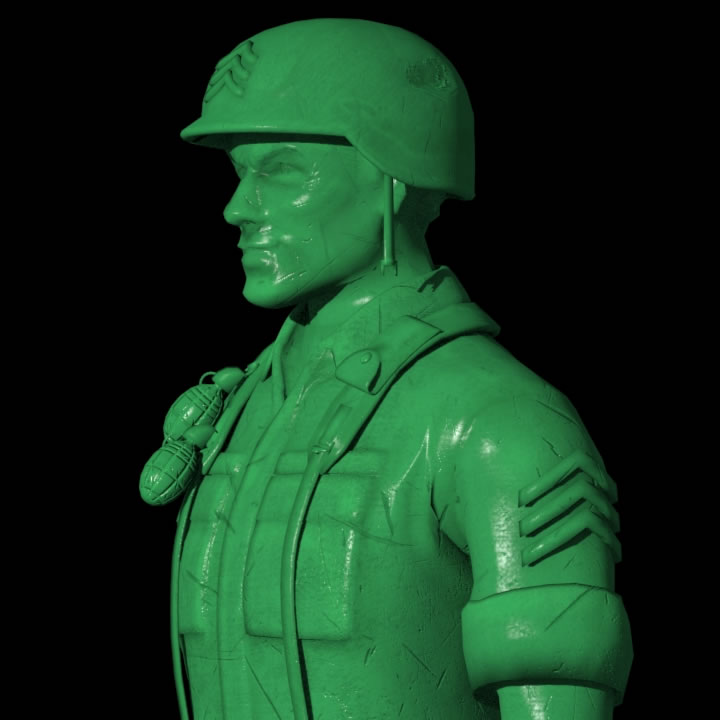
- Helmets with painted stripes, symbols, skulls, or unit insignias.
- Backpacks or vests with inscriptions, phrases, or names of fallen comrades.
- Lost limbs replaced with improvised parts, pieces from other toys, found objects, or even metal elements.
- Ribbons, bandages, extra armor plates, and handcrafted modifications.
Every scar, every scratch, every modification isn’t just decoration: it’s living history.
Beyond Appearance: Personalities Forged in Plastic and Combat
It’s not just about appearance. The wear and tear of war also shapes the mind and character of each soldier.
- Some become reckless, others calculating.
- There are jokers, others deadly serious and disciplined.
- Some turn superstitious, others philosophical or solitary.
- Losses, traumas, and victories leave both visible and invisible marks.

And in extreme cases, the transformation goes even further: Some soldiers lose their heads (literally and figuratively). Others desert, tired of the endless fighting. Some are declared AWOL (Absent Without Leave), missing without permission, lost or fled. And some even cross the line, abandoning their cause and joining the enemy, whether out of conviction, desperation, or madness.
War wears down more than plastic. It wears down the soul.
Psychological Tendencies According to Army Color
While all soldiers share the same production origin (a mold, a material, a function) the cultural and military context of each army also shapes their minds, character, and way of fighting.
Tan (Ocher/Brown) Soldiers tend to be the most ruthless and belligerent. Their military culture is deeply rooted in doctrines of supremacy and conquest. For them, war isn’t just a means… it’s an end in itself. Aggression isn’t a consequence: it’s a mandate.
Blue Soldiers are calculated, meticulous, and highly tactical. They avoid impulsive actions and always prioritize operational efficiency. Their mindset favors minimal casualties and precise execution, even if it means retreating or waiting for the perfect moment.
Grey Soldiers have become almost synonymous with unconventional warfare. Experts in guerrilla tactics, sabotage, espionage, and attrition warfare, they rarely engage in frontal battles. They prefer to wear down, confuse, and ambush. Their culture is one of tactical invisibility and long-term endurance.
Red Soldiers are perhaps the most fanatical in their doctrine. Their nationalist fervor is such that they follow orders to the last consequence, without question. They are the definition of blind discipline, capable of launching into suicidal offensives if high command demands it. Their pride as a plastic nation is as strong as their capacity for sacrifice.
These differences don’t erase individuality, they frame it. Each soldier carries not just their personal story but also the weight and cultural heritage of their color, their nation, and their army.
The Toyverse Super Soldier Program
“Not all soldiers are born equal. Some… are improved.”
In the world of Army Men, the constant war and combat demands pushed the high military spheres of the plastic nations to develop one of the most ambitious and controversial projects in Plastic World history: the Super Soldier Program.
Its goal was clear: take a plastic soldier beyond their original capabilities. Create fighters stronger, more resilient, faster, smarter, and, in some cases, with structural upgrades that clearly set them apart from the common soldier.
Unlike other experiments aimed at mass-producing soldiers, like clones or special molds, the Super Soldier Program doesn’t start from scratch. Its philosophy combines two paths:
- Selection from the mold: Some soldiers are born directly with exceptional traits, the result of slight variations in the molding process, whether intentional or accidental.
- Post-manufacturing enhancement: Others, after proving their worth in combat, are selected to undergo remolding and reinforcement processes, giving them structural upgrades, material reinforcements, and in some cases, partial redesigns of their plastic anatomy.
Iconic Case: Sarge Hawk
The most famous and representative example of the program is undoubtedly Sarge Hawk.
Originally a standard sergeant within the Green army ranks, Sarge was gravely injured during one of the major offensives of the the Plastic-Real World transition war.
Instead of being discarded or recycled, he was remolded using advanced techniques, reinforcing his structure and enhancing his capabilities… saving his invaluable military experience.
Since then, he has adopted the name Sarge Hawk, symbolizing not just his new condition but also his vision, instinct, and leadership capacity.

Sarge Hawk was practically an exception within the program, a rare case of perfection rarely replicated. However, the rest of his famous unit, the Bravo Company Commandos, wasn’t as lucky when it came to post-enhancement mental stability.
Each of them suffers unique side effects, a reflection that the Super Soldier process is far from perfect… and in some cases, amplifies both strengths and flaws of those undergoing it.
- Scorch: Obsessed with fire, he’s become practically a full-blown pyromaniac. His behavior borders on madness, rarely thinking of anything but watching enemies burn.
- Shrap: A somewhat carefree soldier who completely disregards protocol. He’s obsessed with mortars and any form of long-range artillery.
- Hoover: The process was not kind to him. He emerged as a completely cowardly soldier, unable to face direct combat and unwilling to harm others.
- Thick: Thick is… well, Thick. Basically, he’s a finger on the trigger of a machine gun. His intellectual capacity was reduced to the bare minimum, acting on pure instinct: brutal, direct, and with no room for reflection… with a little kid mindset.
- Riff: The only one besides Hawk who seems to have emerged from the process without adverse effects. A jazz fanatic, he keeps a cool head, is an excellent soldier, and serves as second-in-command with a perfect mix of discipline and style.
This group reflects that the Super Soldier Program, while ambitious, doesn’t always deliver the desired results… and often leaves permanent marks, both physical and psychological, on those who survive it.
From Mold to Myth: When a Soldier Surpasses the Product
This phenomenon reflects something deeper:
- The mold may be the origin, but it doesn’t define the destiny.
- What starts as a mass-produced object transforms, reinvents, and finds new meaning.
- Just like the Sci-Fi clones, who despite being products of genetic engineering become brothers, comrades, heroes, and legends… the same happens in the Army Men Toyverse.
Conclusion: Plastic Is Not the End… It’s the Beginning
The universe of Army Men teaches us a similar lesson to that of the Human’s Sci-Fi clones: We are born the same, but we don’t live the same. Experiences, choices, losses, and scars are what make us unique.
The mold only gives us form. What we do with that form is what truly defines us. So even though they all started as green (or tan, or gray, or red) plastic soldiers… none of them ends up being like the other. Because war and time turn objects into individuals… and plastic into legends.
Behind the scenes:
The Evolution of Plastic Soldiers in the Army Men Toyverse
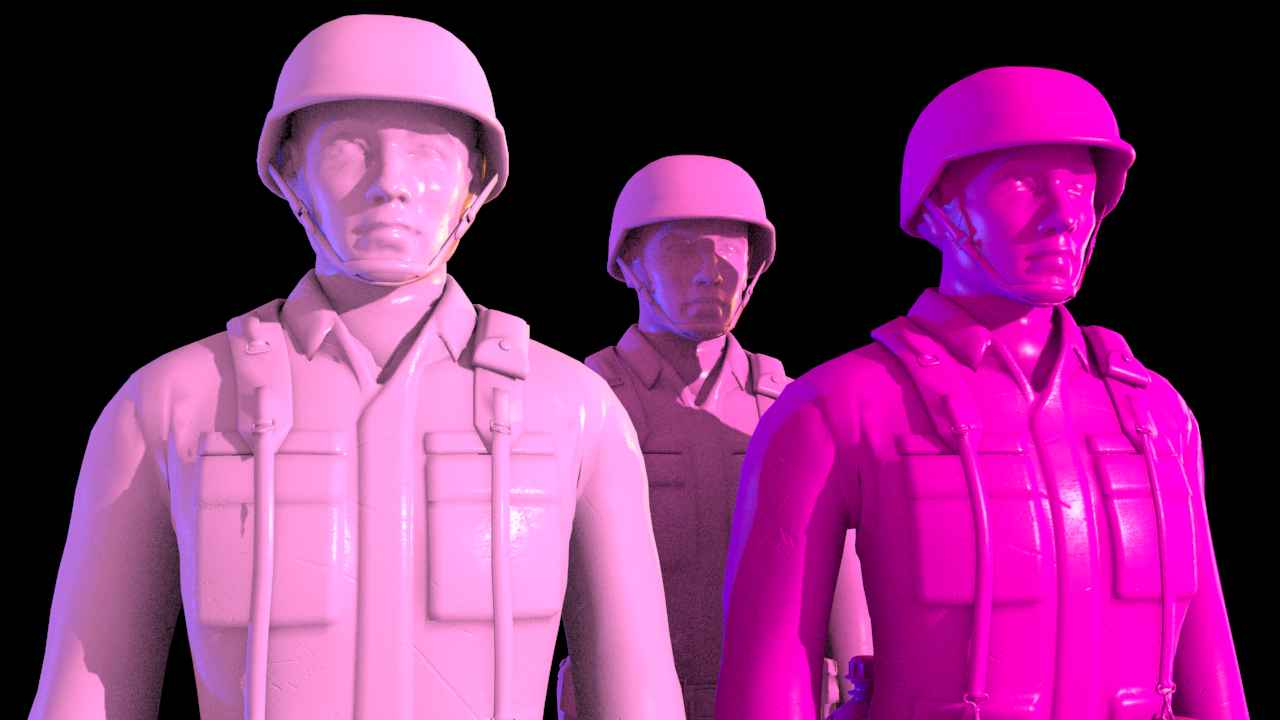
Like the clones in Star Wars, Plastic Soldiers are mass-produced with a single purpose: to fight. Fresh out of the mold, they are identical in appearance and function. They have no personal identity, no opinions, and no customization. Their abilities are the same, their uniforms are standard, and their mindset is programmed to obey orders without question.

Initial Uniformity: Born from the Mold
Their existence is purely functional. They are replaceable, interchangeable, and in the chaos of war, individuality is not a priority.
Battlefield Marks: Experience and Change
However, war is unforgiving, and no soldier remains the same after facing the reality of combat. With each mission, Plastic Soldiers begin to develop their own instincts. The scars of battle (cracks in the plastic, burns, improvised accessories) become marks of identity.
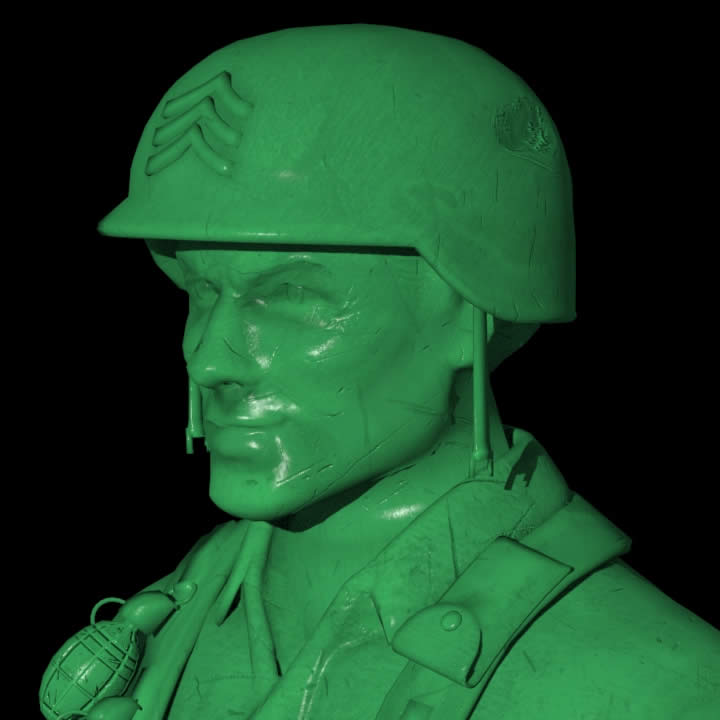
Just as the Star Wars clones adopted unique hairstyles, armor modifications, and personal emblems, Plastic Soldiers also find ways to stand out. Some reinforce their weapons with duct tape, others paint symbols on their helmets or adjust their posture, slightly bending their joints to differentiate themselves. These small adaptations become badges of veteran warriors.
The Awakening of Individuality: More Than Just Soldiers
Over time, the standardization of their existence begins to crumble. Those who survive long campaigns develop their own thoughts, question orders, reflect on their purpose, and adopt an identity beyond their initial function.
The Star Wars clones evolved from mere troops to individuals with distinct voices, such as Rex and Cody, who led with autonomy and genuine emotions. In the Toyverse, Plastic Soldiers follow a similar path. Once uniform figures on a battlefield, they become characters with distinct personalities, choosing how to fight, what to preserve, and how to leave their mark.
The Experienced and Enhanced: Beyond Natural Evolution
Not all Plastic Soldiers follow a progression solely based on combat experience. Some, whether through battlefield merit or strategic necessity, are selected for enhancement programs (similar to the Super Soldier project or cybernetic modifications seen in Star Wars with Clone Commando Echo, or even characters like Cable from X-Men and Bucky Barnes, Marvel’s “Winter Soldier).
These soldiers undergo physical and tactical upgrades that elevate them beyond their comrades. Some receive structural reinforcements, advanced armor, or bio-mechanical enhancements that increase their endurance and strength. Others are transformed into hybrids of machine and soldier, integrating advanced communication systems, improved sensors, or even prosthetics with specialized abilities.
However, the cost of these enhancements is not just physical. Like Echo in Star Wars: The Clone Wars Season 7, many of these upgraded soldiers face an identity crisis: Are they still Plastic Soldiers, or have they evolved beyond what they were created to be? Are they tools of war or individuals with their own purpose?
For some, enhancement is a blessing; for others, a curse. Their role in the Toyverse becomes a dilemma between utility and individuality, where war reshapes them not only physically but also spiritually.
Conclusion: Evolution Beyond the Mold: More Than Plastic, More Than Soldiers
A Plastic Soldier’s fate is not set at the time of its creation. Though they are born with a fixed purpose: war, experience gives them something invaluable: identity. Thus, what was once a homogeneous army transforms into a brotherhood of unique warriors, each with their own story sculpted in plastic.
The progression of Plastic Soldiers in the Army Men Toyverse mirrors the journey of Star Wars clones: from interchangeable units to unique individuals with their own stories. But in the case of the enhanced ones, a new element is at play: transformation not only as a result of war but also through deliberate intervention.
From mass-produced warriors to experienced soldiers who choose to forge their own destiny, each Plastic Soldier faces a different path. Whether shaped by battle or by technology that turns them into something more, their evolution defines the true weight of individuality in a world where they were created to be identical, and for war.