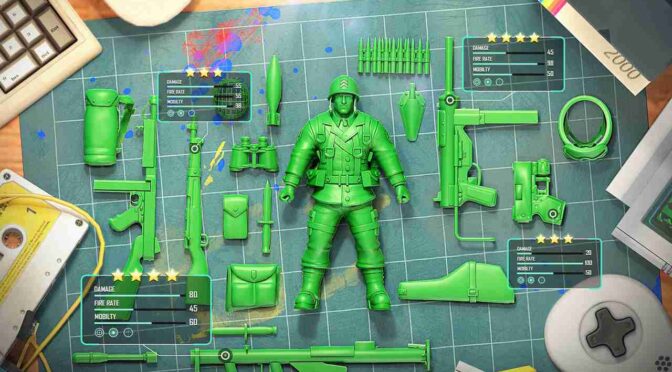
Tools of war: Now for the good stuff!
Like dentists need a drill, Army Men need weapons. There’s an entire arsenal of weaponry in the Army Men Toyverse universe, not only from the Plastic World, but all the other. Here is a breakdown of what each weapon does and how to use them.
Weapon categories
These sorts of categorizations are often ‘soft’ meaning that there are many guns that could be argued to be in more than one category. In addition, the terms have ‘shifted’ in usage over time.
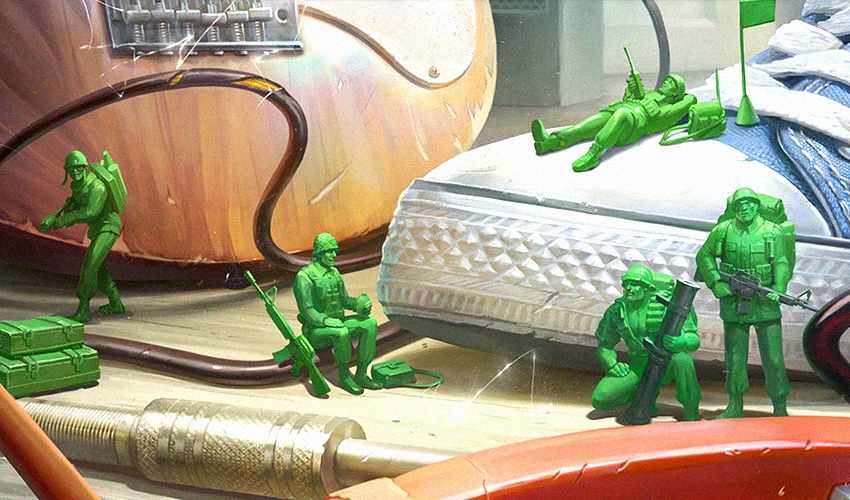
Plastic Weapons
In the Army Men universe, plastic weapons represent the original and native technology of the toy soldiers. These weapons are molded from the same material as their wielders: solid plastic (typically PWC, PVC or polyethylene). They operate through internal compressed air systems, allowing them to fire with force and speed within the environment of the Plastic World.
While effective in their home world, these weapons have physical and power limitations when compared to weapons from the Real World or other dimensions within the Toyverse.
- Material:
100% molded plastic, created through the same process as the soldiers themselves. - Ammunition:
Deal real and lethal damage within the Plastic World and against other plastic-based beings. Almost ineffective with Metal outside Plastic World. - Damage:
Lethal within the Plastic World, but ineffective against Real World materials (metal, ceramics, glass). - Durability:
High when facing other plastic weapons, but vulnerable to heat, pressure, or real-world chemical exposure. - Customization:
Limited: soldiers cannot freely modify their weapons without structural risk.
Graphite Weapons – Mid-Level Technology of the Toyverse
Graphite weapons represent a key technological leap in the military evolution of the Army Men. They were developed after the discovery of the Real World, specifically during the events of Toys in Space, when ground forces used materials and weapon designs originally used by the Space Troopers — the only faction with the technology to manipulate and manufacture weapons from this mysterious substance.
Graphite is an artificial material created by the extinct humans of the Real World. Composed entirely of carbon, it was engineered for high heat resistance, electrical conductivity, and lightweight strength. Its discovery offered an ideal alternative to metal: lighter, more manageable, and better suited to the physical capabilities of plastic soldiers.
Predominantly black or dark gray, Lighter than metal weapons but heavier than plastic ones, Graphite Weapons can transmit energy, enabling designs such as pulse weapons or energy-based systems, and are high resistant to heat, pressure, and harsh environments. But this manufacturing requires advanced tools and knowledge; only technologically advanced factions can produce them.
Graphite adoption by the Army Men
Initially, only the Space Troopers had the means to produce and operate graphite weapons. However, after analyzing fallen trooper equipment and salvaged tech, the Army Men began replicating them after the Aliens leave the planet. This marked a turning point in Toyverse military history.
Graphite weapons were embraced as an intermediate solution:
- More effective than plastic weapons.
- Lighter than metal weapons.
- Better suited for interdimensional operations.
This allowed plastic soldiers to carry out missions outside the Plastic World more effectively, without sacrificing mobility or functionality. In any case, graphite weapons eventually become non-functional outside the Real World, although they take longer to lose effectiveness. And are very rare because of the difficult manufacturing process.
The rise of graphite weapons marked the military maturation of the Army Men — the moment they began to assimilate external technologies without fully depending on the Real World. This class of weaponry symbolizes the beginning of the “Era of Adaptation”, when plastic soldiers realized they could no longer survive relying solely on what they knew from the Plastic World.
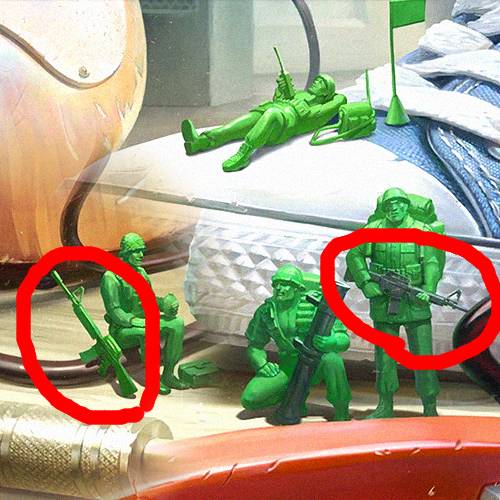
Metal Weapons
Appearing on the scene approximately in 2001, and being mass manufactured on the Real World in 2002-2004, metal weapons were molded from one of the most powerful materials extracted from the Real World: Metal.
The metal alloys and their relationship of structural integrity and weight made these weapons the most lethal in the worlds. But not everything is so simple and rosy with these plastic devourers: they don’t work in the Plastic World. Everything that comes from another world tends to lose effectiveness in other worlds. Therefore, although this materials do not lose their physical properties, the weapons that use them do.

Transition to Other Worlds: The Clash of Realities
With the discovery of interdimensional portals, plastic soldiers began to explore new environments. In these other realms (such as the Real World) their plastic weapons didn’t stop working immediately, but:
- Gradually lost power, eventually becoming ineffective.
- Suffered loss of pressure or accuracy, compromising their basic functions.
This forced factions to:
- Improvise new weapons from Real World components (paperclips, springs, batteries, etc.).
- Study foreign technologies and materials to craft more resilient equipment.
- Adapt to new physical laws, developing unique combat methods.
In Reverse: Real World Weapons in the Plastic World
Interestingly, real weapons (made of metal, graphite, or complex Real World materials) also suffer noticeable weakening when brought into the Plastic World. They lose power, precision, and often cease to function as expected, eventually becoming comparable in effectiveness to native plastic weapons.
As a result, in fully plastic environments (or derived realms), Real World weapons cease to offer a meaningful advantage. This unexpected balance has forced many factions to rethink their strategies, favoring adaptability over brute firepower.
The nerfing effect: a reality check on weapons/materials
Within the Army Men Toyverse, the dynamics between plastic, metal and other kinds of weapons are fascinating, governed by the unique physical / reality laws of their respective realms.
In fact, these laws inherent to different realities govern all kinds of objects and special characteristics, such as magical objects.
Plastic Weapons in the Plastic World: In the Plastic World, plastic weapons are enough powerful, matching the effectiveness of metal weapons from the Real World. This power is derived from the inherent properties of plastic within this dimension, where the plastic material’s nature enhances maneuverability, lightweight and speed, allowing for swift and precise attacks. The energy that powers these weapons is a form of plastic based kinetic energy, seamlessly integrated into the plastic soldiers’ physiology.
Metal Weapons in the Plastic World: When metal weapons from the Real World are brought into the Plastic World, they quickly lose their potency. The theory of the nerfing effect occurs due to the incompatibility between metal and the Plastic World’s energy matrix. Metal, being foreign to the Plastic World’s physics, cannot efficiently channel or maintain the energy required for sustained use, causing these weapons to deteriorate or malfunction after a short period.
Plastic Weapons in the Real World: Conversely, plastic weapons transported to the Real World experience a significant drop in their effectiveness. The dense and rigid nature of the Real World’s physics diminishes the energy that powers these plastic weapons. They become fragile and unreliable, unable to generate the same level of impact as in their native realm. In the Real World, metal is one of the most powerful materials in that world.
Uncompromised Weapons: Melee weapons, regardless of their origin, logically maintain their functionality across both worlds. These weapons rely purely on physical force rather than energy projection, making them immune to the dimensional discrepancies. However, special powered weapons like Thor’s Hammer, Mjölnir, exhibit a dependence on their mythological world’s unique energy source. In the Real World, Mjölnir loses its supernatural abilities and functions merely as a handheld weapon.
This intricate balance ensures that each world retains a level of authenticity and challenge for its inhabitants, reflecting the distinct nature of their respective realities. On the other hand, the properties of each world act as a natural defensive barrier against advanced technologies and better equipment.
- Assault Rifle
- Auto Rifle
- Bazooka
- Carbine
- Excalibur
- Explosives
- Flamethrower
- Grenade
- Grenade Launcher
- Heavy Machine Gun
- Luger
- Martian love gun
- Mines
- Mjölnir (Thor’s Hammer)
- Mortar
- REAL Pulse Rifle
- Rockets and Missiles
- Shotgun
- Sniper Rifle
- Vikki’s Bow
Plastic-Graphite Weapons – Functional Hybrids of the Toyverse
Plastic-graphite weapons emerged as a key innovation during the events of Major Malfunction. They represented a strategic middle ground between pure graphite weapons (powerful, but prone to shutting down outside the Real World) and full-metal weapons (extremely strong, but heavy and visually unappealing to many plastic soldiers).
What Are Graphite-Plastic Composites?
Graphite-plastic composites are hybrid materials made by combining graphite particles or fibers with a polymer base (such as PVC or polyethylene). This mixture retains the lightweight flexibility of plastic, while adding the resistance, durability, and conductivity of graphite — resulting in a highly versatile material adaptable to many environments.
Technically, these are advanced artificial compounds, difficult to manufacture in the Plastic World without external technology, but increasingly common after contact with Real World materials and designs.
These hybrid weapons were created with two main goals:
- Stable functionality across multiple worlds, both in the Plastic World and in Real World environments.
- Aesthetic and cultural acceptance, preserving the design, color, and visual style of Army Men units.
While it may seem superficial, the rejection of metal weapons among some units was real: they believed the metallic look “didn’t represent them” or “made them look like soulless machines.” Plastic-graphite weapons, with their darker finish but plastic-compatible design, became an ideal solution.
To achieve visual consistency, many of these weapons are coated with an outer layer of colored plastic, matching the soldier’s faction. This allows them to retain both the graphite’s performance and the individual or unit’s visual identity.
Strategic Advantages
- Energy stability: Graphite allows these weapons to maintain pressure, charge, or power even outside their original environment.
- Reduced weight: Their hybrid build enables portability without the need for heavy-weapon training.
- Tactical identity: By preserving a visual style familiar to plastic forces, these weapons boosted morale and cohesion among troops reluctant to adopt foreign gear.
- Highly moddable: More suited to modular upgrades than fully plastic weapons.
- Custom aesthetic: Plastic coatings allow each weapon to visually match its user’s faction or unit.
These weapons represent a reconciliation between tradition and innovation. They don’t signify a surrender to Real World power, nor a rejection of plastic heritage. Instead, they symbolize how the Army Men learned to blend the familiar with the foreign, preserving their identity while adapting to a hostile and ever-changing multiverse.
In many ways, plastic-graphite weapons marked the beginning of a new military philosophy, where balance, style, functionality, and multiversal compatibility became just as vital as raw firepower.
Behind the scenes
This contrast highlights both the functional fragility of plastic soldiers and their remarkable adaptive capacity. Transitioning from a familiar closed world to a multiverse of unknown threats radically shifted their approach to warfare, technology, and self-understanding.
It opens up narrative themes such as:
- The forced technological evolution of an artificial species.
- The struggle of the small and fragile against the massive and dominant.
- Creativity as a weapon: improvisation, sabotage, and lateral thinking are essential to survive outside the Plastic World.
To work or not to work, that is the question
Weapons will work in a very particular way in the Army Men Toyverse. They will work normally in the worlds they come from, but will stop working in other worlds, or will be nerfed at least. This way we ensure that the seemingly weak plastic weapons can compete against the new metal weapons. And we also make sure that you must use swords, axes, hammers, bows, arrows or your fists, in the Medieval World. So in every world you must behave “in-universe”.
That is, the world you visit is influenced by you and your elements (external elements), breaking its nature and rules. Therefore, this world you visit will seek to correct that anomaly in some way, by nerfing or disabling you and your weapons or equipments.
Functionality and materiality, not composition
The materials composition are not modified, but the shapes of some objects are, as is the case of Vikki and her bow in Portal Runner. These unique and exceptional cases allow us to make visual skins change, depending on the universe being visited. But it’s not discarded that in some way the materials may also change in the future, or that some world may produce this effect.
Composition is the proportion of the different constituents of the material (chemically and physically different). Structure, on the other hand, refers to the spatial distribution, orientation and association of the constituents. Characterizing a material is determining the parameters necessary to identify and describe it. In simpler words, it is impossible for a world different from where a weapon comes from, to transform its plastic into metal. But you can modify a banana-shaped plastic weapon to an apple-shaped one, always maintaining the same composition and proportion. The characteristics for the most part, although this can change radically to the point that, for example, a bow becomes a bayesta (which is almost the same, just seen differently by the Army Men).
Sources for this article:
https://reddit.com/r/H3VR/comments/7lsiij/whats_the_difference_between_carbines_assault