
RUH-1 “Scout” Recon Utility Helicopter
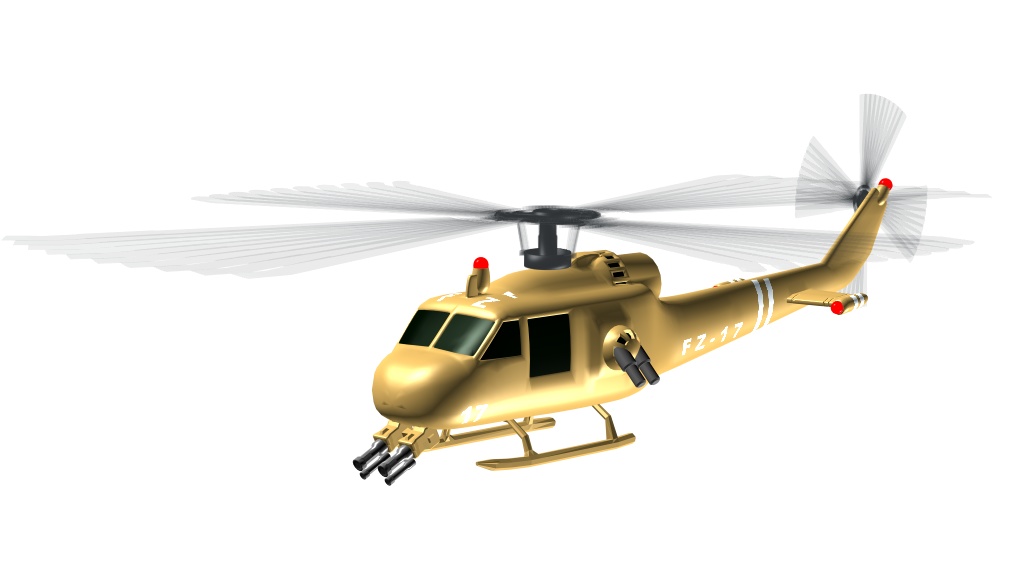
The Scout is one of the most iconic and enduring aircraft in the Plastic World. Inspired directly by the Real World’s UH-1 Huey, this helicopter served as the primary recon and light utility platform for the Green Army and its allies during Air Tactics campaign. It was the first helicopter to encounter Dr. Madd’s Mutant Monsters.
Its silhouette is unmistakable: rotor blades high above a long, narrow fuselage, twin skids skimming over terrain… but there’s something subtly different about the Scout. Something that marks it as more than just a toy replica.

Unlike other craft molded entirely within the confines of the Plastic World, the Scout is a hybrid creation, designed using recovered Real World technology and aesthetic principles. It looks like a Huey, yes, but a version you’d expect to see on the box of a high-end grown kid toy or a forgotten aisle of a toy store. Slightly sleeker, slightly brighter, slightly off. Its contours and proportions feel more like a child’s interpretation of a military helicopter than a faithful reproduction, which makes perfect sense: this is a toy reimagined by toys, built to operate in a world of their own making.
Role and Capabilities
Designed primarily for reconnaissance, rapid insertion, and extraction missions, the Scout excels at speed and maneuverability. It lacks the heavy firepower or armor of its bigger cousins, but that’s not its job. This is a machine built for eyes-on-the-ground scouting, agile troop movements, and field logistics. Whether it’s inserting a commando squad behind enemy lines or retrieving wounded units under fire, the Scout performs its duty with remarkable efficiency.
Despite its light frame, it can be fitted with modular side doors, allowing for small arms or mounted guns when necessary, though these are typically only installed during frontline deployments. Its rear cabin can accommodate a half-squad of soldiers or a mix of personnel and cargo, depending on the mission’s demands.

Real World Roots and Toyverse Innovation
The Scout stands as one of the earliest examples of successful Real World–Plastic World hybrid engineering. Recovered components, schematics, and model kits from human sources were studied and interpreted by Green engineers, who lacked the full context of human aviation but possessed an uncanny intuition for toy-scale design.

This led to a helicopter that doesn’t just resemble the Huey: it feels like one, if one were imagined by toys who only glimpsed humanity through leftover blueprints and packaging art. It is both an homage and a transformation.
Many Scouts carry subtle design variations: custom-painted insignias, cockpit visors made from scavenged Real World plastics, or even altered tail booms shaped during local manufacturing. Each one tells a story of adaptation and creativity.
Legacy and Battlefield Presence
Throughout campaigns like Operation Dust Storm and The Green Horizon, the Scout has earned a reputation as a reliable, brave, and vital element of Green Army strategy. Pilots often describe the machine as having a “mind of its own”, not in a literal sense, but due to its uncanny responsiveness and versatility under pressure.
Because of its Real World lineage, the Scout is often deployed with reverence. Many believe its existence is a symbol of the bridge between the two worlds, and a reminder of where toy soldiers truly came from.
Though unarmored and lightly armed, the Scout remains a symbol of tactical agility and field awareness. It might not carry the raw firepower of the Attack ‘Copter or the sci-fi mystery of the Super ‘Copter, but where it goes, victory usually follows close behind.