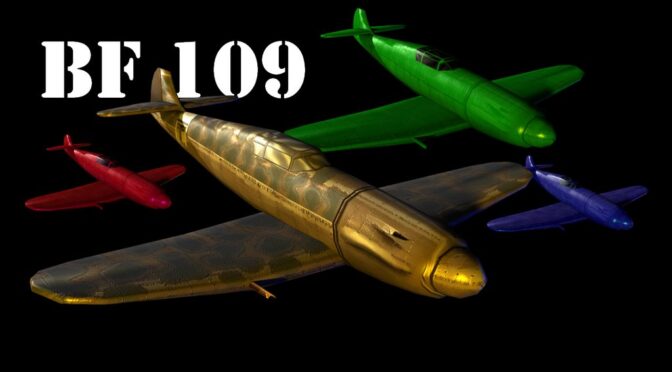
Grey Men’s Legacy Fighter
The Bf109 was born in the workshops of the Grey Army during the Great Army Men War, a homegrown design intended to dominate the skies of the Plastic World. Its sharp, aggressive profile and nimble handling made it a fearsome adversary in dogfights, perfectly suited to the Grey doctrine of swift interception and precision attack.
After the Greys fell from power, the design was seized and adapted by the Tan Army, who mass-produced the fighter and fielded it in countless engagements against the Green Air Corps. For the Tan forces, the Bf109 became a symbol of their aerial supremacy, deployed to harass convoys, protect strategic positions, and challenge Green control of the skies.
The Bf109 appeared for a last time during Army Men II events, during the Tan invasion of Maynard Airport, where squadrons of the fighter filled the air in a deadly show of force. Later, in Sarge’s War, the final known evolution of the type emerged, the Bf109X, upgraded with reinforced metal armor, improved weapons, and advanced targeting systems. During the climactic final assault of Plastro’s forces, Bf109Xs served as tactical bombers, delivering devastating strikes that caused more green plastic men casualties than the attacking infantry, leaving whole sectors of the battlefield scorched and littered with wreckage.
When the Real World was discovered in 1998, surviving Bf109s underwent a transformation. Later variants were modified to more closely resemble the Real World’s Bf 109 model kits, incorporating aerodynamic changes and detail work copied from scale models and reference photographs. These hybrid designs merged the Grey’s original engineering with newly acquired human knowledge.
Though many have been destroyed or retired, the Bf109 remains an enduring icon: a dangerous blend of pre-Real World ingenuity and post-discovery refinement, forever tied to the legacy of the Grey Army and the ambitions of the Tan.