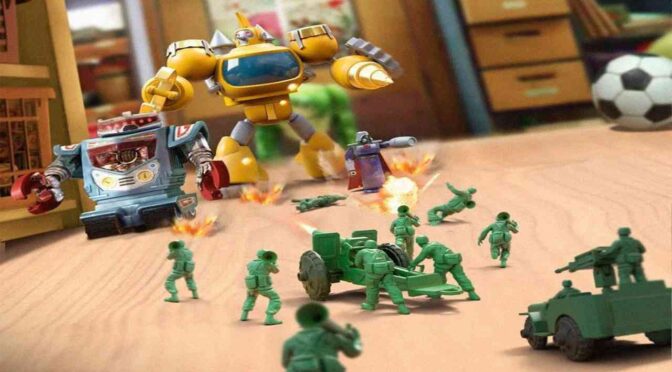
One of the largest military deployments since the end of the World Wars, which culminated the conflict between the Tan and the Green.

After Plastro’s death, what remained of the Tan Army regrouped in the Real World under the military leadership of Field Marshal Tannenburg, using the Tan Hawk Clone as his iron fist. The Tan Army sought to take advantage of the moment of shock and disorganization suffered by the Green Army in the attack on the peace treaty, losing key figures from the high command such as Admiral Plankt, Colonel Grimm, General Monthgreen and Sarge Hawk, who was declared AWOL.
But shortly before the Tan Army finished organizing the attack, and with all their troops concentrated in one place, the Green Army, taking advantage of the moment of weakness and distraction after losing Plastro, launched the largest Green offensive in history against the Tan Army in the Real World.

Most of this events were called “the Red Retaliation events“.
“For the Maker… what is this world?”
Context

After Sarge’s War there was a severe power vacuum when the tyrant Plastro died, which led to internal conflicts among the Tan, until a new supreme commander emerged: Tannenburg. This new leader exterminated all the unificationists Tan who wanted peace and an alliance of Army Men nations, and led the rest into war with the help of Plastro’s unfinished and abandoned plans to rearm the Tan Army with new technology, incorporating a large percentage of metallic materials in weapons for troops and vehicles. Although this difference was quickly reached by the rest of the nations in conflict, the inclusion of the Red Army in alliance with the Tan made them take the lead in individual weapons power. This meant that for every Red or Tan Super Tank destroyed, between 3 and 6 common tanks were lost.
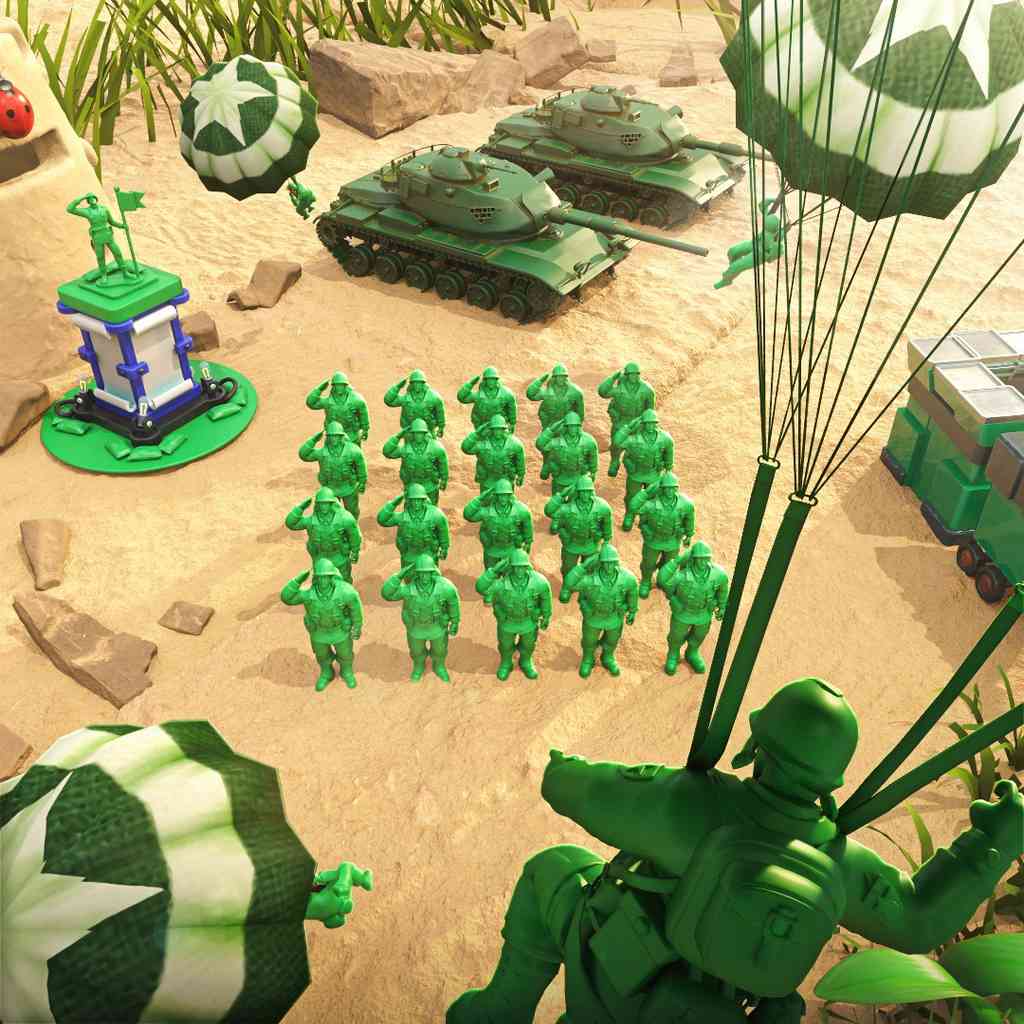
The new Tan leader was strongly aligned with the ideas of the Red army, and with the Reds being the army with the largest reserves, they somehow reached an agreement and formed an alliance. The details of how or why they came to this are still unknown, given that before they fell, the Tan burned and destroyed all records about it.
The Strategic Crisis at the Dawn of the Real World War
At the outbreak of the Real World War, the Green Army and its allied factions found themselves catastrophically unprepared to respond to the massive, multi-front invasion launched by the Tan Army, the Red Army, and a swarm of opportunistic third-party forces. The crisis had not emerged from a lack of discipline or bravery, but from the sheer impossibility of reacting in time to an enemy that moved faster than any conventional doctrine had ever anticipated.
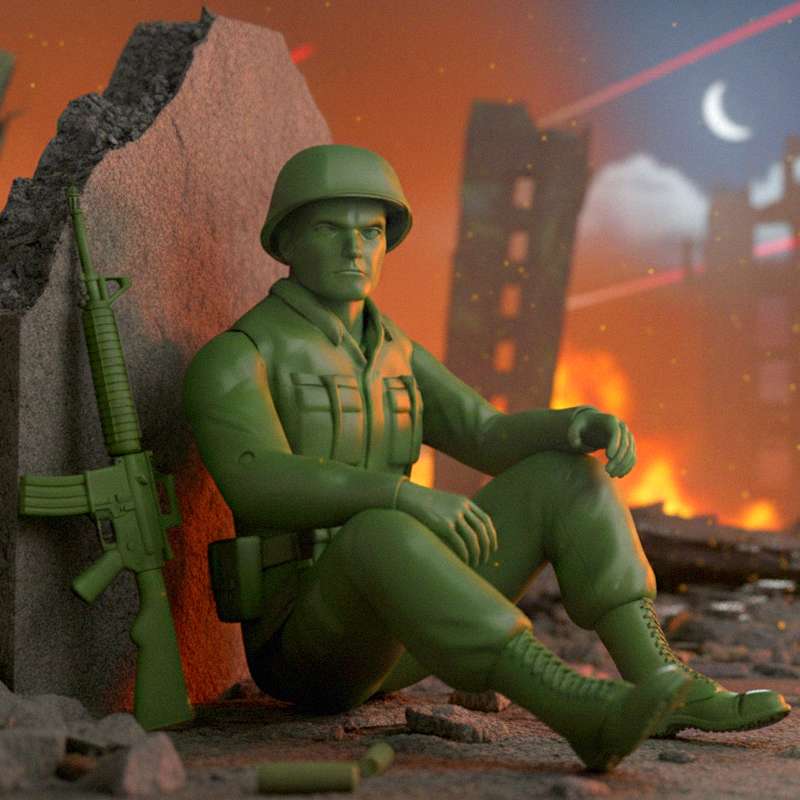
The Real World itself posed the first and most obvious barrier. Its vast geographical spread, already immense by plastic standards, became nearly insurmountable when measured against the tiny scale of the Army Men. Strategic zones that appeared only inches apart to humans were, for soldiers of molded polyethylene, the equivalent of mountain ranges and deserts. An enemy battalion could overrun an entire household before Green reinforcements could even clear the perimeter of a single room.

But the greatest challenge came from the other worlds.
The portals… unstable, elusive, and scattered across dimensions, had turned every operational map into a guessing game. Locating a single active portal was like hunting for a needle in a haystack exponentially larger than anything the Green High Command could reasonably chart. By the time scouts triangulated a location, the Tan and their partners had already crossed through, surged into a new territory, and entrenched themselves.

And even when the portals were found, transporting forces through them was dangerous and slow. Every deployment carried the risk of disorientation, fragmentation of units, or emergence in a compromised zone already crawling with enemy forces.

Adapting to this environment required rapid communication, forward observers, and units capable of identifying enemy footholds before they solidified. Yet even this was strained. “When you saw a Spotter,” one Green veteran later recalled, “you shot him, because calling artillery strikes across worlds was the one thing the renegades did better than us.”
The same dynamics applied at the macro level:
the Tan coalition could signal, move, and deploy faster than the Greens could even establish where the fighting was.
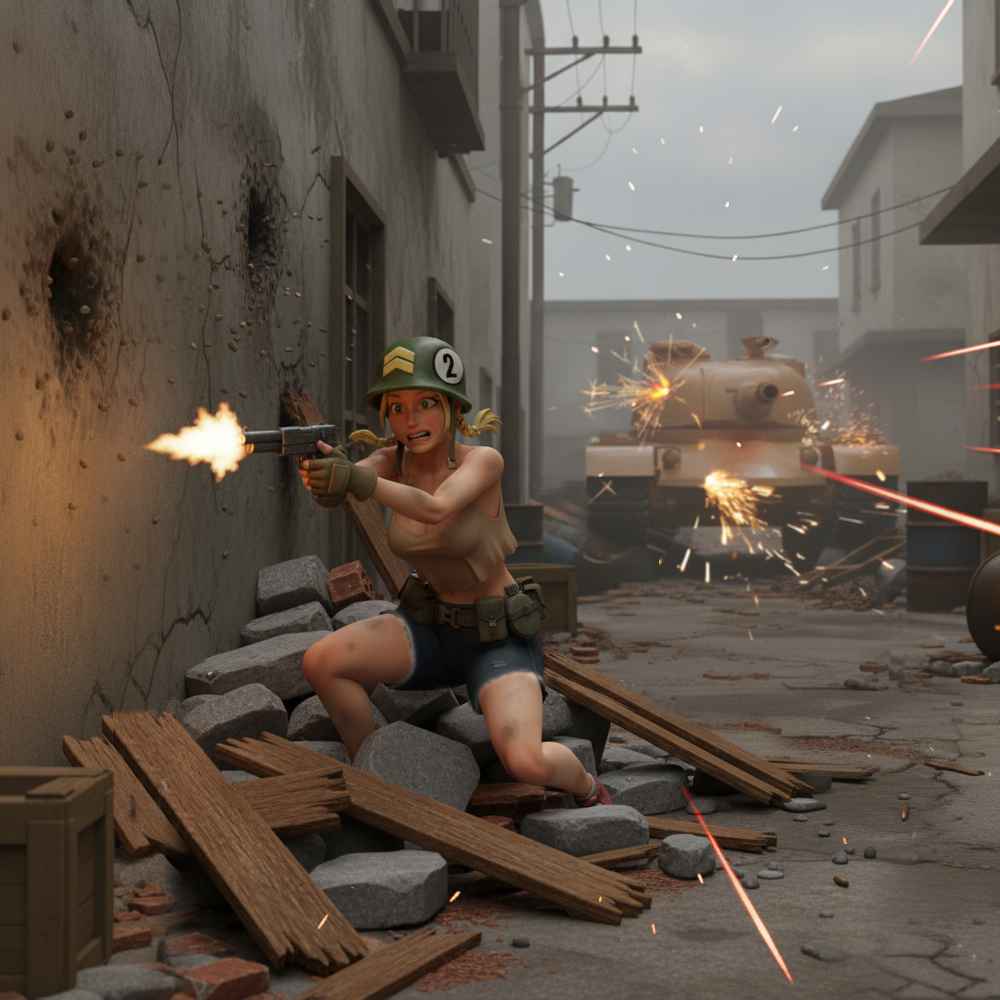
As enemy incursions multiplied (on tabletops, in yards, across gardens, attics, basements, jungles, vast deserts, digital realms, and foreign dimensions) the Green Army found itself perpetually a step behind, arriving too late to prevent the fall of strategic chokepoints or to break sieges before entire Real World sectors were overrun.
What ultimately began the Real World War was not simply an invasion, but a failure of scale, a tragic mismatch between the expanding battlefield and the limited mobility of those sworn to defend it. The Green Nation had faced formidable foes before, but never a conflict where the terrain itself was bigger than their capacity to understand or reach.

It was a crisis born not of weakness, but of physics.
Not of cowardice, but of distance.
And it reshaped the Toyverse forever.
The Weather Front: When the Real World Turned Against Them

As the Real World War unfolded, the weather itself became one of the most formidable enemies the Green Nation had ever faced. Fog was only the beginning. For soldiers designed to fight in controlled environments, like alpine, bayou, deserts, and the predictable climates of the Plastic World, the dynamic, chaotic atmosphere of the Real World was overwhelming.
This was their first true encounter with a mega-sized battlefield governed not by strategy, but by nature.
Rain: The Great Deluge
For humans, rain was an inconvenience.
For a five-centimeter soldier, it was annihilation.
Even a mild drizzle struck like artillery fire, each drop capable of knocking troopers off balance or pinning them in place. A steady rainfall became a bombardment; a storm was a cataclysm. Whole platoons were washed downslope, funneled into drains, gutters, or muddy pits that swallowed them whole.
Enemy forces took advantage of this. Tan units often advanced during rainstorms, knowing Green aerial support was grounded and infantry movement slowed to a crawl. Soldiers spoke of “waterfront battles” fought in miniature rivers that formed where humans saw nothing but puddles.
Wind: The Invisible Giant
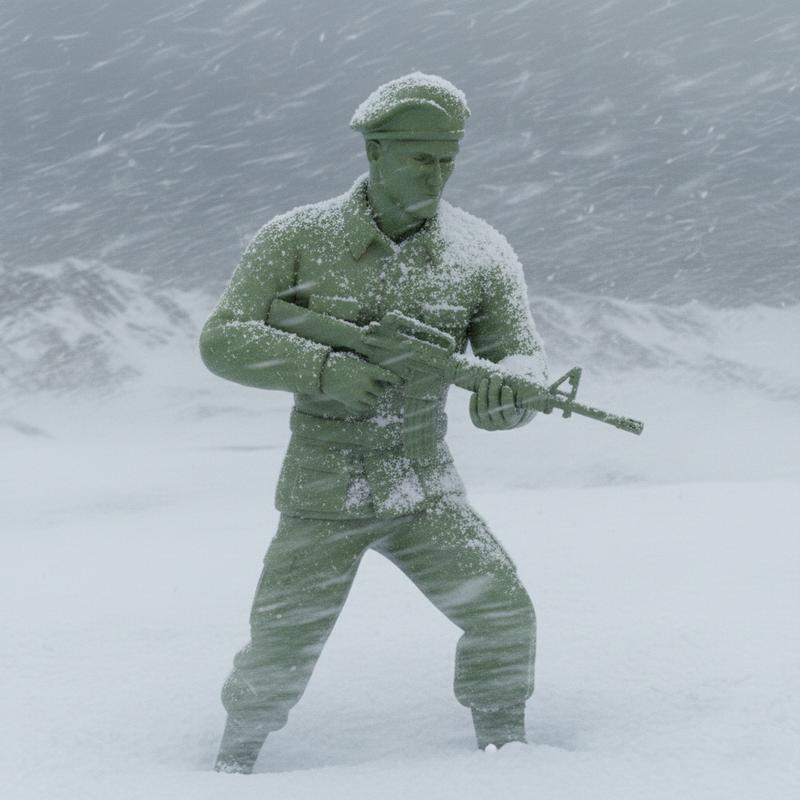
Wind did not respect front lines.
A gust that barely stirred leaves could flip armored transports, scatter squads, or send supply crates tumbling across entire yards. Artillery patterns became unreliable; light-weight airplanes were shredded mid-flight.
Entire offensives had to be aborted when crosswinds grew too strong to anchor ropes, grapnels, or improvised bridges.
Some historians later described the wind as “a giant with no allegiance,” striking Green and Tan alike without warning.
Heat: The Slow Burn
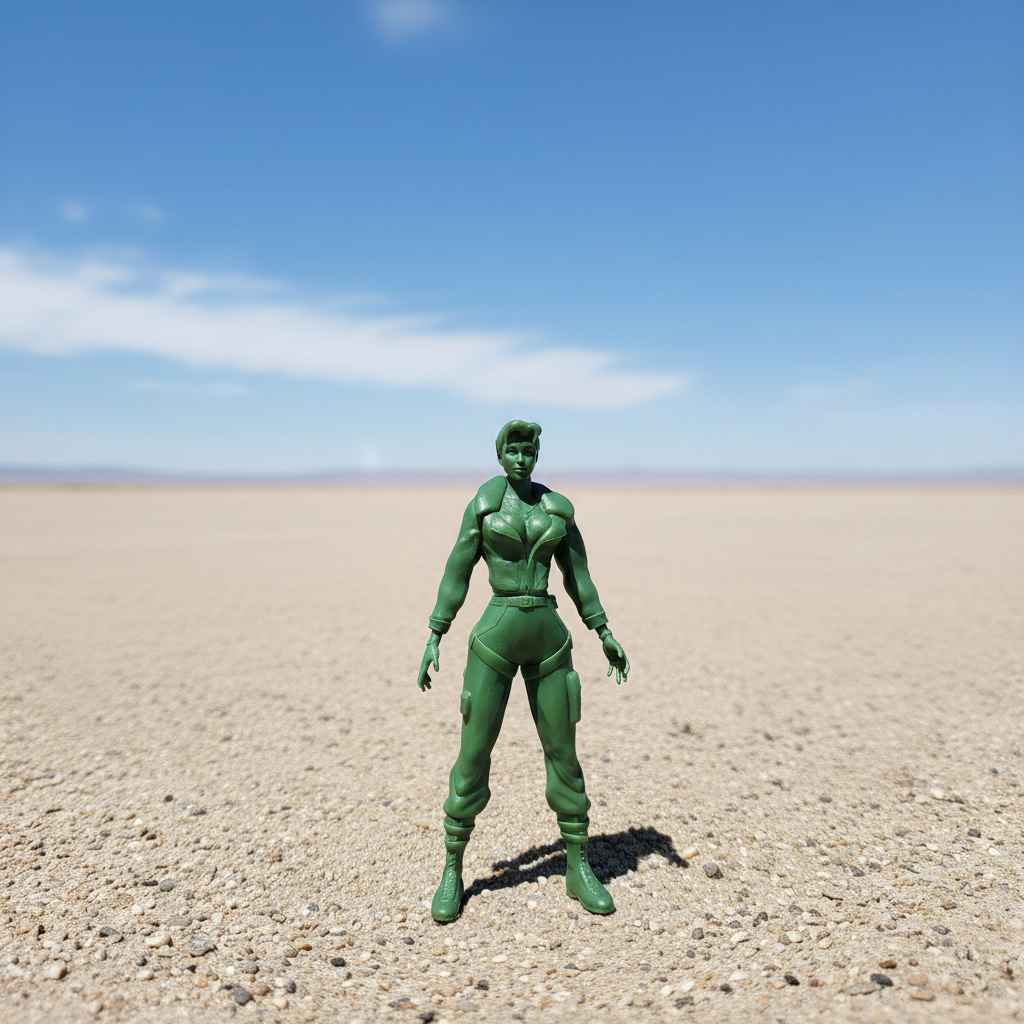
High temperatures introduced dangers unknown in the Plastic World.
Extended exposure to sunlight softened the plastic of helmets, weakened joints, warped weapon barrels, and even caused some early-model soldiers to deform. Tan units (whose faction color absorbed more heat) were especially at risk, though Malice’s renegades often exploited shade, vents, and metallic debris to compensate.
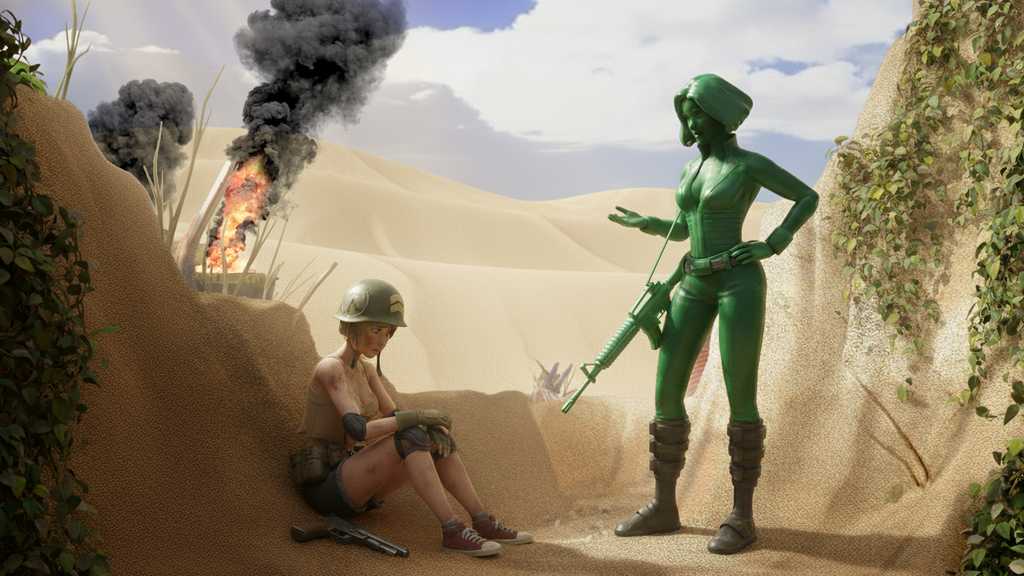
Vehicle crews battled overheating engines salvaged from human toys. Electronics salvaged from the Real World malfunctioned unpredictably, leaving reconnaissance teams stranded behind enemy lines.
Cold: The Silent Cracker
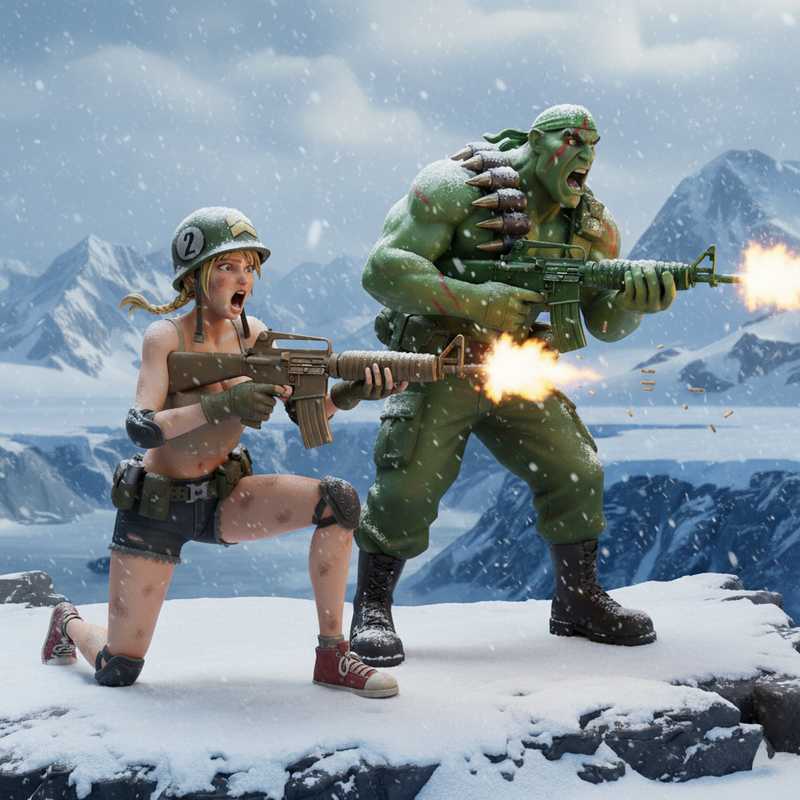
Cold presented the opposite threat.
Freezing temperatures made plastic brittle. A hard fall could shatter a rifle stock. A misstep could snap a limb joint.
In snowy regions (south and north poles, garage freezers, human refrigerators, or winter yards) soldiers waded through drifts that reached above their heads. Tactical retreat often became the only option when the temperature dropped faster than expected.
Thunderstorms and Lightning: Unpredictable Killers
Lightning strikes were rare but devastating.
A bolt that hit a nearby tree or metal object could knock down entire formations with the shockwave alone. Electrical surges fried communications hardwired from salvaged parts, erasing days of reconnaissance data.
Thunder itself (harmless to humans) stunned small soldiers, disoriented pilots, and caused panic along poorly secured lines.
The First Lesson of Real World War

To the Army Men, the Real World was not just vast… it was alive, volatile, and capable of reshaping a battlefield in minutes.
For the first time, commanders realized that strategy had to account not only for enemy maneuvers and interdimensional threats, but for an environment millions of times larger than anything they had trained for, filled with wild and diverse dangerous lifeforms.
Weather events of all kinds became tactical variables:
- A single drop of ice rain could destroy a tank.
- A windy afternoon could scatter an entire battalion.
- A sunny day could warp weapons beyond use.
- A cold snap could break soldiers like brittle twigs.
And through all of it, the fog… the same fog that defied airplanes, hid threats, and shrouded every advance, remained the ever-present reminder that in the Real World, even the air itself could turn the tide of war.
In short, several things happened during the conflict…

It started with an alliance between the Tans and the Reds to take over some of the most important territories in the Real World, attacking the Blues, Browns, Purples, Jade and Pinks in that world. Although they stayed out of the war for a while, this provoked a large-scale military response from the Greens, in an alliance with the Violets (who were believed to be extinct and had actually hidden in the Real World), the Grays and the Blues, joining the war in an unprecedented coordinated military deployment, which required them to first travel from the Plastic World to the Brick World, and from the Brick World to the Plastic World, so that the Tans and Reds would not notice. Added to this, a deception was organized in the Plastic World where the Greens, Grays and Blues built thousands of vehicles out of clay brought from the Real World, painted with cheap paint. This caused the spy planes Tan and Red to believe that they were amassing troops in the Plastic World, so they amassed their troops, in preparation for an invasion, at the portals in the Real World that were connected to the Plastic World.

The Tans and Reds were winning the war, but when the Green-Gray-Blue alliance came in, the balance of the conflict stabilized for a while… but not for long. The Reds had several aces up their sleeves. Among these were the Browns and Orange, who joined their ranks (at gunpoint). But the Violets were key here, having prepared themselves, they entered the war shortly after, from several fronts that made the Tans and Reds have to retreat after being taken by surprise from the rear. The Violets took a long time due to the great distances they needed to travel for this plan to work.

But the Reds counterattacked: In the same way that the Violets entered the conflict, so did the Purples, once again stabilizing the balance of the conflict.
In response, the alliance added the Cyans, who entered the conflict even more surprisingly than the Violets, allying themselves with the Greens-Grays-Blues-Violets.
What finally tipped the balance in favor of the alliance of nations, the Jade and Pink nation summoned their remaining forces. But was the use of unconventional weapons that used advanced experimental technology which determined the outcome of the conflict, in a contest of super weapons that caused drastic changes during the conflict and maybe the future of the Toy Wars of the Toyverse.

Conflict results
The result was the total and final defeat of the Tan as they were known until then, and the destruction of more than two thirds (2/3) of the Red forces, which although not completely defeated, suddenly abandoned the conflict. They signed a ceasefire and finally a non-aggression pact, retreating to their territories, ceding much of the occupied territory.
The reality behind the end of the war is that it was a lucky coincidence, as the Greens predicted a possible defeat if not, having lost more forces than the Reds. Luckily the latter never knew this…

Technology used
Both the Tan and the Reds, but especially the latter, focused on making heavy weapons and leaving, for example, classic tanks to the detriment of heavier, more resistant and powerful tanks. This had its pros and cons, leaving history with the question of whether it was an effective strategy or not. At sea the Tan and the Reds focused on submarines and not ships, which produced either pros and cons.

Among some of the important things that happened in this conflict was that there was supposedly time travel, or at least attempts at it. Indeed, it has been documented that there were some types of experiments and real results, but they were very small, such as slowing down the time of some troops for a few seconds or teleporting vehicles to other places, which in theory was moving a vehicle from one place to another by shortening or accelerating travel time.
On the part of the Reds it was the invention of making their troops immortal for a certain amount of time.

Individuals who participated in this conflict
- Sergeant Hawk: Long lost (AWOL) since 2004, returned a year later during the conflict to once again lead the troops to wipe out the Tan once and for all. The only reason he did this was because he was driven by his hatred and thirst for revenge against the Tan, who took everything from him.
- Tan Hawk Clone: Released by Tannenburg after years of confinement as a failed despised product by Plastro, this “madman” was the leader of their troops on the front, while Tannenburg commanded strategically from behind.
- Tannenburg: A former ally of Plastro, one of his main commanders, Tannenburg was one of the most effective Plastro commanders of his era, the natural next to Plastro leader, to replace him in any case of need, like when Plastro disappears in Sarge’s Heroes campaign.
- Sarge: One of the Green Army’s most decorated soldiers, he somehow reappeared on the battlefield to fight side by side with Sgt. Hawk.
- Among other well-known personalities who participated in the conflict, most of those who remained alive after the peace treatterrorist attack reappeared, such as Baron Bon Beige & Major Von Braunen for the Tan, Bullseye and Captain Blade for the Green, Brigitte Bleu and Spy 001 for the Blue, the formerly retired Grey Colonel and General Cinza for the Grays, among others like Captain Redford for the Red, General Lilac for Violet, General Fire for Orange.

Battles:
- Battle of the Sandbox: It was an assault on a Tan fortification that was located on top of an immense mountain of sand, in a human building materials depot. Precisely because of this it was almost impenetrable, the sand made it almost impossible to climb and the position on top gave the Tan Army a perfect 360° vision, with anti-aircraft defenses that made it impossible to bomb it.