Category Archives: 3DO Company

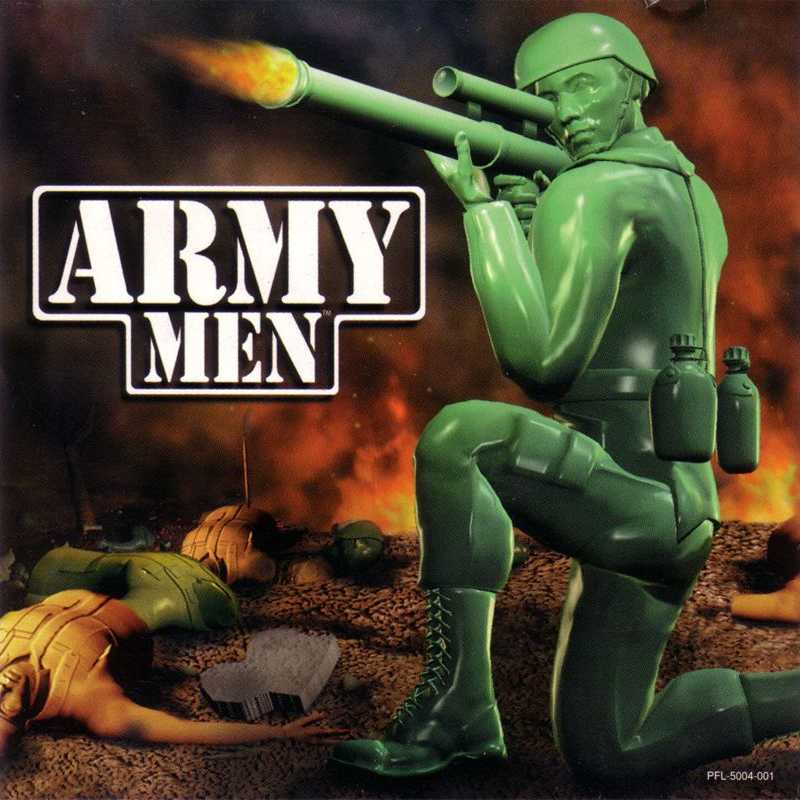
Army Men Action Figures by Playing Mantis (2000-2001)

Army Men – Real Combat (Playing Mantis)

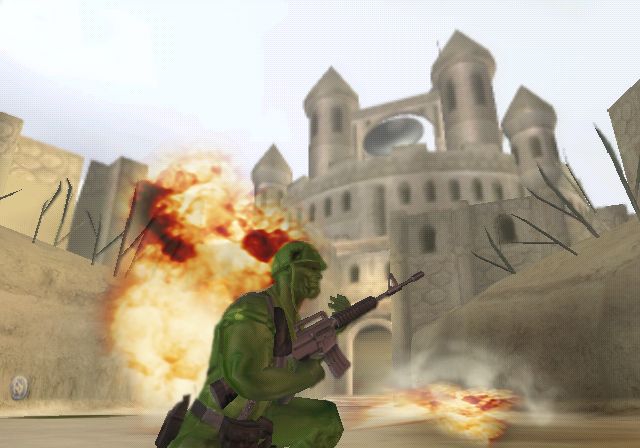
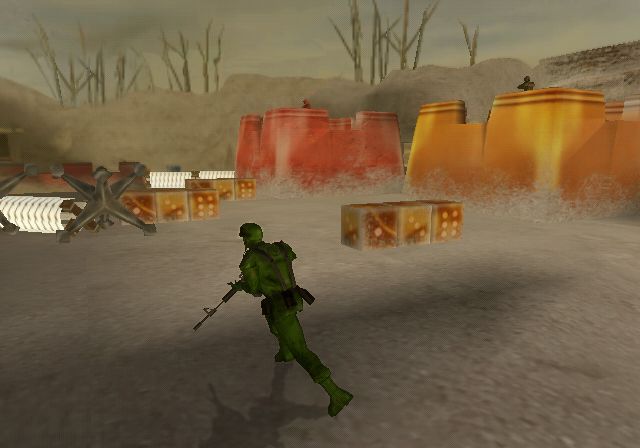
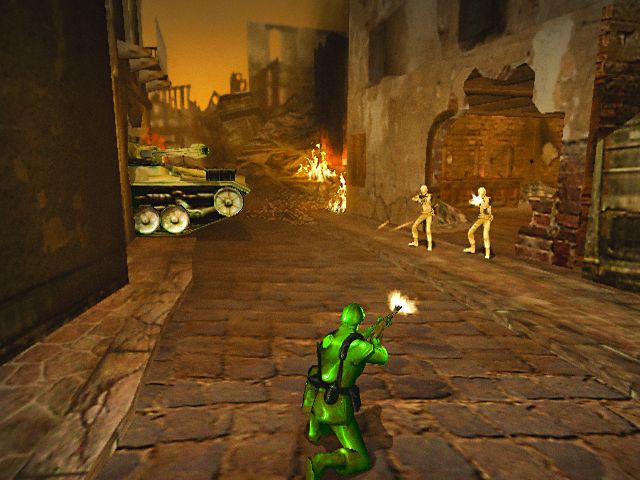
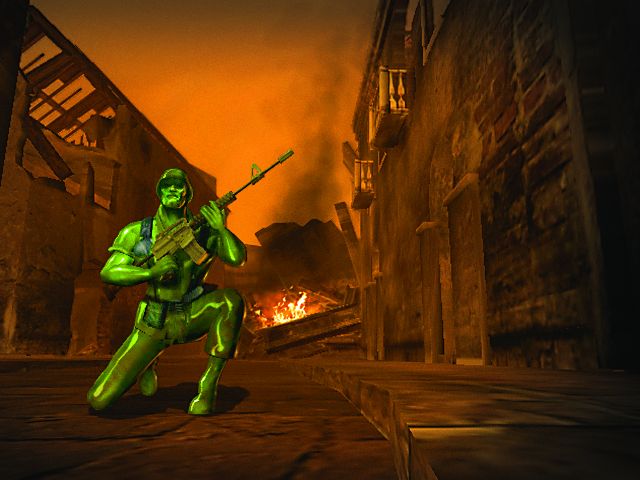
In the early 2000s, the toy company Playing Mantis released a short-lived action figure line called Army Men – Real Combat, directly based on the 3DO’s Army Men Videogames franchise. The figures were around 6 inches tall and designed with a military theme, clearly inspired by the Army Men characters of Army Men: Sarge’s Heroes, but produced as articulated collectible toys.

Overview

Playing Mantis produced a licensed action-figure line based on The 3DO Company’s Army Men video games (notably the Sarge’s Heroes era). Contemporary materials explicitly state that Playing Mantis and 3DO teamed up to release six figures from the games.

Release window

Packaging and checklists place the line around 2000–2001. Listings show 2000 manufacture dates, while hobby write-ups and checklists tag the series as 2001.

Lineup (6 figures).

  • Sergeant Hawk (Team Leader)
  • Vikki Grimm (Lovely Soldier)
  • Colonel Grimm (Commander-in-Chief of the Greens)
  • General Plastro (Tyrannical Tan Leader)
  • Riff (Bazooka Specialist)
  • Hoover (Mine Sweeper)

Scale & features. Figures are roughly 6–7 inches tall with around 10 points of articulation, packed with weapons/accessories. Packaging commonly included a dog-tag style display base and a trading card, and used the franchise tagline “Real Combat, Plastic Men.” Some packaging/ads also used “Hyper Action!” branding.

Branding. Item specifics and packaging references connect the toys directly to the Sarge’s Heroes sub-brand and 3DO license.

Availability today

The run was short; figures surface mainly on the secondary market and collector blogs/checklists. Collectors remember this line as an unusual and somewhat obscure branch of military-themed toys from the early 2000s.

Video reviews of every Army Men action figure

Sources for this informacion:

figurerealm.com
Now And Then Collectibles
eBay

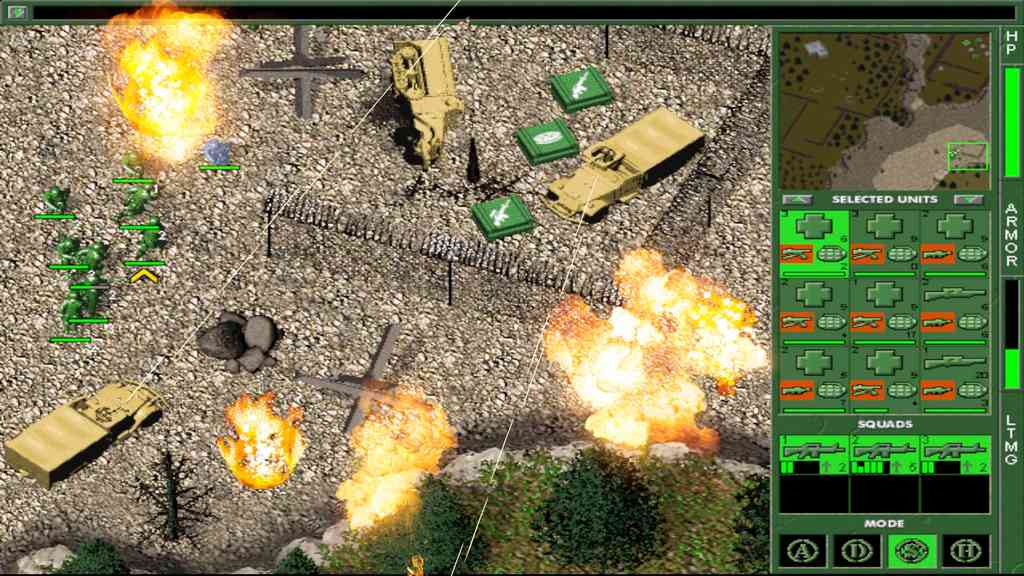
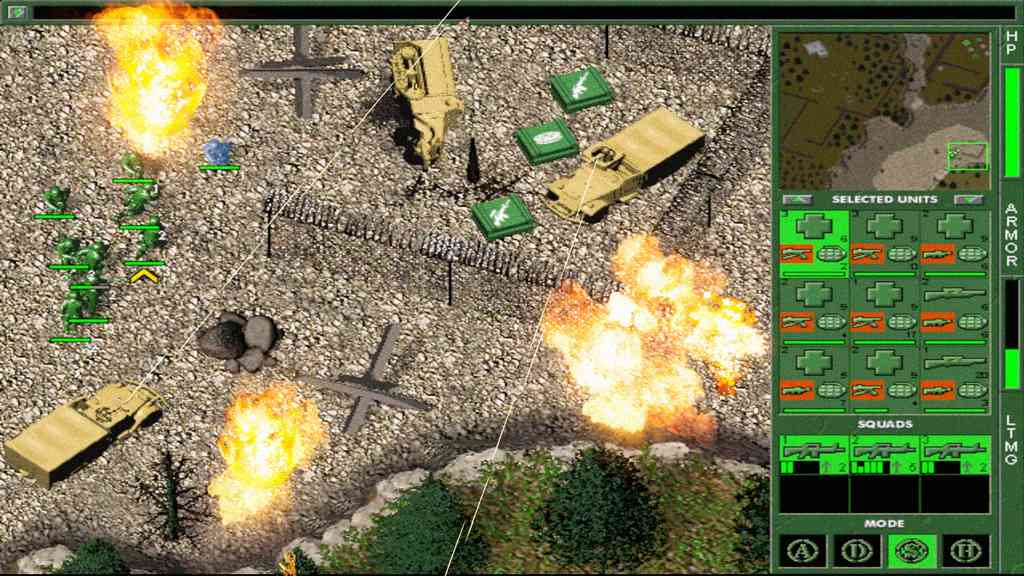
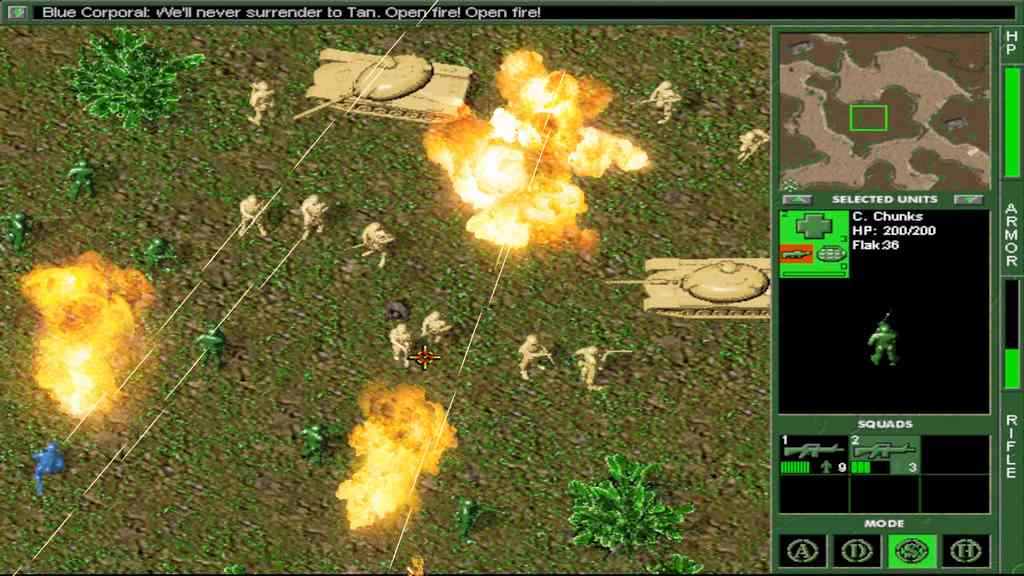
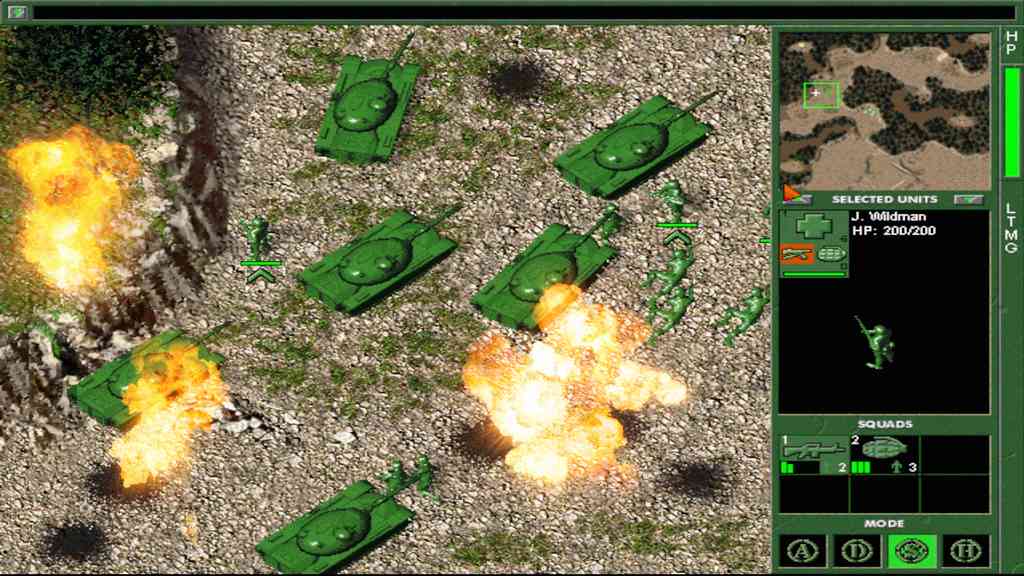
How PC Army Men 2D games were made

Army Men 2.5D games: Step by Step

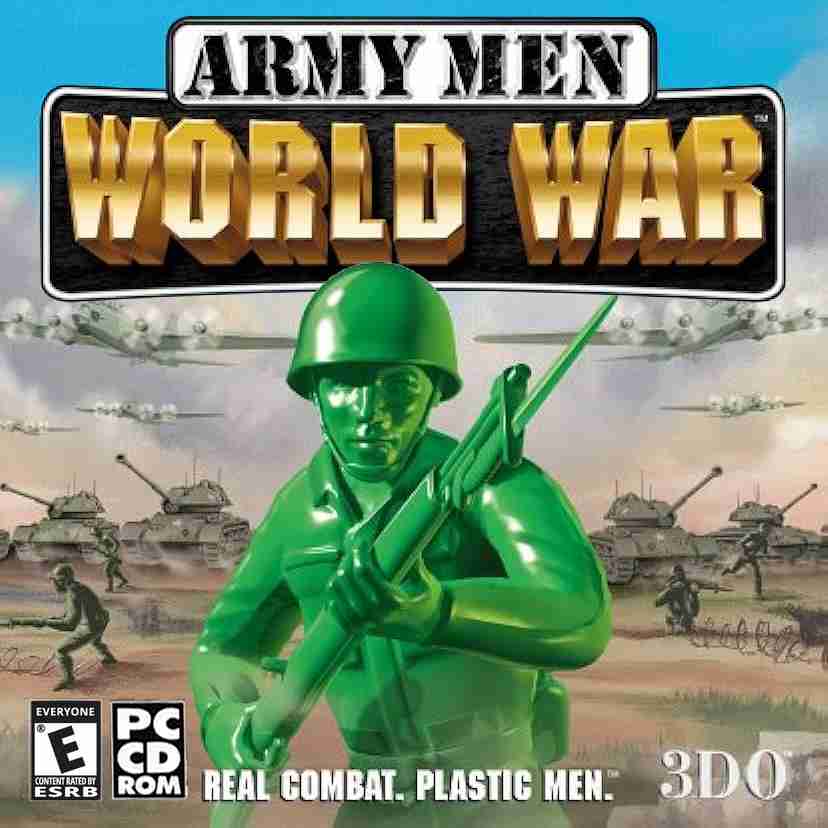
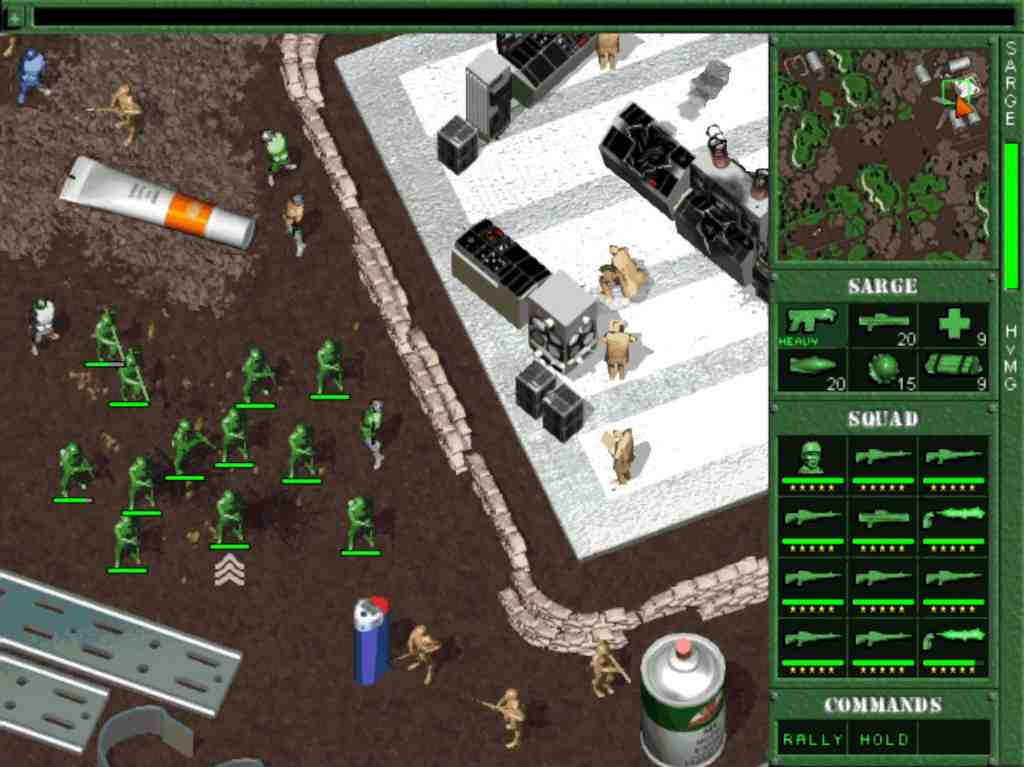
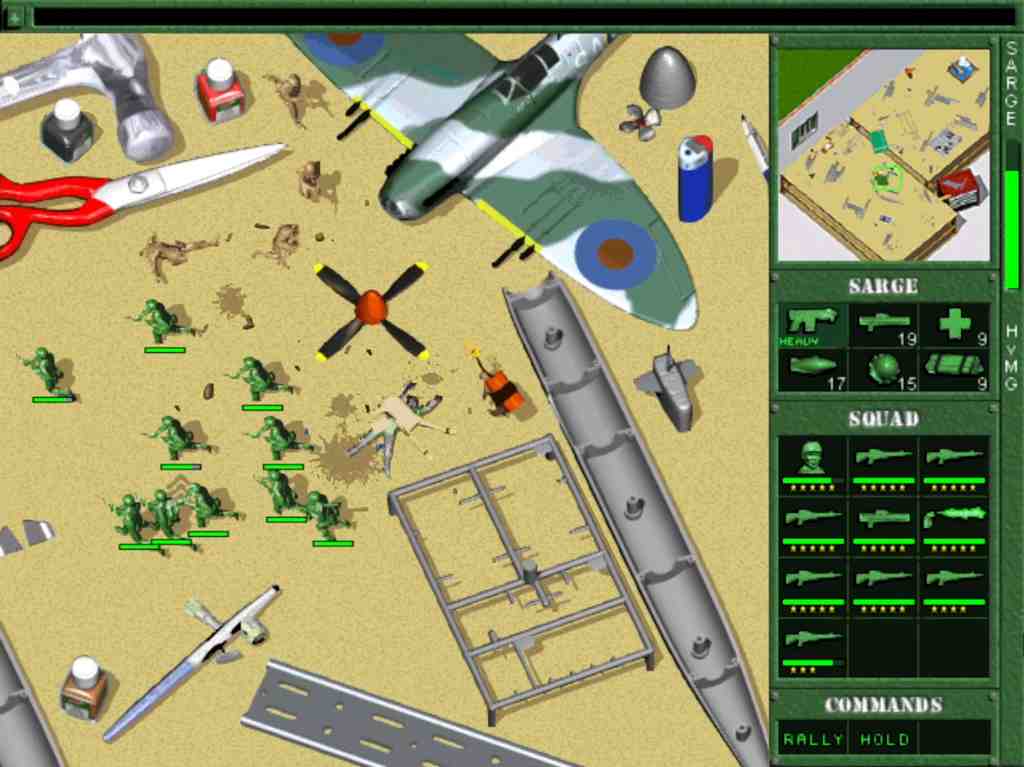
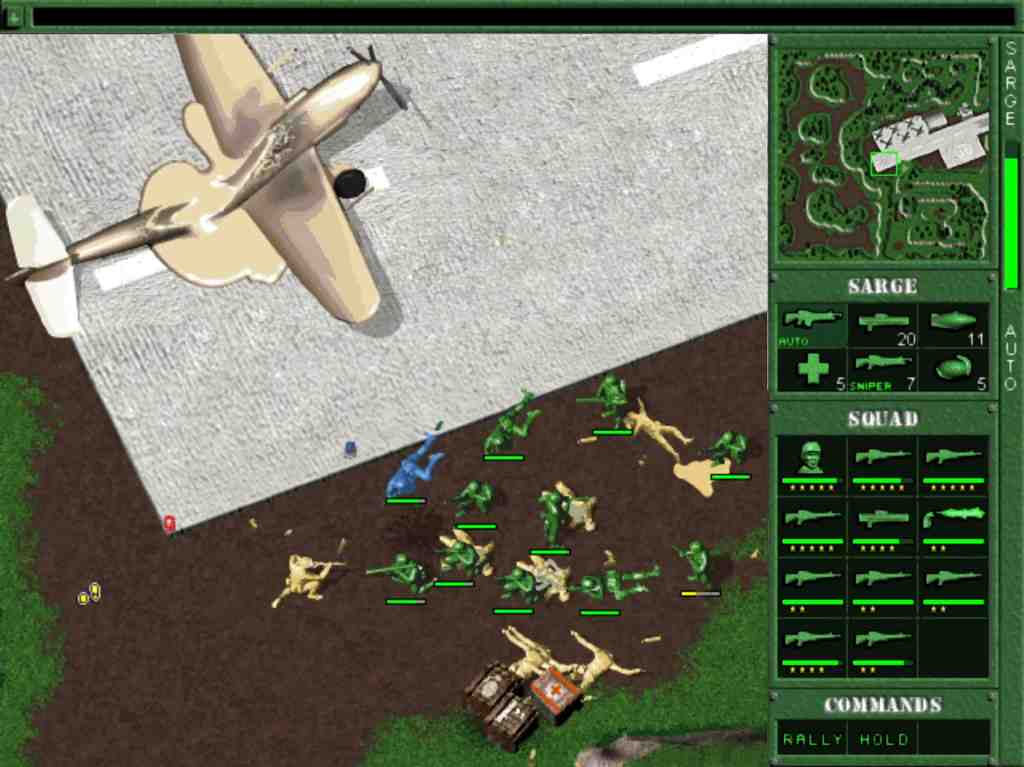
The first Army Men games, Army Men (1998), Army Men II (1999), Army Men: Toys in Space (1999), Army Men: World War (1999, PC version), and Army Men: Air Tactics (2000) were developed by The 3DO Company during the late ’90s. These titles were created for PC, though some would later be adapted to consoles.

At the time, 3DO’s internal development relied heavily on a mix of 3D modeling tools, custom engines, and asset pipelines tailored for low-end consumer hardware. Each game was built with a relatively short development cycle (often under a year) requiring assets reuse, modular design, and a streamlined production process.

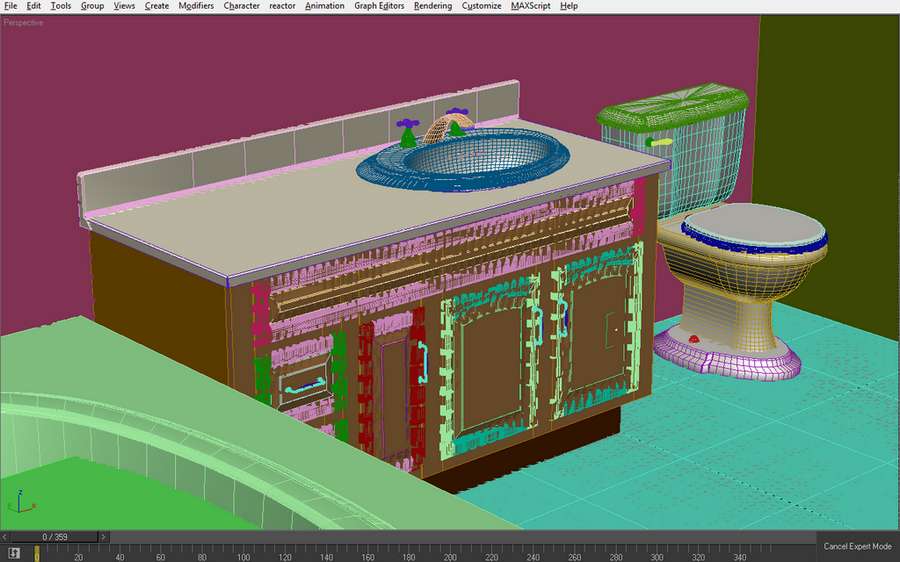
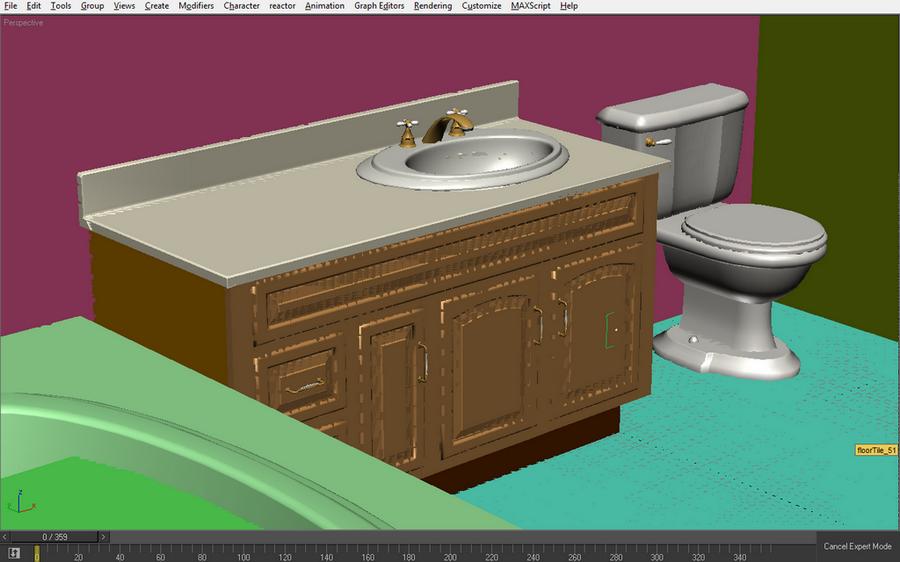
The visual style combined pre-rendered 3D elements (created in 3D Studio Max software) with in-game sprites and textures, carefully optimized to run within the memory and performance constraints of computers of the time. Meanwhile, cutscenes and promotional material often featured higher-quality renders that were directly representative of in-game graphics.

The combination of these production methods, rapid iteration, and the particular creative direction of 3DO’s art team gave the early Army Men titles their distinct aesthetic… halfway between miniature toy realism and stylized video game worlds.

1. Concept and Scripting

Designers began with a concept document defining the environments, enemies, mission objectives, and available weapons.

These documents were usually very functional, focusing on mechanics before narrative (although Toys in Space and Air Tactics had more elaborate storylines).

The narrative script and dialogues were written in parallel with level planning so the story wouldn’t interfere with technical limitations.

2. Creation of 3D Assets

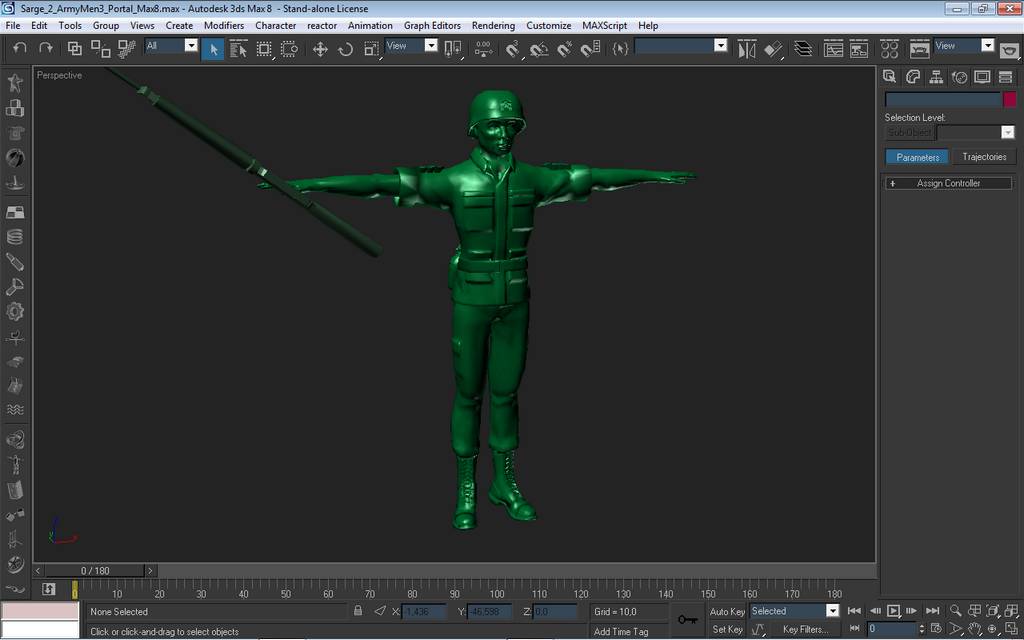
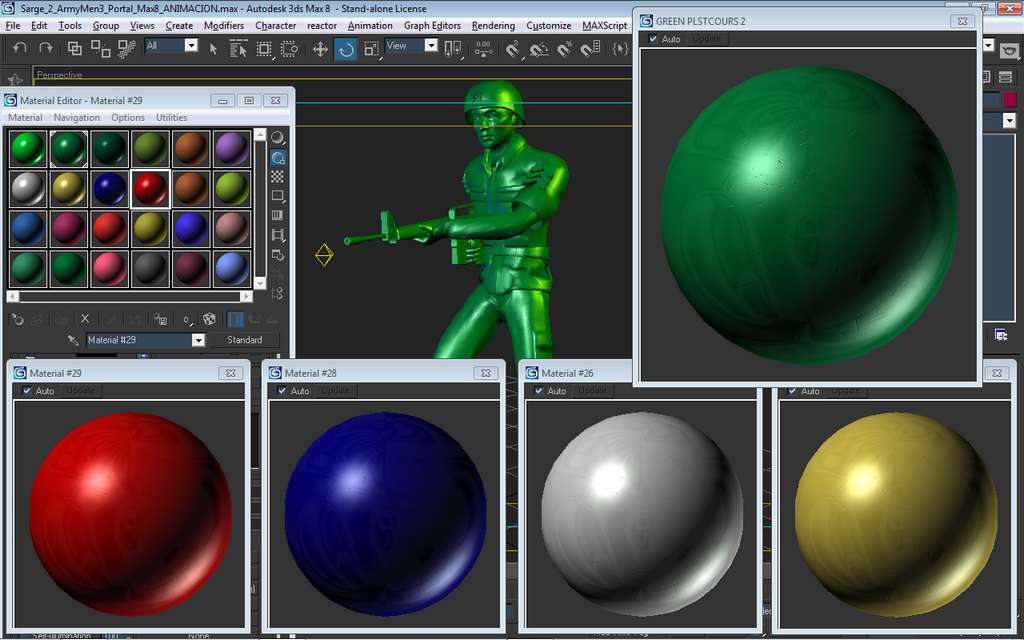
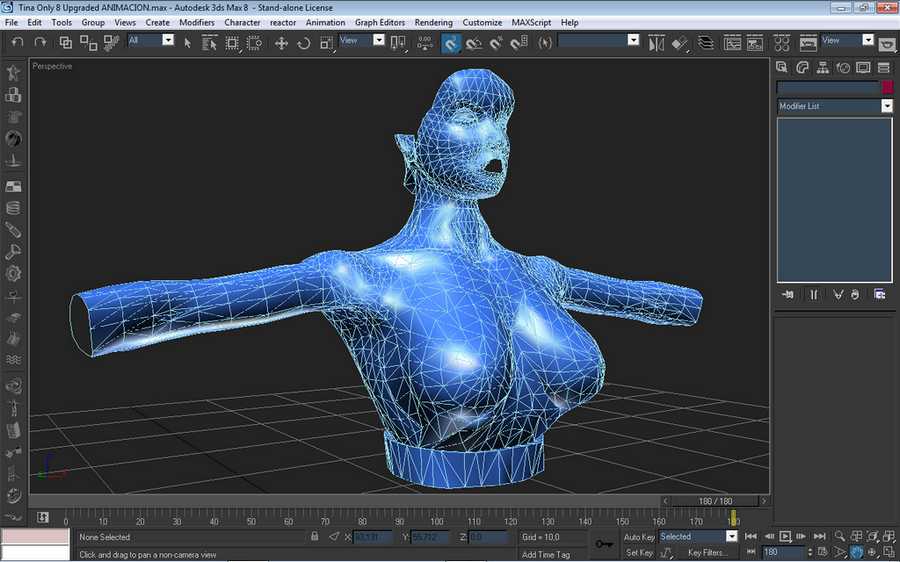
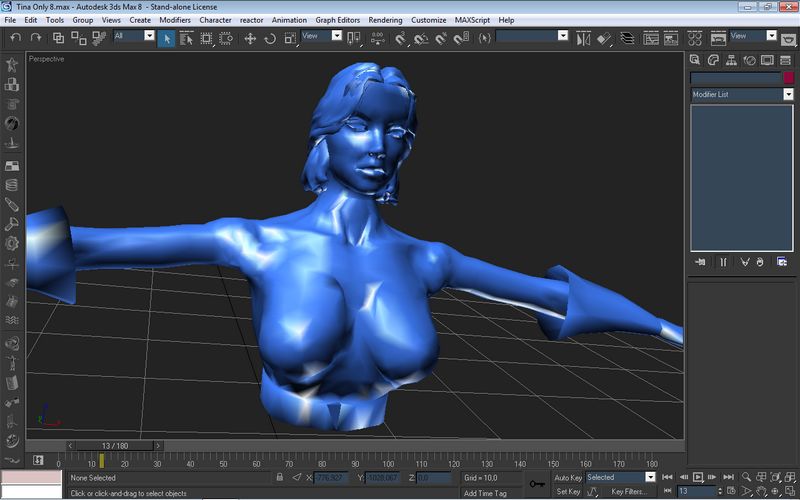
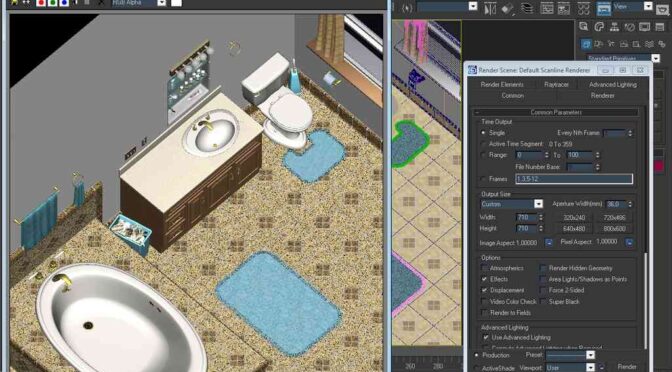
Models of soldiers, vehicles, and environments were made in 3D Studio Max.

Sarge 3D model from Army Men Toys in Space

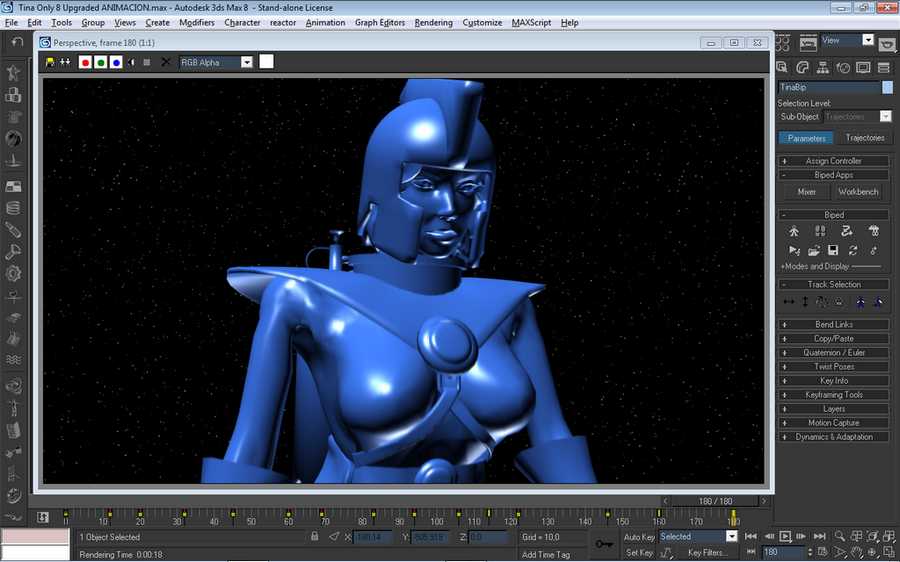
Although the final game used highly simplified sprites, high-quality 3D model versions were created for marketing renders and cutscenes.

The models were “baked” into sprites or textures, trimming polygons and reducing color palettes to fit within RAM and VRAM limits at the time.

It’s important to note that the 2.5D Army Men games were developed exclusively for PC; console versions used different adaptations of the game engine and design approach.

So… how?

2.1 – 3D Modeling and Texturing

The visual production of the early Army Men titles was a meticulous and multi-step process that combined 3D modeling, detailed texturing, and careful sprite rendering. Development teams began by designing each character, vehicle, and object as a fully realized 3D model in 3D Studio Max. These models were built with more geometric detail than the final games would ever display, ensuring that the rendered sprites would look crisp and convincing even at the relatively low resolutions of late 1990s PC games.

Textures were then painted by hand or derived from scanned materials, giving plastic surfaces their distinctive molded look. Special care was taken to simulate the subtle light diffusion and shading characteristics of plastic, which gave the Army Men their iconic, toy-like presence. Vehicles, buildings, and environmental props followed the same pipeline, often modeled with exaggerated proportions to read clearly from the game’s fixed viewpoint.

  • The process began in 3D Studio Max, where artists modeled soldiers, vehicles, weapons, and environmental props in full 3D.
  • Although the game ultimately used sprites (2D images), the models were initially built with full geometry, high-resolution textures, and realistic proportions for marketing renders and cutscenes.
  • Textures were painted by hand or generated from photographic references, then downscaled and palette-limited to fit the technical constraints of the game engine (often 256 colors per set).
  • Each model was rigged with basic skeletons in Max’s “Biped” system for posing, not for real-time animation. All movement was baked into pre-rendered sequences.

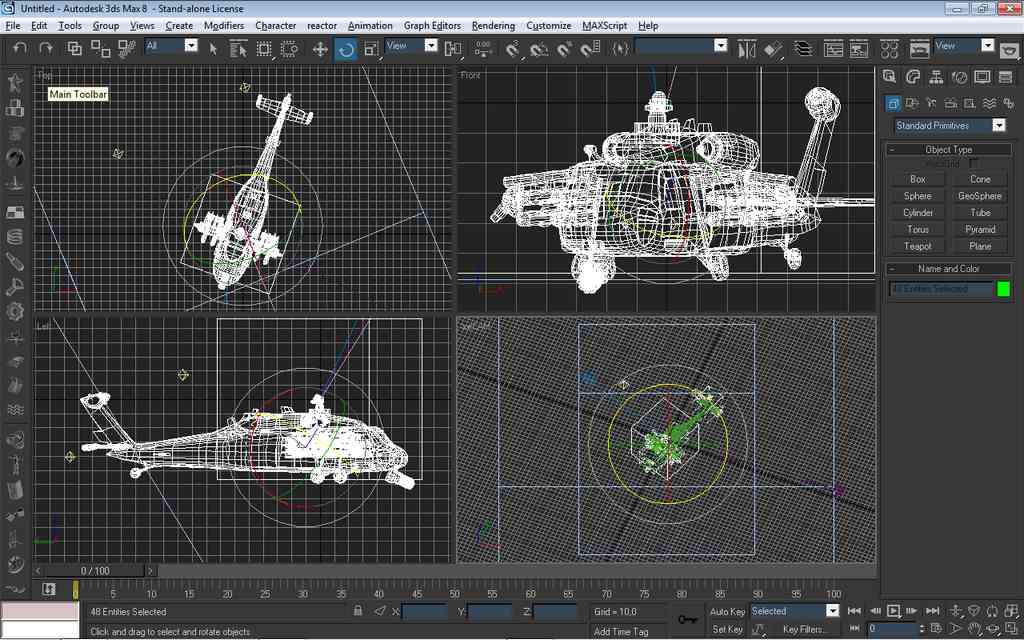
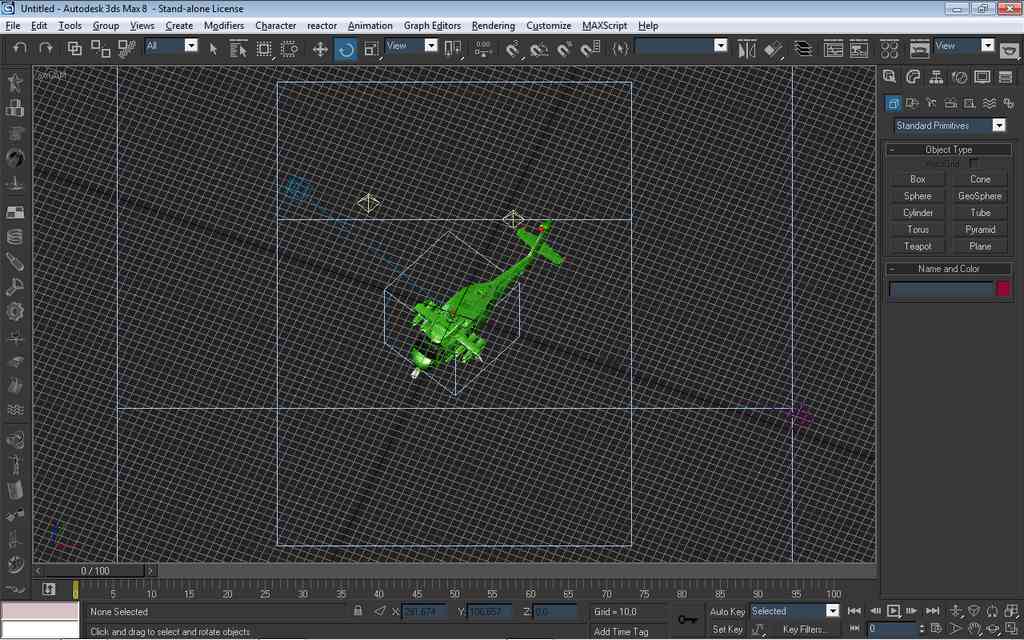
Once modeling and texturing were complete, the development team moved to the rendering stage. Instead of importing the 3D models directly into the game engine, they were pre-rendered into 2D sprites. This technique allowed for a higher level of visual fidelity than real-time 3D of the era could achieve on average home PCs. Animations (such as walking, firing, or rotating turrets) were rendered frame-by-frame in 3D Studio Max, then exported as sprite sheets to be used in-game. Special effects like muzzle flashes, smoke, and explosions were often created as separate rendered sequences and composited on top of the base sprites.

2.2 – Environment Creation

The environments followed a similar principle. Terrain tiles, buildings, and interactive objects were modeled and rendered in segments, allowing designers to piece together maps within the game editor. Lighting was baked into these renders, giving the illusion of complex shading without taxing the PC’s hardware.

The gameplay itself was presented from a fixed isometric camera perspective, tilted at roughly a 45-degree angle. This viewpoint was carefully chosen to maximize the clarity of the battlefield while retaining a sense of three-dimensional depth. From this angle, players could easily distinguish elevation, obstacles, and the orientation of units. It also allowed artists to control exactly how models were rendered, ensuring consistent proportions and lighting across the entire game world.

The combination of high-quality pre-rendered graphics, baked lighting, and the stable isometric viewpoint gave the early Army Men games their distinctive “miniature war” aesthetic, striking a balance between technical limitations and the highly artistic ambition of 3DO’s Trip Hawkins.

  • Game environments were also modeled in 3D, but separated into terrain layers and static props.
  • Terrain tiles were rendered at fixed angles to match the isometric view, then stitched together in the in-house map editor.
  • Static objects (buildings, trees, fortifications) were rendered as isometric sprites with multiple damage states where applicable (e.g., intact, damaged, destroyed).
2.3 – Rendering Sprites
  • The 3D models were placed in a rendering scene with lighting and camera settings that matched the game’s perspective.
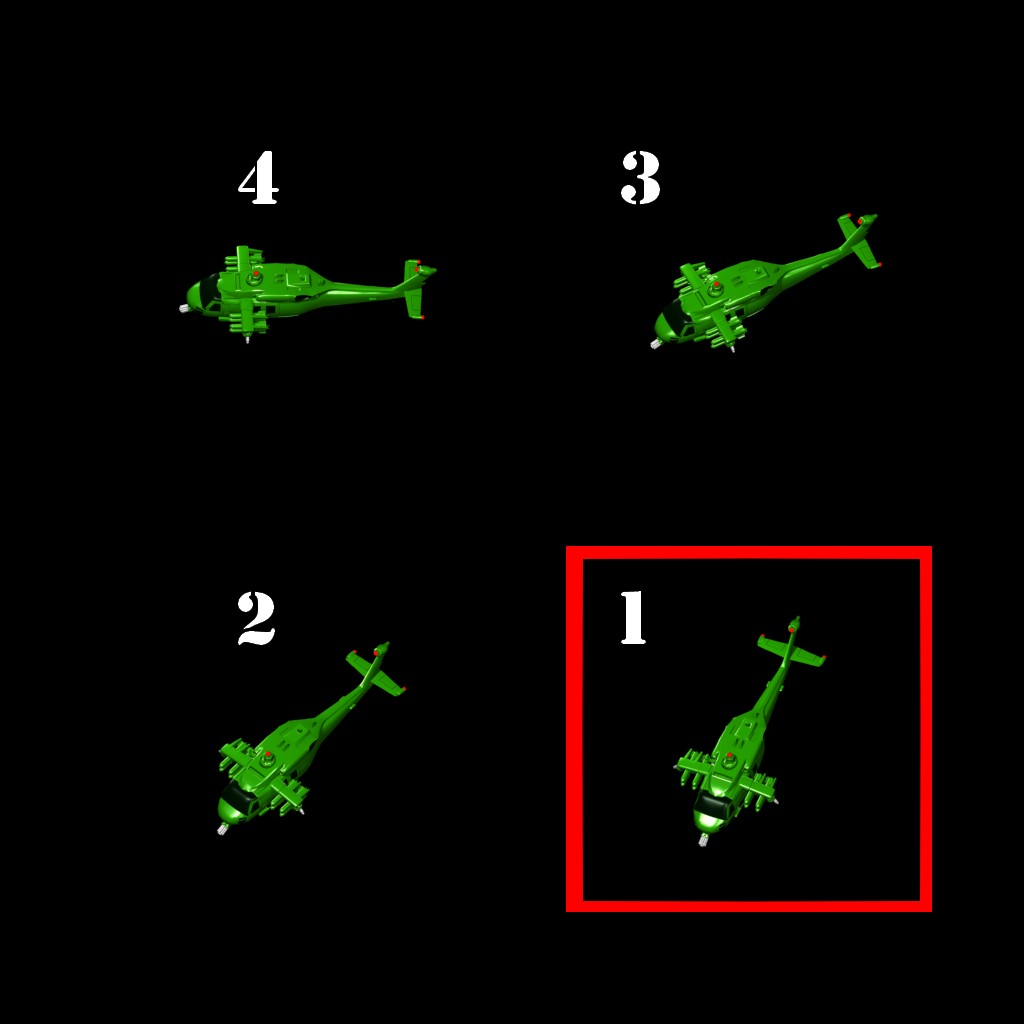
  • Soldiers and vehicles were rendered in 32 or 64 different angles, depending on their importance.
  • Animations (walking, shooting, reloading, turning) were rendered frame-by-frame into sprite sheets.
  • Each frame was then processed to remove the background, optimize colors, and align pivot points so the engine could rotate and move them smoothly.

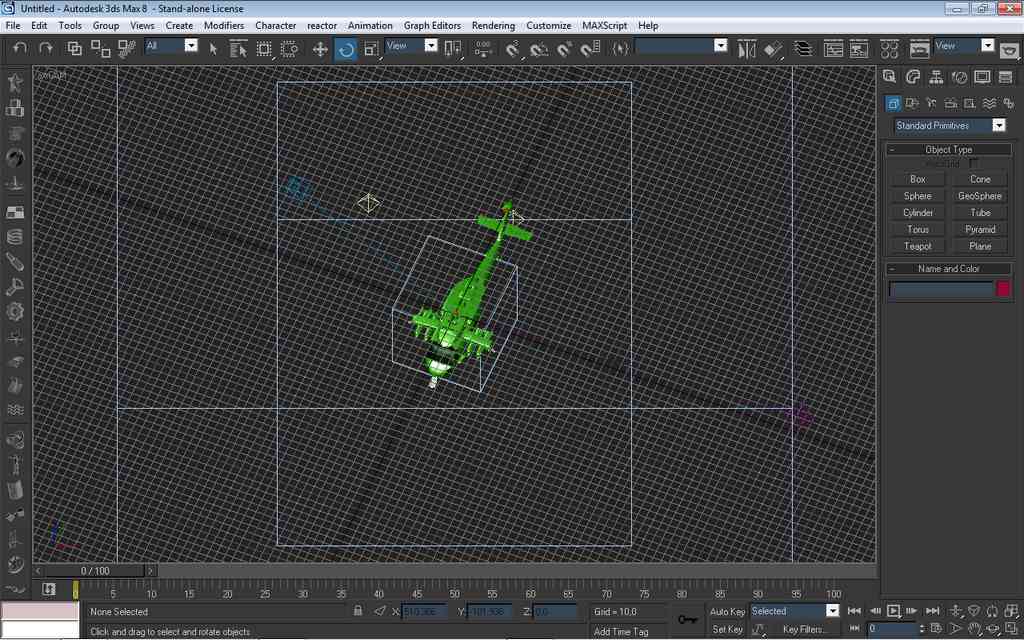
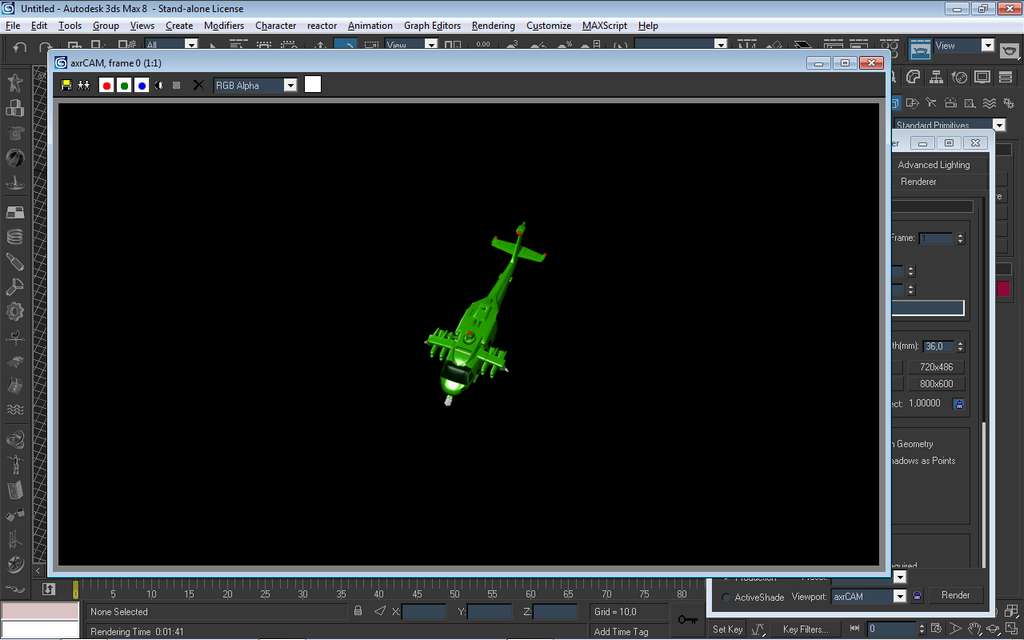
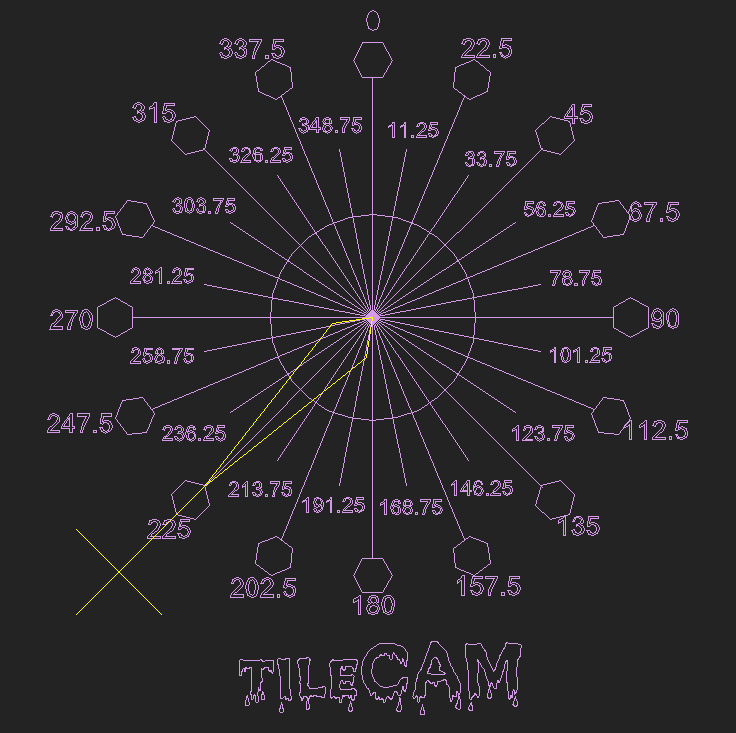
In the image below we can see the “Tile Cam,” or sprite capture position camera. A graphic that 3DO developers always kept in mind to know the angle of each of the multiple images they had to capture of each 3D model, to obtain the 360-degree motion effect of soldiers, vehicles, etc., in addition to each set of images carrying a weapon and the like. The yellow arrow, in addition to functioning as a clock hand indicating the angle of capture, also marks the height at which the camera should be positioned. The object/model goes in the center of the graphic.

2.4 – Special Effects
  • Explosions, muzzle flashes, smoke, and fire were usually hand-drawn frame-by-frame in a pixel art program to achieve a stylized look and keep file sizes small.
  • Some effects, like shadows and ambient lighting, were faked by rendering a semi-transparent dark shape beneath the units.
  • Transparent effects (glass, water, energy shields) were simulated with dithered patterns instead of true alpha blending, to ensure performance on lower-end hardware.
2.5 – Movement and Animation Systems
  • Despite being based on 3D models, all gameplay movement was sprite-based. Each unit had pre-rendered frames for each movement direction.
  • The engine swapped frames quickly to simulate animation, while changing the sprite set to match the direction of travel.
  • Rotation was not continuous but snapped between the pre-rendered angles, giving the characteristic “stepped” turning look.
  • Collision detection was based on simplified bounding boxes rather than the full shape of the sprite.
2.6 – Integration into the Engine
  • All assets (units, terrain, effects) were packed into proprietary resource files.
  • The engine combined terrain tiles and object sprites in real-time, overlaying animated units and effects according to their Z-order (depth).
  • Lighting changes were simulated with palette swaps, allowing entire environments to shift from day to night without rerendering the assets.

3. Maps and Levels

Environments were built using an in-house proprietary editor designed specifically for the Army Men engine.

This editor allowed placement of terrain, static objects, and “event points” (enemy spawns, mission scripts, sound triggers).

Maps were generally small to keep loading times low and were often connected through transition screens or cutscenes.

4. Programming and Engine

The Army Men engine was an evolution of a framework that 3DO had already used in other strategy and action games.

It supported:
  • Pseudo-3D sprites and pre-rendered rotations.
  • Multiple terrain layers to simulate elevation.
  • Basic AI scripting and enemy behavior.
  • The code was primarily written in C/C++, with auxiliary tools in Visual Basic for resource conversion and packaging.
4.1 – How camera, pathfinding, and depth sorting worked

Since that’s what made Army Men’s isometric view feel dynamic despite being built entirely from static sprites. That part connects directly to how the movement system was implemented.

The isometric camera itself was fixed in angle but could pan across the battlefield. Camera movement was tied to mouse edges or keyboard input, and it followed a smooth scrolling pattern to maintain player orientation. Since the camera never rotated, all sprites could be pre-rendered from the same set of angles, greatly reducing memory use and production time.

Pathfinding relied heavily on an A* (A-Star) algorithm adapted to the isometric grid. The system calculated optimal routes while accounting for terrain type, impassable objects, and unit collision. Because maps often featured elevation changes (ramps, cliffs, and bridges) the pathfinding system also factored in “height layers,” preventing units from attempting impossible routes. This was especially important for vehicles, which had stricter movement constraints than infantry.

Depth sorting (deciding which objects should appear in front of or behind others) was handled through a “Y-sorting” system. The engine drew objects in order of their Y-coordinate in world space, meaning that units lower on the screen (closer to the player’s viewpoint) would be rendered on top of those further back. This simple yet effective technique ensured consistent layering without the need for real-time 3D z-buffer calculations.

4.2 – Movement, Interaction, and Technical Implementation in the Isometric Engine

The fixed isometric perspective of the early Army Men titles was not just a visual choice.. it directly influenced how movement, interaction, and gameplay logic were implemented.

Unit movement was handled on a 2D coordinate grid that corresponded to the isometric map’s tile layout. Each tile represented a fixed unit of space, but because the camera was angled, the game had to apply a transformation to convert “world” coordinates into their isometric screen positions. This meant that while players saw units moving diagonally across the battlefield, the game internally calculated their positions in standard X-Y Cartesian space.

Interaction with the environment followed a “selection → command → execution” model. When the player selected a unit, the game temporarily highlighted its sprite and displayed its selection circle, a 2D ring projected onto the ground plane. Issuing a movement or attack order triggered an internal check: the game verified whether the destination tile was valid, whether the target could be reached, and whether line-of-sight was available (a simplified visibility check rather than true 3D ray tracing).

Together, these systems created a smooth and intuitive gameplay experience despite the limitations of late-90s PC hardware. The isometric rendering allowed for highly detailed graphics, while the underlying grid-based logic kept gameplay predictable, readable, and strategically satisfying.

5. Testing and Optimization

Testing was intensive because different PC systems required different optimizations to work. Back then, consoles were a single, unified system, but on PC, there are multiple different systems that require tweaking the game for proper universal operation. At that time, the game that was launched usually was the final version, with no DLC to fix the game post-launch. Although patches did exist, usually just one. Everything was always released in physical format…

On consoles, animation frames, polygonal 3D objects and texture details were reduced, and sometimes entire environmental elements were removed. But in this 2.5D games, usually was a matter of programming tweaking and fixing.

Testers reported bugs using printed screenshots (yes, on paper) with handwritten annotations.

How Marvel’s Missteps Mirror the Fall of Army Men: A Lesson in Creative Oversaturation

When James Gunn (now the creative head of DC Studios) was recently asked what he believed had hurt Marvel, his words were both honest and damning: “Too much content. Not enough planning. It killed them.” His remarks, aimed at the overextension of Marvel Studios in the wake of Avengers: Endgame, could just as easily describe what happened to the Army Men franchise in the early 2000s.

Back in the late ’90s, Army Men stormed the gaming world with a simple yet irresistible premise: toy soldiers brought to life in an imaginative, war-torn plastic world. The original titles stood out with charming aesthetics, quirky humor, and solid gameplay. But the publisher, 3DO, quickly turned that initial success into a production frenzy. From 1998 to 2003, they pushed out over a dozen Army Men titles—a pace that left little room for refinement or reinvention.

Back in the heyday of 3DO’s rapid-fire release strategy, even those of us in the The Army Men videogames channel were caught off guard. Titles arrived so frequently that not even the fans seemed fully aware of what was launching (or when). By the time a new game crossed our radar, it was often already out in the wild, too late. In an industry where annual sports releases were considered the norm, Army Men shattered expectations by flooding the market with an unrelenting stream of entries. No amount of pre-release buzz could keep up. The public wasn’t just underprepared: they were overwhelmed.

Much like Marvel’s recent deluge of films and Disney+ series, 3DO’s Army Men games began to feel rushed, repetitive, and disconnected. Without a clear long-term narrative or gameplay evolution, fans began to lose interest. By the time fresh ideas were needed most, the brand had burned out… and 3DO filed for bankruptcy in 2003.

James Gunn’s criticism of Marvel’s strategy (greenlighting projects without finished scripts and saturating the audience with underdeveloped content) perfectly echoes the pitfalls of 3DO. Both cases show how creative properties, no matter how beloved, can collapse under the weight of rushed schedules and corporate overreach.

The Lesson? Sustainability in storytelling matters more than ever. The audience craves meaningful worlds, not just more content. In the age of ever-growing universes (cinematic, gaming, or otherwise) the smartest path forward is one paved with vision, patience, and purpose. Part of what was missing in those years was the breathing room—a chance for the audience to anticipate, absorb, and get excited. Great franchises don’t just drop content; they build moments. But with Army Men, there was rarely time to prepare the public or give each title its spotlight. Without that crucial window to inform and engage players, even solid ideas were lost in the noise.

Fake Army Men images

The Truth Behind the Famous “In-Game Screenshots” of the First Army Men Games

There are phrases that have become part of gaming folklore. One of the most common (and persistent) is:

“It was from a beta version…” —said with the tone of someone convinced they’ve uncovered a hidden development secret.

But when it comes to Army Men, many of those promotional screenshots were not beta versions of anything. In fact… they weren’t even screenshots.

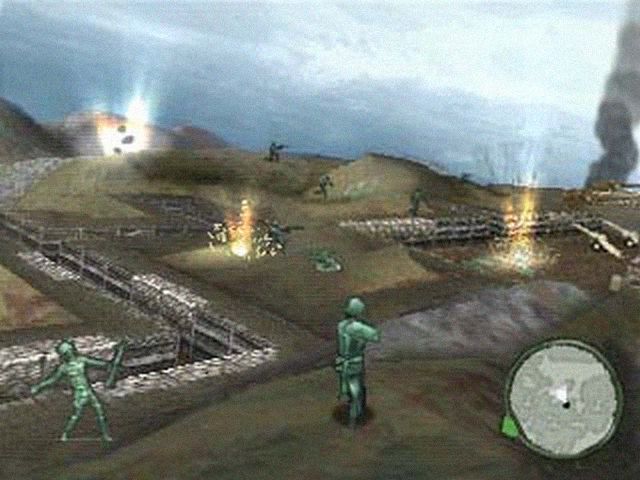
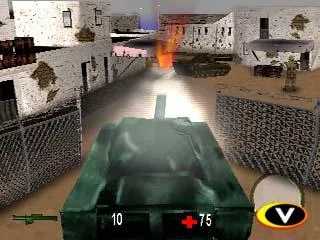
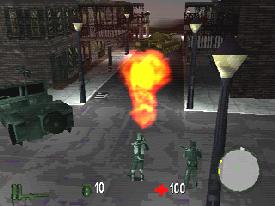
Slightly modified screenshot of PS1 Army Men: World War used in ads all over the internet at the time

What Looked Like In-Game… Wasn’t

Back in the golden age of 3DO, when Army Men was just beginning to take shape as a franchise, the creative team had a challenge: They needed a visual way to pitch the idea before the game was even fully designed.

Veteran developer Michael Mendheim, who played a crucial role in conceptualizing the Army Men universe, would put together digitally composed images to present the tone and feel of the project.

These images were a mix of:

  • Independently rendered 3D models.
  • Partial engine screenshots, when available.
  • Added effects like smoke, fire, and lighting.
  • And of course, a healthy dose of Photoshop.

They were never meant to be real gameplay footage: they were visual mockups, created to evoke the style, mood, and action the final product was aiming for.

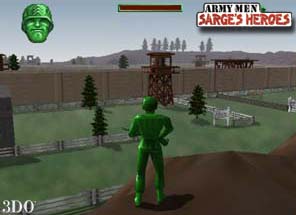
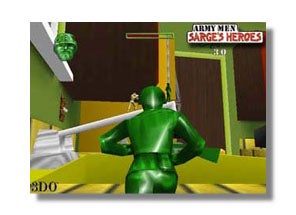
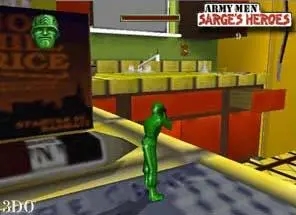
Slightly modified screenshot of N64 Army Men: Sarge’s Heroes used in ads all over the internet at the time

Although with minor modifications to the images, these are surely from the Army Men: Sarge’s Heroes engine for the Nintendo 64, but before going through the final version for the N64, it was actually a beta version of the levels and functions, not very different from the final version.

When Marketing Takes Creative Liberties

What’s interesting is that, even though the developers understood these images were purely conceptual, 3DO’s marketing team used them in advertisements as if they were actual in-game screenshots.

These images showed up in:

  • Magazines
  • Game boxes
  • Promotional flyers
  • Manuals
  • And even official press kits

The result? Players thought that’s how the game would look. And while that wasn’t exactly true… it worked. The hype exploded. The visual concept of Army Men (green plastic soldiers fighting battles in real-world environments) instantly captured players’ imaginations, long before the games were even finished, even a few years before 1998 Army Men.

The Speculation That Never Died

Even today, many fans still insist that those images came from early builds or beta versions of the games.

You’ll still hear comments like:

“This must be from a lost prototype…”

Or comments like:

“They had to downgrade the graphics later due to hardware limitations.”

And while it’s true that Army Men underwent plenty of visual changes during development (and yes, they had to scale things down to run on systems like the PlayStation 1 and Nintendo 64) those promo shots were not captured from actual working versions of the game.

People who worked with Photoshop or 3D Studio Max back then can clearly recognize the techniques used in these composites. If anything, they were stunning examples of concept art disguised as gameplay.

In a way, we wish they were real beta shots… it would’ve added an extra layer of mystique to the franchise’s development history. But no, it was just clever marketing. Fake… but effective.

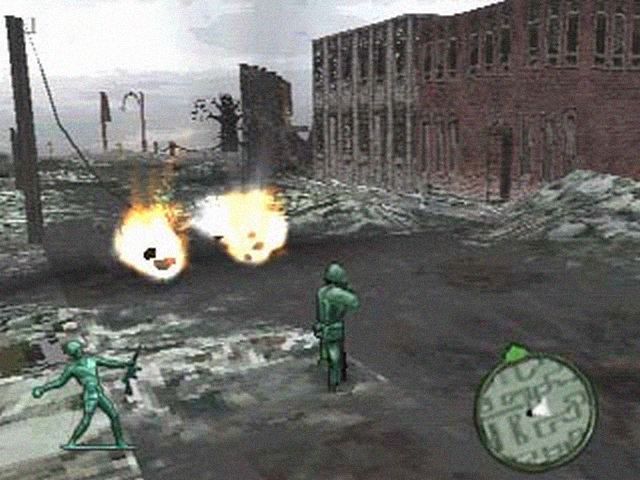
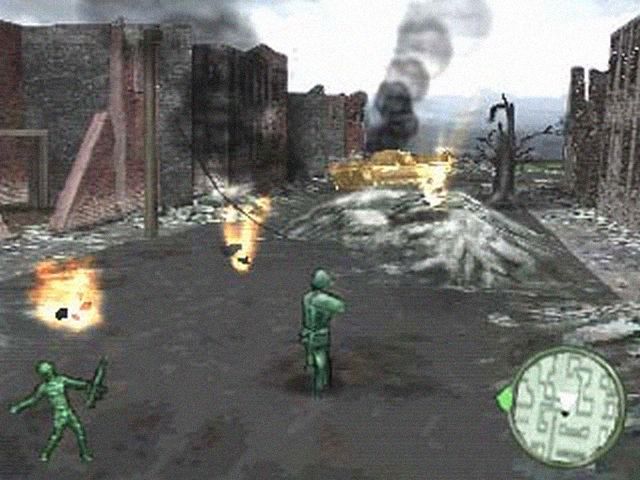
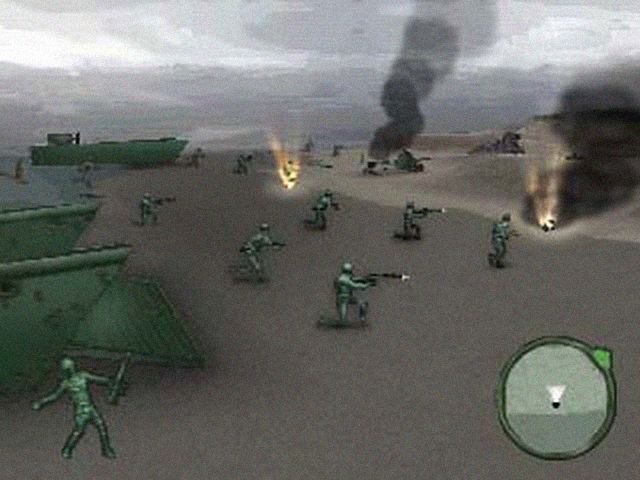
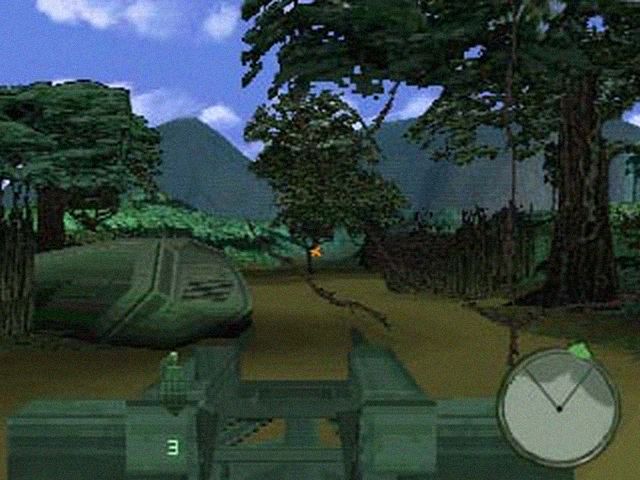
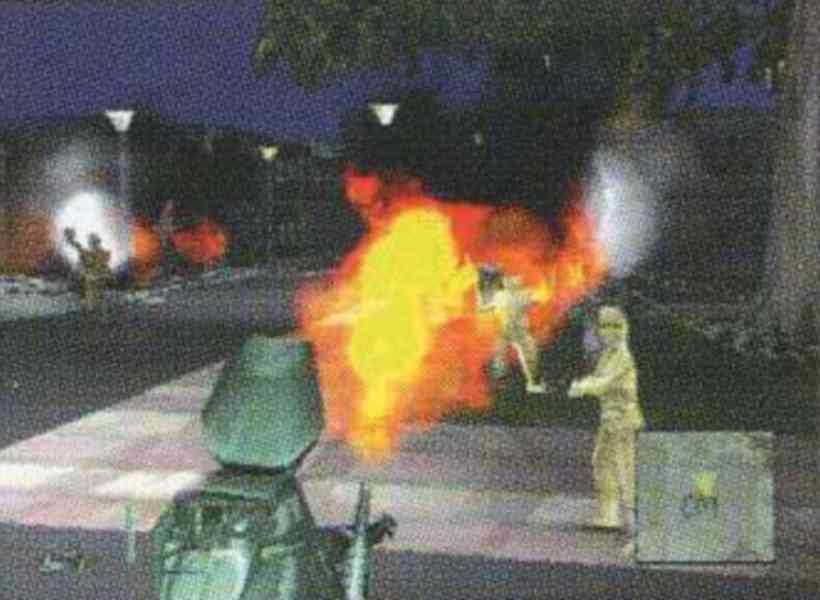
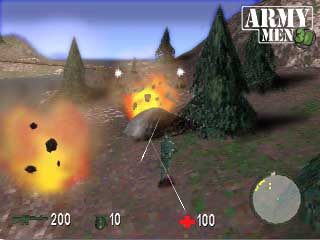
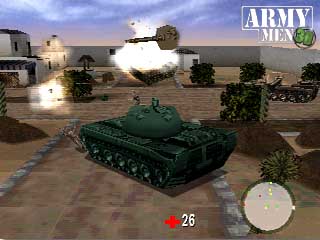
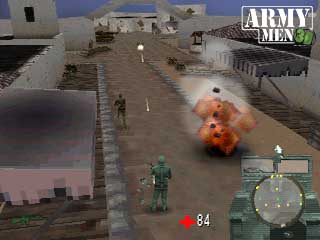
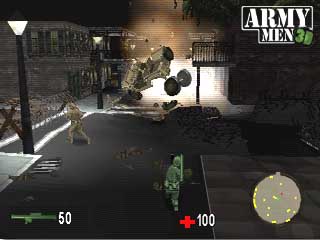
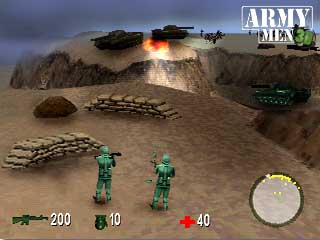
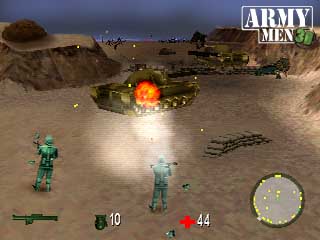
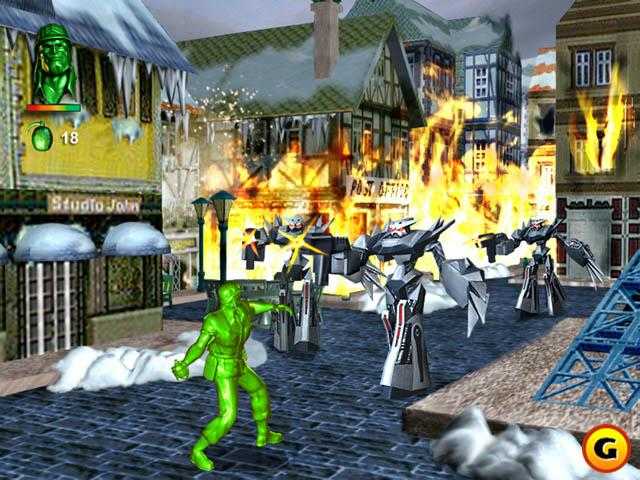
Modified screenshots of the “supposed” Army Men 3D beta version for PS1, used in promotional content all over the internet at the time

Deception or Strategy?

Today, in the era of frame-by-frame breakdowns and mandatory “not actual gameplay” disclaimers, this kind of tactic would get you dragged online in seconds. But in the ‘90s, with a franchise as visually unique as Army Men, it was a legitimate (and successful) marketing tool.

Some might call it deceptive. Others see it as an effective way of presenting an evolving creative vision.

Either way, those images weren’t beta builds, they weren’t unreleased versions, and they weren’t screenshots from a hidden dev console.

They were Photoshop. Plain and simple. And in context… they were brilliant.

What Does This Say About the Toyverse?

Like many good stories in the Toyverse, this one also carries a lesson. Just as molded toys become soldiers with names, stories, and purpose, a fake image can become the spark that brings an entire world to life.

Those visuals (however artificial) were the first real representations of the Army Men franchise. Before missions, before bugs, before battlefield chaos… there was a carefully crafted picture. And it worked.

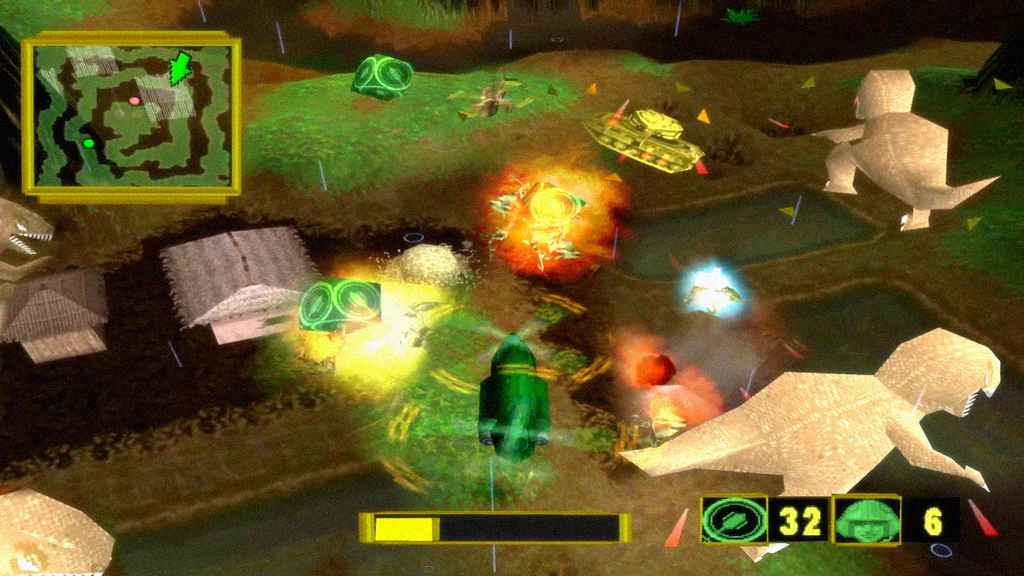
Heavily fake screenshots of Portal Runner (PS2) where they used heavy 3D CGI models to make concept screenshots that 3DO used in promotional content on magazines and all over the internet at the time

Bonus: Where to See These Images Today?

Many of these fake-but-iconic visuals still survive today in:

  • Archived game magazines (GamePro, EGM, etc.)
  • Scanned promotional material
  • Original manuals
  • The official 3DO websites via the Wayback Machine
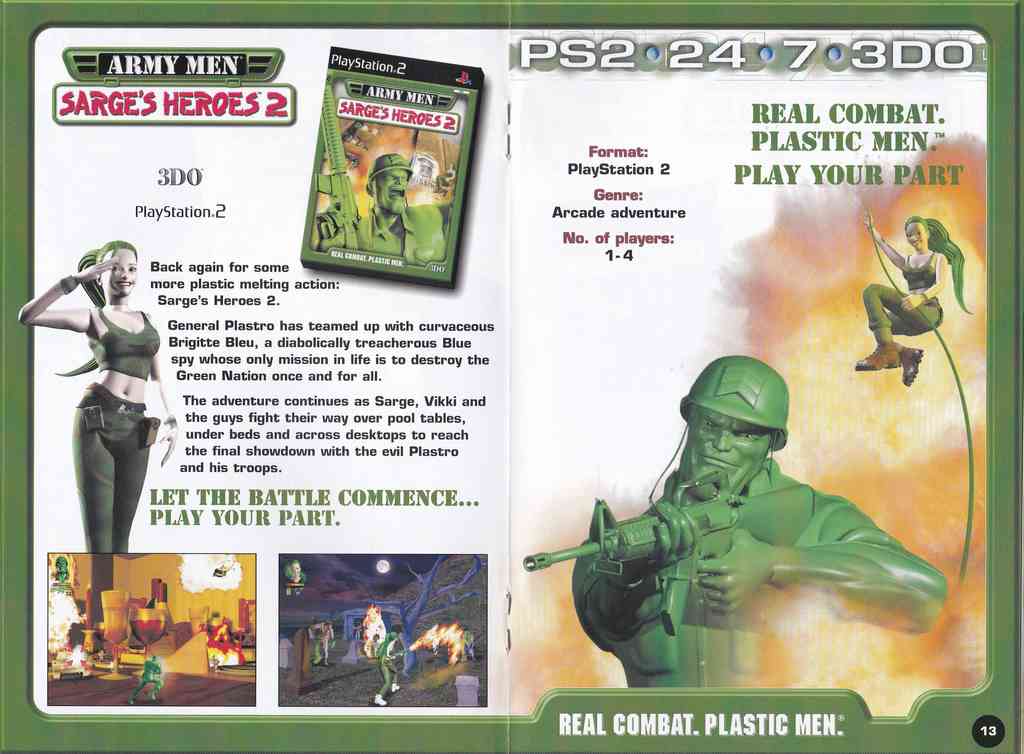
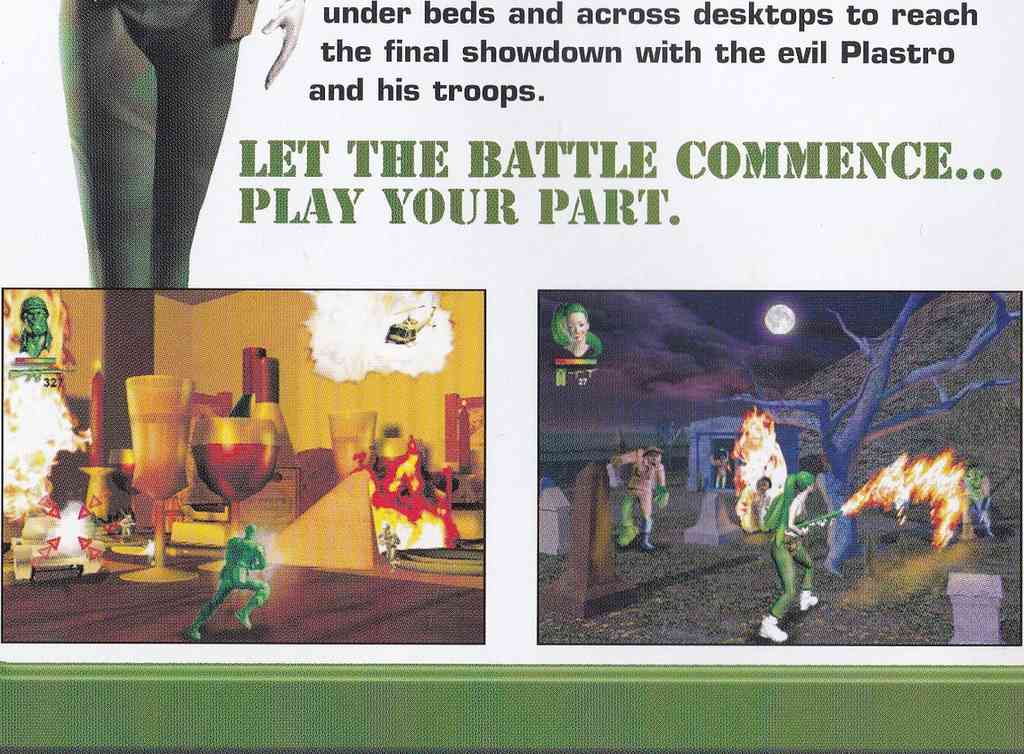
Heavily fake screenshots of the “supposed” Army Men Sarge’s Heroes 2 for PS2, used in promotional content on magazines and all over the internet at the time

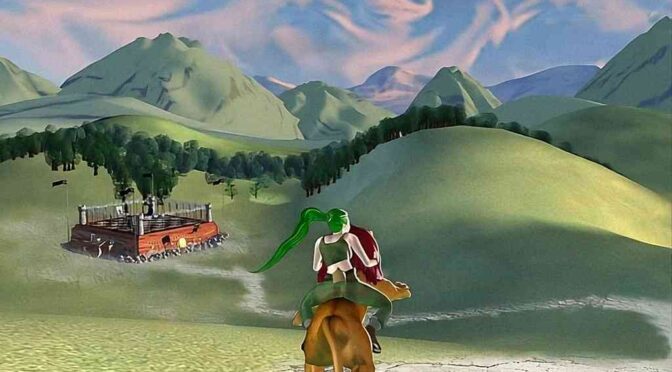
In the game’s different media promotional contents, these screenshots were used to show off the game in its Playstation 2 version. In reality, they are composites using partial images of the game’s actual stages generated in a different engine or stage editing program, along with CGI models of the protagonists and a lot of added effects, something impossible to do for the Playstation 2. These were most likely images made as concept art of how the game should have looked for its development.

And of course, at ArmyMen.com.ar, where fans are still collecting and preserving all official documentation and rare media.

True BETA with minor modifications

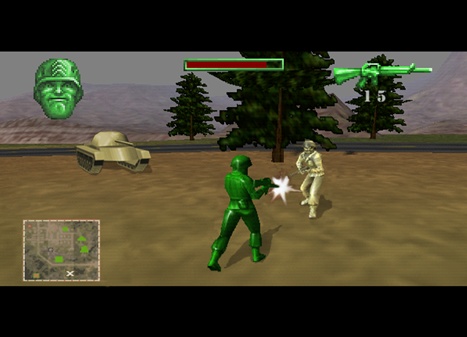
The last 3DO game wasn’t exempt from 3DO tactics. Although these are real in-game images from the game engine (Zero Engine), they have minor additions, such as some soldiers, tanks, and explosions. And these, as they didn’t report, are images from the actual beta, up to the point where 3DO worked on it, before Global Star Software took over and finished the game.

Epilogue: Not Real Gameplay, But Still Part of the Game

And óo players ever got to take control of Sarge.Because sometimes, a fake image contains a very real truth: The spirit of a franchise that helped shape an entire generation’s imagination.

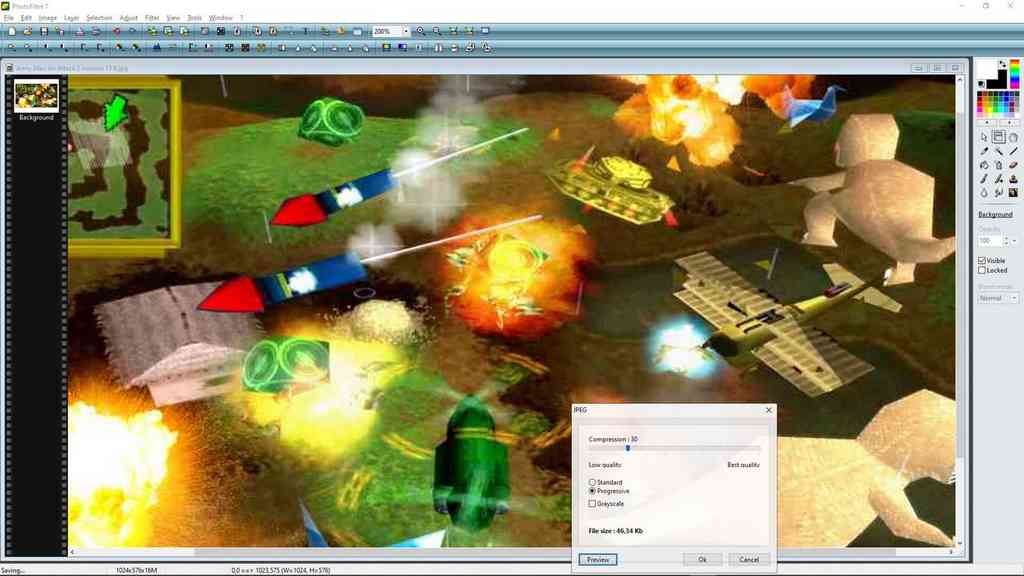
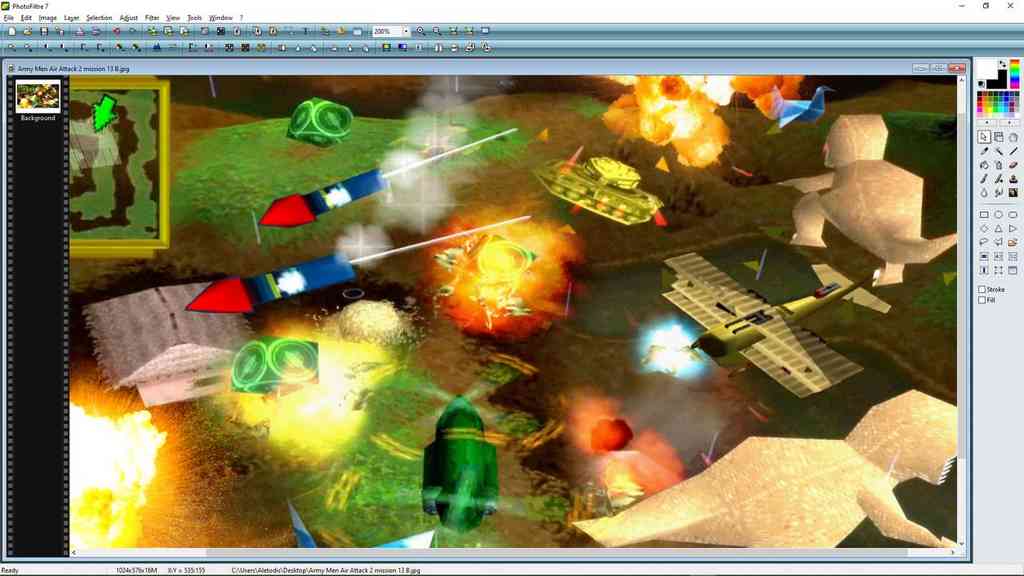
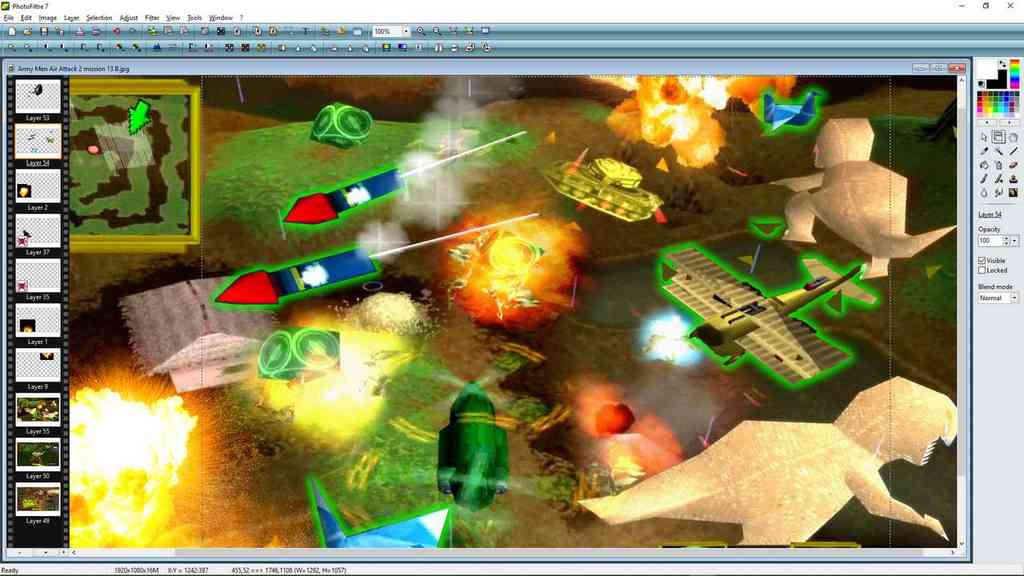
This are some of our own “fake” promotional images. We usually use them for our video thumbnails… but from now on we’ll be using them to promote older 3DO games a little… excessively.

Heroes may die, but plastic lasts forever. By Zoey Handley – destructoid.com – including some words from Michael Mendheim – Jun 27, 2021

Original source

https://destructoid.com/sarges-war-eulogy/

Army Men: Sarge’s War: The eulogy for an entire series

It’s a complicated subject, the Army Men series. The 3DO Company released somewhere in the realm of 25 games between 1998 and 2002. When you consider some of the ports were made from the ground up and entirely distinctive to the platform they were released on, the actual number of unique games is probably around 35 or more. I’m sure you can already see the problem.

Army Men Vikki Dead
Army Men Sarge’s War Vikki Dead

“The problem was with all the early success of these Army Men games, the executives at 3DO thought they could ship an Army Men game (or bundle) every quarter and be successful,” Michael Mendheim, creative director of Battletanx and the Sarge’s Heroes subseries, told me. It’s obvious. The output was stunning, putting even history’s most prolific market spammers, like Guitar Hero, to shame. What started as a promising series with a few hits on its hands quickly declined into one that was treated with scorn and derision by players and the press.

The result is that the Army Men games are poorly remembered. I’ve previously compared the series to a shotgun blast: a sudden and abrupt spread, sometimes causing a lot of agony. Few mourned the loss of the franchise, but I still visit to place flowers on its grave.

Col Grimm dead
Army Men Sarge’s War Col Grimm dead

The 3DO Company was founded by Trip Hawkins, who previously founded Electronic Arts years earlier. Hawkins dreamt of a console that would become the universal medium for games. Licensing fees would be almost non-existent, so developers and publishers would jump aboard with little risk, abandoning frontrunners Nintendo and Sega. Hawkins left EA to pursue this dream, but by 1996, the 3DO Interactive Multiplayer flopped under the weight of FMV game ports, and the company had to pivot to purely making software. Hawkins even took on a creative role to help out his teams.

Army Men started out quietly enough in 1998. The first game on PC, merely titled Army Men, was a reasonable success. Early the next year, Army Men II came out alongside a PlayStation remake of the first game called Army Men 3D. Again, these were pretty successful. By the end of 1999, however, a second PC title, Army Men: Toys in Space, the 3D action title Army Men: Sarge’s Heroes, and the top-down helicopter game Army Men: Air Attack were all released. Five titles in its second year, and the snowball had only just begun rolling.

Riff dead
Army Men Sarge’s War Riff dead

That’s where Michael Mendheim comes in. In 1998, he was creative director on Battletanx, which was a hit for 3DO. He was then given creative license on his own Army Men title and envisioned a character-driven game with more of a story, and that became Sarge’s Heroes.

Once again, Sarge’s Heroes was a hit. If I can wade into the story for a moment, it’s where I was introduced to the series, and it’s one that still holds a place in my heart. It had its rough spots, but a lot of its design, especially when it came to its levels, was fantastic. I remember following it through Nintendo Power up to its release and playing the hell out of it.

While I’ve trudged through a great deal of the Army Men series since then and could give you the full and detailed history, that’s quite a detour. We’re going to hurry the story along here.

Scorch dead
Army Men Sarge’s War Scorch dead

The important fact is that not only did the quality of Army Men titles start to plummet almost immediately, but the public’s appetite for the games declined just as fast. I’d say that the four PlayStation Army Men: World War games are pretty consistent fun, but by the release of the last two titles, the press was practically ignoring them.

It became something of a laughing stock. In 2001, Portal Runner was released to harsh reception. After a particularly scathing review in Gamepro Magazine, Trip Hawkins even went as far as writing to the Editor-in-Chief to defend the title in an almost comical fashion. He described the staff as “angry young men” and threatened to reduce their advertising. I can understand him wanting to defend his creation, but the letter wasn’t a good look.

Around 2002, the pace of releases from 3DO had slowed and the writing was on the wall. “We already had a round of layoffs; everyone was nervous about the company’s future,” said Mendheim. He had a team working on a game called Four Horsemen of the Apocalypse. “It was an edgy, gritty, post-apocalyptic nightmare, based on the Book of Revelation.” Mendheim also believed this to be the best chance at saving 3DO, but it wasn’t to be. “I was called into a meeting and told that I could keep a small team working on Horsemen but everyone else, including myself, would need to make another Army Men game. That Army Men game would be Sarge’s War.”

Thick dead
Army Men Sarge’s War Thick dead

Sarge’s War would be the last 3DO developed Army Men game, put together in haste as the company took on water. “Honestly, it was like developing the game on the Titanic and it took 9 months for the ship to sink,” described Mendheim.

If you’ve played Sarge’s War, you may have been stricken with how tonally different it was from previous games. The series’ standard features were there, but a lot of the color was washed out of it. In its place was a grittier veneer, even over its more cartoonish elements. The entire supporting cast of the Sarge’s Heroes sub-series–all of them–were killed in an explosion, sending Sergeant Hawk into an avenging rage.

This was the sound of a series dying. There are plenty of franchises that have disappeared from the face of the planet, never to be heard from again. Jazz JackrabbitTop GearF-Zero; there are many easy examples of games that have just…gone away. Sarge’s War was a game on its deathbed, one last defiant scream before the embrace of oblivion. It was a deliberate move to put the final nail in the coffin and bring closure to the series.

Hoover dead
Army Men Sarge’s War Hoover dead

I think Michael Mendheim put it best. “There are certain games that you just put your heart and soul into because you love the content, they are your babies. Sarge’s Heroes was one of those games for me. Every character in the game was developed with love and passion. Sarge’s Heroes was fun, positive, and hopeful. It was a game that made you laugh and feel some magic.”

Sarge’s War was the opposite of that. It was grim and dark. The story in Sarge’s War was about loss. Losing everything that you love and care about. In the plotline, the entire cast and crew – Sarge’s Heroes died with 3DO. Everyone except for Sarge.”

“When I killed off Sarge’s Heroes, I also killed my desire to ever design another Army Men game. I designed the first and last game in the Sarge’s Heroes product line.”

By the end of development, 3DO had already breathed its last, and Sarge’s War wound up getting released by Global Star Software, a subsidiary of Take-Two and the new home of the Army Men license. Some sources credit Tactical Development for completing the game, but according to Mendheim, “Our orders were to finish the game and that is what we did…the game was delivered completed as the ship went down.”

Shrap dead
Army Men Sarge’s War Shrap dead

In comparison to the Army Men games that came before it, Sarge’s War was less rickety. It’s obvious that some of 3DO’s best remaining talent had worked on it, though under less than ideal constraints. It doesn’t reach the height of the series, but knowing the story behind it underlines it with melancholy. It’s a surreal experience.

“There are no bad guys in this story; everyone did their absolute best to try and keep the company alive,” explains Mendheim. “No one sets out to make a bad game. No one worked harder than Trip Hawkins, who even put his own money on the line to try and save the company. Unfortunately, not every story has a happy ending.”

Global Star made a token effort at continuing the Army Men series. Their first attempt was Team 17’s Army Men: Major Malfunction in 2006, which I’ve previously covered, and it’s awful. Later they’d try another reboot with Army Men: Soldiers of Misfortune in 2008, which is similarly terrible. There was a mobile game for pre-smart phones, and then that’s it. Aside from a few re-releases, the series has been left to rest peacefully.

Army Men: Sarge's War Hawk
Army Men: Sarge’s War Hawk

Whether or not it deserved that fate is a matter of opinion. On one hand, it was unwise and intrusive to flood the market with those titles. Releasing games of questionable quality to bank on a brand should never be commended. But on the other hand, they weren’t without merit or appeal. The best games were just buried under the worst. It could have been straightened out. It didn’t have to end this way.

Or, as Michael Mendheim put it: “I always look back at my time at 3DO and think what could have been if we had managed the brand better by releasing only one Army Men game a year and each year releasing a different type of Army Men game with cool innovations and game mechanics…maybe, just maybe Army Men and 3DO might still be alive.”

The Making Of: Army Men – RetroGamer magazine. May 16, 2019. By Hareth Al Bustani

Exclusive interview with Trip Hawkins and Keith Bullen

During the mid-to-late 1990s, as video games began branching out beyond traditional genres, a surprisingly simple idea sparked the birth of one of gaming’s most memorable franchises. That spark was to bring the iconic green plastic toy soldiers (the Army Men) to digital life. What followed was a mix of action, strategy, and tongue-in-cheek satire that would grow into a universe of its own: the early foundations of what we now call the Toyverse.

The project emerged from The 3DO Company, founded by industry pioneer Trip Hawkins, who had already changed gaming history with Electronic Arts. At that time, 3DO was primarily focused on software development and searching for its next big concept… something that could blend strategy, humor, and accessibility. The result went far beyond expectation, shaping not just a game, but a world of plastic warfare and nostalgic imagination.

Origins of the Idea

It all began in 1996, when Keith Bullen, an art designer from Electronic Arts, was hired by 3DO to direct the visuals for a new project, then tentatively called War Sports. The goal was to create something in the spirit of Return Fire, 3DO’s popular vehicular shooter, but with stronger squad-based mechanics. Marketing wanted an “E for Everyone” rating, an idea ironically tied to the ESRB system that Trip Hawkins himself had helped establish.

“I remember various marketing meetings when ideas like green blood and making the soldiers robots were brought up as ways to get the game a friendly rating. I didn’t like any of these ideas.” – Keith recalls

Army Men Plastic Soldiers

Months passed without a clear direction, until Bullen had a eureka moment. He thought back to his childhood days, setting up tiny armies in the backyard and taking turns throwing rocks with his brother to knock them down. That memory (of creativity, chaos, and fun) became the emotional core of Army Men.

The toy soldiers had long been a universal symbol of imagination. From the Louis Marx playsets of the 1950s to Toy Story in 1995, these little green figures had stood the test of time. By centering the game around them, Bullen found a way to capture both nostalgia and originality, something fun for players who wanted a break from the gritty realism and machismo of other war games.

Army Men PC
Army Men PC (1998)

Building the Plastic World

Once the toy soldier idea took hold, Keith’s role evolved from art director to lead designer.

“Once the soldiers became plastic, we had to come up with a universe with real terrains and plastic soldiers,” he says. “We wanted the world to feel serious to the Army Men characters’ point of view but fun and nostalgic for the player.”

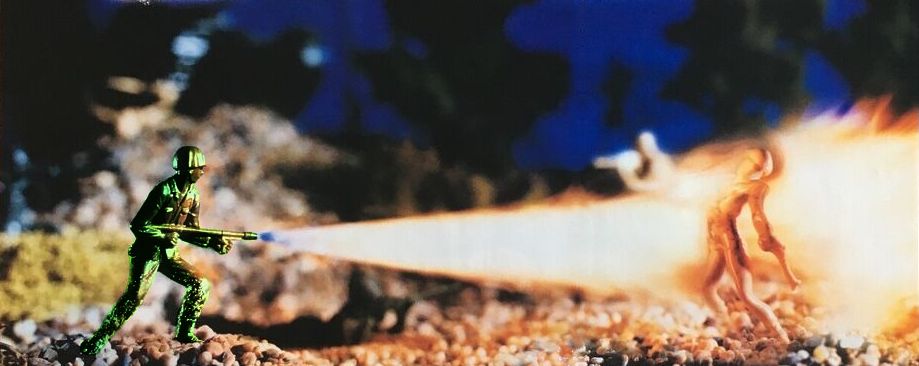
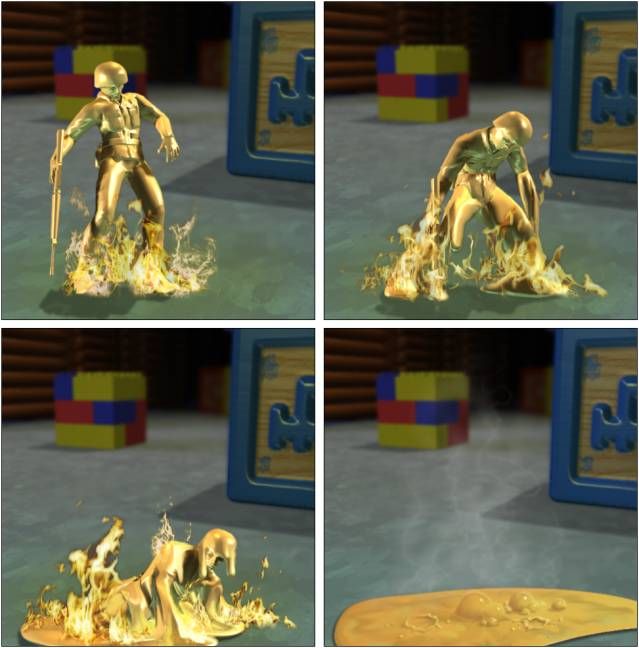
The team paid careful attention to the way plastic behaved in real life, how light hit its glossy surface, how it bent, shattered, and melted.

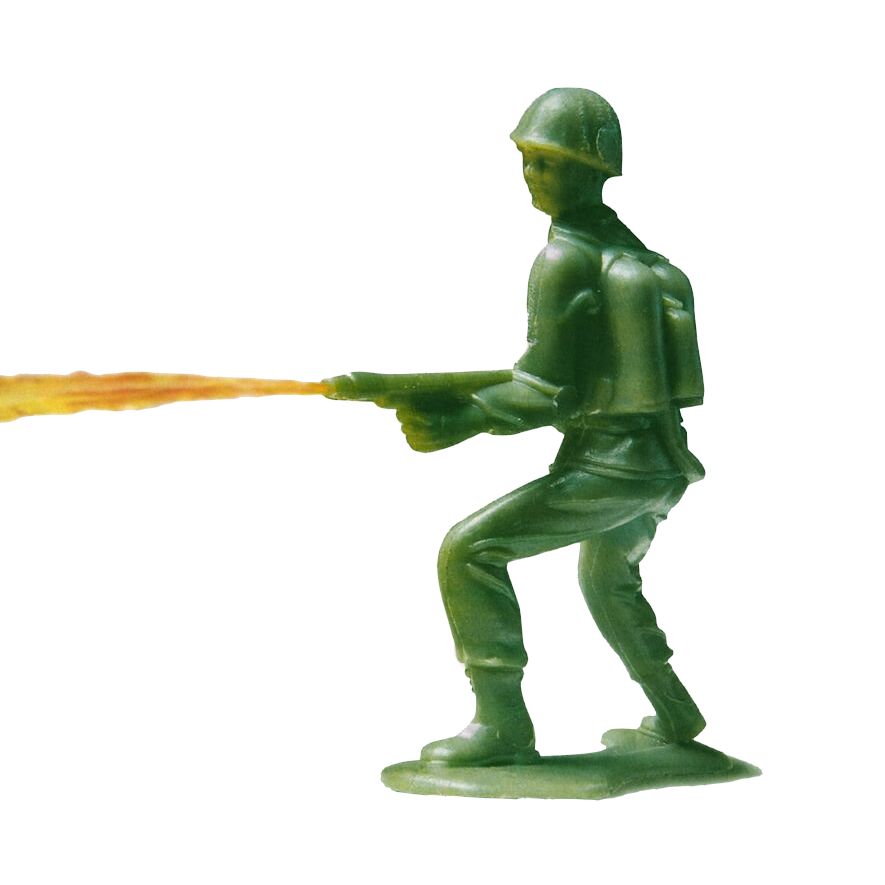
Green Army Men flamethrower

“We paid close attention to the physics in the animations. It was very important to me that the plastic pieces reacted to the world as if they were made of the same light plastic as the original figures.”

But turning that idea into a finished product wasn’t easy. The small team of six soon grew to more than ten as Bullen became creative director.

“It was very challenging convincing the team to adopt my new gameplay ideas… It took several months to finally get everyone on board.”

Executives were another obstacle. Early pitches for Army Men were dismissed as childish, “too young” some said. RTS fans, they argued, wouldn’t take seriously a game about toys. Yet Bullen persisted, finding clever ways to win people over.

Green Plastic Soldier
The “bought” generic soldier 3D model

“I then bought a 3D model of a generic Army Man and brought in some classic toy green and tan Army Men to use as pose references,” he remembers.
“For several weeks, many people from every department in the company would stop to discuss the posed 3D model… Soon after, the momentum switched from the product being perceived as too juvenile to being an awesome nostalgic experience.”

Sarge with rolled up sleeves, a modified version of the original 3D model

That was the turning point. Nostalgia had done its job.

From the Backyard to the Battlefield

The next challenge was translating the tactile world of toy soldiers into an interactive one. The developers recreated classic units like riflemen and bazooka troopers, while experimenting with how plastic would melt or break apart.

“We destroyed many plastic Army Men in the 3DO parking lot for the sake of realistic plastic physics,” Keith admits.
“The enhanced fear of fire when you are made of plastic was a theme we relied on throughout the series.”

To tie everything together, Army Men adopted a satirical tone. The game opened with a mock newsreel showing the totalitarian Tans preparing to invade the Greens.

Army Men News reel Introduction
Plastro from Army Men
The Mussolini Tan leader

“We watched many hours of authentic old reels… The Tan leader gesturing like Mussolini was one of my favourite segments.”

Originally planned as a real-time strategy game, Army Men evolved into something more direct and personal. Players would take control of Sarge, a Green Army hero.

“I’ve always preferred arcade-like action games over strategy games,” says Keith.
“So I redesigned the game around the central character of Sarge… as in games like Ikari Warriors.”

The final product blended tactical movement with fast-paced action.

“The gameplay became more about tactics, rather than strategy,” Bullen notes, crediting Crusader: No Remorse as an influence.

Trip Hawkins’ Perspective

One of the concept’s earliest champions was 3DO founder Trip Hawkins himself.

“Toy soldiers were my dominant play pattern as a child and I’d always invented strong storylines and adventures around them,” he says.
“Besides all the World War soldiers, I had Swoppets from the Wars Of The Roses, Roman centurions, and others – including cowboys, of course.”

Hawkins immediately recognized the blend of nostalgia, humor, and design potential behind Army Men.

“It inspired me to do something more central with humour in the genre and a stronger narrative.”

To him, the plastic theme wasn’t just an aesthetic choice: it was a creative platform.

“We were focused on the US market… nobody cared about them, because they’d not grown up with those toys.”

Despite the game’s playful tone, Hawkins insisted that warfare and destruction were essential to the experience.

“Creatively, we also wanted to have fun repeating some of the famous play patterns from childhood… It allowed us to cast our villains with a bit of sadism, that is still funny because… they’re just toys.”

Colonel Grimm and Sarge from Army Men
Colonel Grimm with Sarge

A Legacy Beyond Plastic

The development cycle lasted just over a year, despite several restarts. Once the formula clicked, Hawkins knew they had something special.

“This is what we live for in game development and publishing… to do something we really believe in and love.”

Across three themed terrains (desert, alpine, and swamp) Army Men culminated in a memorable twist: Sarge crossing into the Real World, a scene that would directly lead into Army Men II. The franchise quickly exploded, selling over 7 million copies across every major platform and generating more than $300 million in revenue.

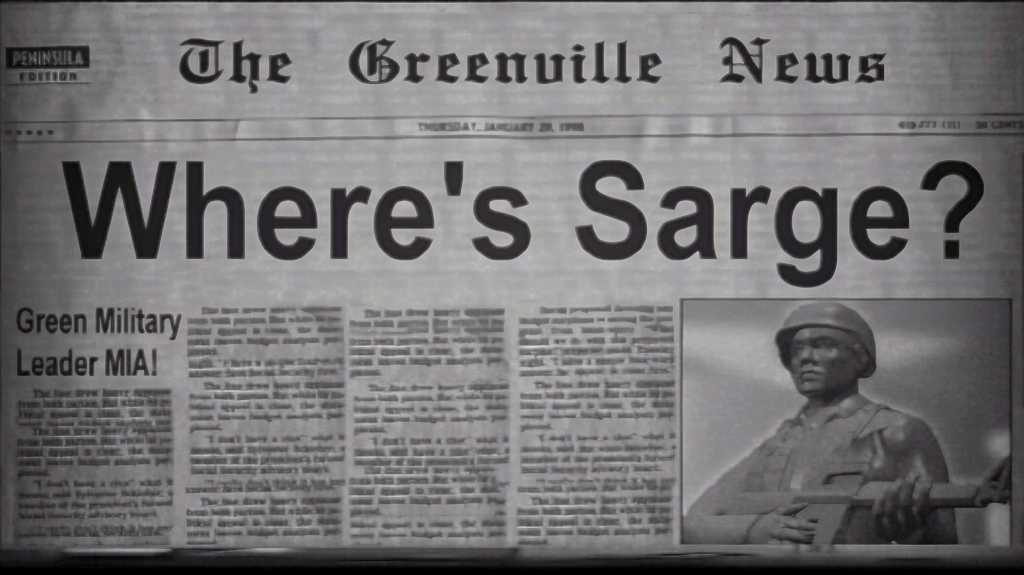
The Greenville News
The Greenville News 01/29/1998

Looking back, Bullen reflects on the impact of that first title:

“I never would have imagined that it would spawn 23 sequels and spin-offs… My goal was to create a game that I would want to play and not a clone of a game I had played before.”

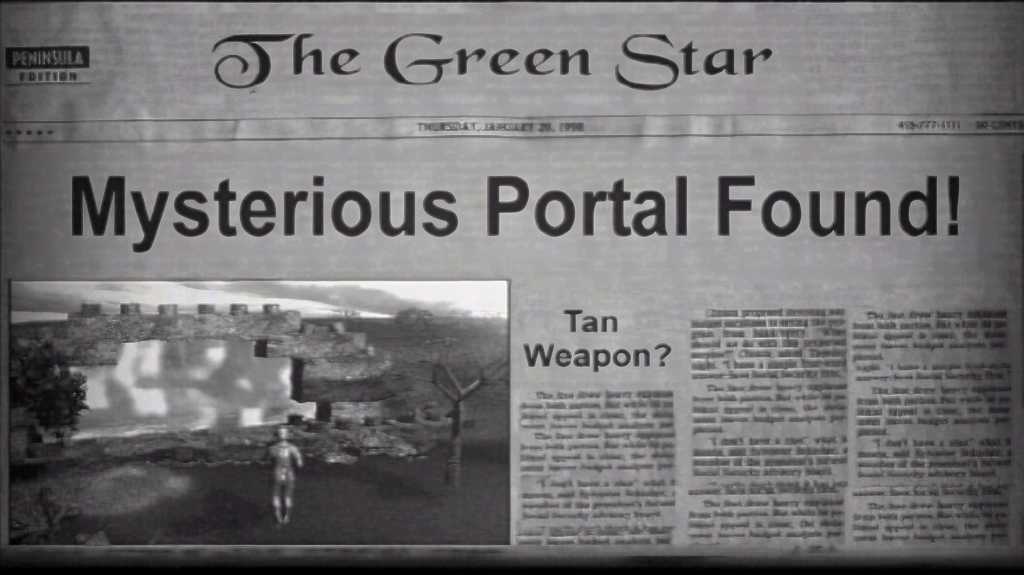
The Green Star
The Green Star 01/29/1998

Indeed, Army Men defied easy classification. It was part shooter, part strategy, part parody… a digital sandbox that reimagined childhood battles through the eyes of living toys. Beneath the surface, it captured something universal: the creative spirit of play itself.

From Sarge’s Heroes to the ever-expanding Toyverse, the legacy of those little plastic soldiers continues to march on.

Army Men PC inside
Sources for this article:

Original source: Retro Gamer (2019), “The Making Of: Army Men” by Hareth Al Bustani.
https://www.pressreader.com/uk/retro-gamer/20190516/281672551382117
Edited and adapted for armymen.com.ar

Sarge’s Hero. We talk with Michael Mendheim. By Dean Austin ign64.com Sep 24, 1999 / Jun 20, 2012

Original source

https://ign.com/articles/1999/09/25/sarges-hero

IGN64 talked with Michael Mendheim, Creative Director on Sarge’s Heroes, about the game & the industry.

IGN64: How did you get into the industry and what were the first titles you worked on?

Michael Mendheim: I started in advertising and eventually became a freelance illustrator. I got involved in the industry by designing and painting box covers for video games, that led to character design and eventually game design. The first title I ever designed was Fester’s Quest (NES). The game was a hit and I decided creating and designing video games was incredibly satisfying and fun, so I started a company that specialized in character and game design. I had a small team and we designed numerous games from Tazmania (SNES) to the Mutant League Series (Sega Genesis).

IGN64: What was your most satisfying product to work on and why?

MM: Tough question since I have enjoyed the majority of products I’ve worked on. I can’t pick one but I can pick my 3 favorites.

1). Mutant League Football (Genesis):

This product was a dream for me because I love football, mutants, and carnage. Every aspect of this game was fun to work on from character and field design to testing. The game was quite successful and spawned one of the first video game animated television shows and a toy line.

2). BattleTanx (N64):

This was the first product I designed at 3DO. Trip Hawkins spent a lot of time working with me on this product. The team was great and incredibly talented, our Technical Director Robert Zdybel bent over backwards for the designers. We finished the product from start to finish in under a year. It was touch and go there for a while but the product came together over the last two months. I remember having to plead with the team to stop playing it so we could finish it.

3). Sarge’s Heroes (N64 / PSX):

This game is wonderful to work on because of the dynamic character design and overall strength of the brand. The development teams are probably the hardest working and determined people I have ever worked with. The Technical Director on the N64, Dan Geisler is a God. Bob Smith is the Technical Director on the PSX and he is a Gods’ God. It’s a very good feeling to be working on a product that you know has the potential to be a big hit and you are being supported by strong engineering, strong art direction, and strong marketing.

IGN64: Please tell us the story for Army Men: Sarge’s Heroes.

MM: General Plastro and his evil Tan Army have discovered mysterious Portals. These portals offer passage to an alternate reality, a dimension that holds the secret to ultimate power. General Plastro is currently in possession of the Portals and has sent his soldiers through them to find new weapon technologies which, when brought back to the plastic dimension, can be used to destroy the Green Army.

Fortunately, for the Green Army it has Sgt. Hawk, aka “Sarge,” a one-man wrecking ball, trained and guided by Colonel Grimm to be the leader of the most elite squad in the Green army… The Bravo Company Commandos. The Tan Army is now in possession of the most diabolical weapons ever created and General Plastro has mounted a full-scale attack on the Green Nation. With the capture of his entire squad and Colonel Grimm’s daughter Vikki, Sarge has a one in a million chance to save the Green Nation from the clutches of defeat.

One of the first weapons of mass destruction General Plastro’s forces bring back is a giant magnifying glass. Needless to say, General Plastro loves the smell of burnt plastic in the morning! One of the coolest weapons of Plastro’s army, is the dreaded “V-Bot,” which is a toy robot that comes to life once it is brought back from “Our World” into “Their World.” Any inanimate plastic object that is brought back (using the Portal) from “Our World” into “Their World” becomes animate.

IGN64: What did you learn from your experience of making the first Army men?

MM: First and foremost, Sarge’s Heroes is not a sequel to Army Men 3D it is a line extension from the Army Men brand. Army Men 3D is about plastic army men waging real combat, it is a game of tactics and gritty combat and it does it better than most. Sarge’s Heroes is a much lighter and funnier game, it is a character (Sarge) -based action game with an entertaining and compelling story that evolves from mission to mission.

I was not involved in Army Men 3D (PSX) but I thought the team did a very good job. The three main areas where we wanted to differentiate ourselves from Army Men 3D:

Real world environments:

We wanted to take the game player into our world environments like the kitchen, bathroom, and backyard sandbox. The thought of kitchen counter warfare sounded like an absolute blast and it was something that hasn’t really been done before in an action shooter.

Animations:

Nina Stanley (the game’s Art Director) and I set out at the start of this project to focus on the character animations. Our goal was to create some of the finest animations ever seen in a video game. We wanted to bring Sgt. Hawk to life. All the animations in Sarge’s Heroes are hand drawn and the reason for this was to allow the artists to interpret motion and to exaggerate gesture, in the end the character’s personality comes to life through motion and artistic expression. This cannot be achieved using motion capture.

Plastic soldiers that look plastic:

Another goal that we set out to achieve was to create an effect that would make Plastic Army Men look like plastic. Dan Geisler, the game’s Technical Director, came up with a technique for mathematically approximating the effects of light reflecting on a plastic material surface. He calls it Plastosheen (Plast O Sheen).

IGN64: How many levels and/or missions are in the game? Can you describe some of the missions and the environments they take place in?

MM: There are 14 missions in Sarge’s Heroes, 7 that take place in “Their World” and 7 that take place in “Our World.” We also have 7 multi-player levels, and of course this wouldn’t be an Army Men game without Boot Camp.

When playing in “Their World” the player will experience everything from treacherous mountain terrain to arctic wastelands, forests, towns, and heavily defended enemy army bases. When playing in “Our World” the player will experience giant terrains that take place on the inside and outside of one particular house in Suburbia, USA. The player will experience warfare like never before as he fights the dreaded Tan Army in the backyard garden (complete with giant insects and flowers), the living room, and the kitchen. The designers of Army Men: Sarge’s Heroes have even included a massive bathroom.

IGN64: Could you describe the game engine?

MM: The engine was built by a very talented corp. of engineers, led by industry-vet and Technical Director, Dan Geisler. The engine and its supporting technology was built to fully accommodate the ambitious Sarge’s Heroes design. Some of the challenges were to build an engine that would support very large worlds with a fast frame rate and an incredible viewing distance. Missions like the Living Room and Bathroom well demonstrate this success. Additionally, the engine supports a high-resolution mode with the Expansion Pak. Sarge’s Heroes also shows all characters in a 3rd person perspective in 4-player deathmatch, which is rare.

IGN64: How would you describe the player view and how does the interface work?

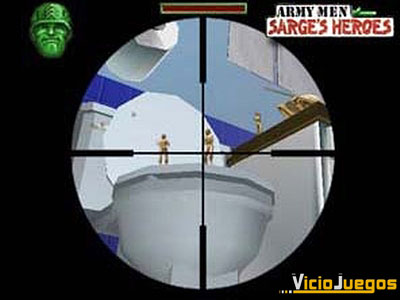
MM: The game is primarily played from a third-person, over-the-shoulder perspective. The camera does have some dynamic elasticity to it and allows the player to view Sarge from the front. A quick tap of the R-Button, resets the view to directly behind the character. Another view we have comes via the sniper lens. While in this view, the player can survey the land and manually zoom in and out to take out enemy troops from long range. It’s a very effective method for the more patient player.

The interface was truly designed with the action gamer in mind. It is very intuitive and easy to navigate. Here we allow the player to choose items like resolution (w/Exp. Pak), view type (normal or letterbox) as well as configure their controller to their liking. Players should also find the multi-player setup very user-friendly. Many players will get well into game play without ever reviewing the manual.

IGN64: We understand that the game features both two player and four player modes. How do these work from both a game play and graphical standpoint?

MM: Sarge’s Heroes actually supports two, three or four players in a competitive capacity. We have also included a Family Mode that was introduced in the original BattleTanx game. This mode levels the playing field between all players. It removes an oft-found intimidation between parents and kids by presenting them with startup weapons and a more forgiving difficulty level. This has proven successful and has been well received by the customers. From a graphical standpoint, we opted to display all the characters in a 3rd person perspective. While this presents its own challenges, we felt that this was the best way to introduce the various characters and get players to connect with them. Watching the Sarge’s Heroes characters battle it out in the Bathroom or Living Room is a sight to behold. The sense of scale and heavy firepower kick butt!

IGN64: Can you play multiple characters?

MM: You can select from a variety of different characters (Sgt. Hawk, Vikki, and Plastro) to play as in a multi-player game. Since Sarge’s Heroes is a character-based game we spent a lot of focus on the character development, below are the stars of Sarge’s Heroes:

SGT. HAWK:

Sgt. Hawk is Bravo Company’s unquestioned leader. He’s an experienced Army Man who has seen it all – gritty battles over endless sandbox dunes, frozen conflicts across the icy wastes of unshoveled driveways, and the hi-tech warfare of magnifying glasses held aloft by the hands of cruel titans. As a dedicated leader, Sarge is highly respected by his squadron and by Colonel Grimm.

COLONEL GRIMM:

Colonel Grimm is a gruff, tough veteran of the old days when most soldiers were wood or tin. He’s a lifer as were all the men in the Grimm family who made it to Colonel status. The Colonel has suffered numerous tragedies fighting the Tan Menace and from these tragedies, Grimm has become a solemn man who never smiles. Colonel Grimm is the master tactician of the Green Army and Sarge’s mentor.

VIKKI:

Vikki is a beautiful, sexy, independent, hard working young woman whom is one of the top reporters for the Green Army’s newspaper, Green Star News. Raised solely by the Colonel, she has spent her whole life as an army brat traveling to different military bases around the world. Since Colonel Grim was Vikki’s only role model, Vikki followed his every move and grew up to be a very tough, confident, and strong woman.

PLASTRO:

General Plastro is an evil and ruthless man who has no problem slaughtering hundreds of Green Army men with his newly acquired barbaric weapons. He is a highly intelligent war tactician as he leads his Tan Army to victory over the Green Army. Plastro has won the support of several other nations, although they had no choice since he conquered them. Another sign of his genius is discovering the “Alternate World” (Our World) and the Portal devices that can transport him there. From this Alternate World, Plastro has exported powerful weapons that he enjoys using on Green Army Men. The only positive attribute of Plastro is that he has a dry and evil sense of humor.

Sarge’s Squad consists of 5 soldiers that are based on some of the classic Army Men poses (Bazooka, Mortar, Minesweeper, Flame-thrower, and M-60 Machine gunner). As Sarge rescues these squad members over the course of the game, each of their weapons become a permanent fixture in Sarge’s inventory, increasing the firepower that accompanies Sarge at the start of each mission.

BRAVO COMPANY:

RIFF:

Riff is the squad’s Bazooka man and Sarge’s best friend. Riff is every inch a soldier, yet retains the musical chops and coolness of a Blues musician. Riff wails some really cool Bazooka Blues for the enemy’s heavy armor.

HOOVER:

Hoover may be a gawky, geeky-looking beanpole with more ribs showing than a 4th of July barbecue and an Adam’s apple you could hang a helmet liner on, but the squad depends on him nevertheless. His depth of concentration and smooth fluidity of movement made him a natural to either man a minesweeper or run a floor buffer. He chose the minesweeper since the squad didn’t need a janitor.

SHRAP:

Shrap is the Squad’s Mortar Man. He used to pull a lot of shore patrol duty, and became a way cool surfer dude as a result. Later he gave up the big waves for the field artillery.

THICK:

Thick is basically an educated trigger finger attached to a nearly brain dead soldier. His name describes his skull, his neck, and the layer of lead he lays down with his M-60 machine gun, cutting down tan troops like a weed whacker does dandelions. He has the body of an action figure guided by a mind no brighter than a penlight.

SCORCH:

You’ve got to be a little nuts to be made out plastic and still love fire (Scorch is a lotta nuts). Sarge gave him custody of the flame thrower (he was setting fires around camp, anyway) so he could torch tan soldiers until they bubble. He creeps out the rest of the squad by sleeping in a book of matches instead of a sleeping bag.

IGN64: You mentioned the giant magnifying glass weapon in your earlier answer. How many weapons types are there in the game and what are some of their characteristics?

MM: There are 12 different weapons in Sarge’s Heroes:

M-16 Assault Rifle: All-purpose, Sarge’s main weapon.

Bazooka: Great for destroying tanks and helicopters.

Flame Thrower: The most feared weapon of plastic soldiers.

Shotgun: Lays out a circle of buckshot.

M-60 Machine Gun: Heavy machine gun that puts out a tremendous amount of lead.

Sniper Rifle: Everyone’s favorite, allows players to zoom in on enemies.

Grenades: The animation of Sarge pulling the grenade pin with his teeth is awesome.

Grenade Launcher: My personal favorite, the grenade launcher is a trajectory weapon that is incredible fun when used with the precision targeting mode.

Mortar: Player uses a cursor to target the mortar. This is a long-range weapon.

Mine-Sweeper: Not as exciting as a grenade launcher unless of course you’re in a minefield and you don’t have one.

Mines: Great for multi-player.

C-4: This weapon has a time delay and the largest blast radius in the game.

IGN64: You mentioned the RAM Pak earlier. How are you taking advantage of it?

MM: We use the Ram Pak for a high-resolution mode. In this resolution, the player will find that the characters, weapon effects and environments become much sharper. However, the N64 hardware does such nice filtering, so players without this peripheral are still in for a treat.

IGN64: Switching gears, what’s the most overlooked title you’ve ever seen in the game industry and why?

MM: There are many good titles that have been overlooked, but the one that I always think of first is 3DO’s Uprising (PC or PlayStation). Uprising had all the depth and satisfaction a game could ever deliver, with solid graphics and game play, but it didn’t sell in the market. Another game that I enjoyed a lot was Warhawk, one of the first games out on the PlayStation. It was an innovative flight sim/shooter with elegantly simple level designs. Like Uprising, Warhawk deserved to be played more than it was. But the classic overlooked title would have to be Dune II on the PC and Genesis. Some people think that Command and Conquer started the RTS trend, but in fact, Dune II did 90% of what C&C did years before.

IGN64: What usually causes the most lost sleep during a project?

MM: Figure the team spends 16 to 18 hours at the office during the last two or three months of the project (some people don’t go home at all, we had one Director who camped in the building for a month). Everybody is doing the best they can, they are giving 110%, but they are tired and sometimes irritable. They are sacrificing their lives and families for the project. When they finally close their eyes and try to sleep, their brains are wired and moving at 100 mph trying to answer a hundred different unanswered questions all relating to a single question, how to make the game better.

IGN64: What’s the weirdest thing that happened during the making of Army Men?

MM: I came into the office one day and sat down to work and something was wrong. Finally it dawned on me that all my plastic soldiers that decorate my cube were missing. I went to ask a team member if he had seen them and he realized that all his soldiers were missing too. The entire team had their soldiers taken! We then went to investigate and found out that every person in the entire company had their soldiers taken and there were none to be found anywhere (3DO usually has plastic soldiers littered all over the place on the floors, in cubes, etc). A few hours later a ransom note was E-Mailed to everyone in the company, some diabolical fiend was holding them hostage! Needless to say, it was April Fools day and someone pulled off quite a gag. In the end we got our boys back safe and sound and we are planning our revenge.

IGN64: Given carte blanche to build any game you wanted, what would it be?

MM: Sarge’s Heroes with hand to hand combat. Sarge is a very physical guy and it would be a blast to see him tear into those Tan soldiers with an advanced fighting engine running the show.

IGN64: And lastly, who do you respect most in the industry and why?

MM: Certainly from a design stand point Shigeru Miyamoto attains the highest respect from me. His games are pure magic that mesmerizes players of all ages, races, and cultures. His contribution to the video game industry is beyond words. The attention to detail that Mr. Miyamoto delivers to every level shows his passion and dedication.

Another person who awes me is Trip Hawkins. The knowledge that the man possesses is inspiring. Not only does he know game design, product development, marketing, sales, finance, operations, etc. but he will always take the time to sit down and discuss a problem or idea. Trip’s vision is crystal clear and way ahead of its time, if you want to get a sense of where the industry will be 10 years from now all you need to do is listen to Trip.

Trip Hawkins, The 3DO Company and other interviews: Army Men highlights!

Original sources:
  1. https://futuregamez.net/3do-interview

1) Trip Hawkins 3DO Interview, September 23, 1999 on futuregamez.net by David Warner ~ Dreamcast Australia

The games industry can be tough at times. Trip Hawkins should know. He built Electronic Arts from nothing to become the largest gaming company in the world. Several years later he left Electronic Arts to form the 3DO company. 3DO designed a console architecture which was developed by Panasonic. Unfortunately the system lacked software support and coupled with a high price ($US700) the system died soon after the Playstation’s and Saturn’s launch. After another failed hardware bid with M2, Trip Hawkins decided that 3DO was better off as a software company. Once again Trip is aiming to create a major software company, and the games so far have proven themselves as world class titles. I thought it would be nice to have a chat to one of the most powerful men in the gaming industry.

Here are the Army Men highlights from this interview you can read in this link: https://futuregamez.net/3do-interview

Trip Hawkins 3DO Interview, September 23, 1999 on futuregamez.net by David Warner ~ Dreamcast Australia
Young Trip Hawkins
Young Trip Hawkins at 3DO

(…)

– What are your thoughts on technology in regards to gaming and gameplay?

Trip: My mission at 3DO is to turn people into lifelong gamers. That’s why I have been making games for over 25 years. That’s also why I have on occasion in the past made forays into the hardware side of the business when I felt it needed to be moved forward in the interest of gamers.

Sony and others have done a great job moving the hardware to where it is now. It’s very exciting to see the capabilities of these systems getting where they are. The medium is the message, after all. I have always felt that great games need to be simple, hot and deep. That’s how I built EA and EA Sports in particular.
And that’s the same philosophy with 3DO’s game brands like Army MenBattleTanxHeroes of Might and Magic, and High Heat Baseball.

(…)

– Can you explain a little about your major 3DO games titles?

Trip: Army Men is a best-seller because people are emotionally enthralled with the idea that some of their favorite toys have come to life in a way that lets their imagination run wild. Our new lines, Army Men: Sarge’s Heroes and Army Men: Air Attack, add new dimensions to this fantasy world. The first is a terrific character adventure action game with a great story. The second is a charming helicopter action game. (…)

(…)

Would you like to see any other 3DO games ported to the Dreamcast?
Trip: Army MenHigh Heat Baseball, and BattleTanx are great brands that would do well on any platform.

Interview with Nick Earl, Army Men Producer – “Army Men Official Strategies & Secrets” Book by Brett Skogen (Jan 1, 1998 by Sybex Inc.)

It’s no easy feat to develop a best-selling computer game. With the gaming community’s insatiable appetite—always wanting better graphics, special effects, story, and, most importantly, gameplay—it takes a dedicated team of professional producers, writers, programmers, graphic artists, and others to put a finished game on the shelves.

Army Men is no exception. With an estimated budget of 1.5 million dollars, over 20 dedicated people spent two years of their lives making this game. The results are definitely worth it though—this game is one hell of an adventure!

One of the key members of the Army Men team was its producer, Nick Earl. Nick is currently an Executive Producer at 3DO, where he oversees the development of Army Men and BattleTanx products. He’s been with 3DO for over five years, starting out as one of the original 3rd Party Evangelists. Later, he founded and managed the Affiliated Label and Licensing Programs at 3DO, before finally climbing to the producer ranks at one of the company’s studios. As the producer of Army Men, Nick had the responsibility of managing the day-to-day concerns of the project, while keeping the development team in focus and motivated. Nice work, Nick, you did a great job.

Fortunately, Nick was able to spare a few minutes to answer some questions as he put the finishing touches on the game.

Nick Speaks: Q & A with the producer

From the start, what was the vision for Army Men? What did you want to achieve?

Nick: There were a couple of inspirations for Army Men. Back when we started thinking about doing a military game, we were playing a lot of Return Fire, developed by Silent Software. We all loved the game, but yearned for better enemy AI and the ability to give orders to intelligent squads. So, the first vision was an action/strategy game that would give the player depth. But the real and enduring vision developed when we were laying out missions with the little plastic green and tan soldiers one afternoon. Suddenly it hit us to do the game based on plastic army men! As we started to build the design, it gained momentum, and pretty soon we knew we were onto something big.

Where did you get your inspiration for Sarge?

Nick: This was really Keith Bullen’s (the designer of Army Men) idea. He realized early on that the player would want to bond and identify with a personality rather than just move plastic armies around a battlefield as is usually done in a strategy game. With the introduction of the plastic concept, the design really started to evolve from a strategy game toward immersing the player in a fantasy world created in the mind when playing with these great little toys. We knew right away that we wanted to have all of the classic poses, weapons, vehicles, and, most importantly, special effects, such as melting a Tan soldier into a pool of tan plastic with a flamethrower! Many other things evolved over time.

For example, at first the concept was to have Sarge ferry his units to different parts of the world and then issue orders to his troops, who would go off and carry them out. After talking to the magazine editors and focus groups, we realized that the player would want to bond with Sarge and his immediate world by being the one who gets to do all the destruction!

Therefore, we made Sarge tougher and able to carry and use all of the classic weapons. And most importantly, we gave Sarge the persona of a classic soldier. Now, we had what we thought was the best design for a game based plastic soldiers, one other evolution of Army Men was to use the MovieTone news concept. During their time, those clips did such a good job of making the war seem heroic, but not bloody and tragic. The nature of plastic physics lends itself perfectly to this notion—lots of action, heroism, and challenge, but none of the nasty and sickening effects of war.

Obviously, your team spent some time renting WWII movies. What movies were most inspirational?

Nick: Some of the mission objectives are loosely based on the classic WWII movies such as Bridge over the River Kwai, The Great Escape, and Kelly’s Heroes. There is something so dramatic yet clean about these movies—we thought that Army Men worked well within this theme. After all, plastic army men were invented right after WWII.

What’s the origin of the game’s engine? Did you modify an existing one or create your own?

Nick: We built one from scratch. The Technical Lead was Nicky Robinson, who, with the help of several engineers, built a great engine that allows this highly detailed art to come to life.

What has been the most difficult part of bringing Army Men to life?

Nick: Capturing the exact positions and then transitioning them into fully animated sequences. For instance, having a flame thrower start in the classic pose, then run with his weapon, fire it while running, dive, roll, and then move right back into the classic pose. We also spent a lot of time and energy balancing each mission to get the right combination of action, strategy, and intrigue. This is what really brings Army Men to life, because each mission is so fun and compelling that you keep coming back for more—you really feel like you are Sarge blowing up bridges, shattering Tan enemies, and liberating your Green troops from prison camps.

What else does Army Men offer the gamer?

Nick: We like to think that we will give the player a compelling, tough, and heroic character (Sarge), thrilling and humorous plastic special effects, absolutely beautiful art and animations, and an opportunity to really immerse oneself in those great battles we all played out in our backyards when we were kids. We see Army Men as a great blend of action and strategy, and of serious missions sprinkled with humor such as tanks flipping over to reveal hollow underbellies!

What’s your favorite strategy/tip for getting through the game’s missions? For a multiplayer game?

Nick: Wow, there are many. I think the best advice is to be methodical and thoughtful as you progress. There are numerous times that you think you have the mission solved when all of a sudden a Tan tank appears out of nowhere to shatter you! By thinking ahead and planning, you can neutralize such events with a few strategically placed mines or a mortar. I also recommend dropping to the prone position and rolling when in a fire fight. You are less vulnerable, and your chances of hitting the enemy are increased. For a multiplayer game, my favorite strategy is to hide in trees, and when an enemy runs by, melt him with the flame thrower before he knows what happened!

Any Easter Eggs in the game you want to confess to?

Nick: I don’t want to give much away, but after calling in air support a few times, you just may be surprised! I also recommend checking out the lake in the Alpine campaign’s Out of the Mountain mission. You will get a kick out of what lurks there. The best one by far, however, is the final-win cinematic—it has a really great twist.

On a personal note, what are some of your favorite things?

Nick: My favorite game, other than Army Men of course, is probably NHL Hockey ’98. My favorite musical groups are Pink Floyd, Led Zeppelin, U2, and the Grateful Dead. If I had to pick a favorite song, it would probably be “Comfortably Numb” by Floyd or “Unforgettable Fire” by U2, depending on my mood. As far as movies, my two favorites are Platoon and The Graduate.

What’s your next project after Army Men?

Nick: Army Men! I am doing an Army Men sequel for PC, as well as entirely new designs for PlayStation and Nintendo 64.

Thanks, Nick, we all look forward to Army Men sequels in the near future!

About the autor of “Army Men Official Strategies & Secrets Book”

Brett Skogen has worn many hats in the gaming industry: reviewer, strategy guide editor, marketing specialist, and producer. Brett is the author of Hexen II Official Strategies & Secrets and co-author of Final Fantasy Tactics Battle Strategy Guide, both from Sybex.