Category Archives: News & Press

Army Men TV Tropes

What is TV Tropes?

TV Tropes (https://tvtropes.org/) is an online wiki that catalogs and analyzes “tropes”, the recurring narrative devices, patterns, or conventions found in various media, including video games, films, TV shows, books, and comics. Launched in 2004, it started with a focus on television but now covers all forms of fiction. Users contribute to create a dynamic database of tropes with examples and explanations.

What is a “Trope”?

A trope is a storytelling tool, like a cliché or pattern, used to convey ideas or structure narratives. Examples include the “Reluctant Hero” or “Evil Overlord.” TV Tropes documents these, showing how they appear across media, such as “Color Identified Factions” in *Army Men*, where factions are defined by colors like Green (good) and Tan (evil).

Purpose and Use

TV Tropes helps fans, writers, and creators understand narrative structures by breaking down stories into their building blocks. It’s a resource for analyzing how tropes are used or subverted and inspires creative storytelling. For this *Army Men* project, it provides detailed trope lists that can be considered when shaping the Toyverse.

Cultural Impact

Popular among fans and narrative enthusiasts, TV Tropes is known for its engaging, sometimes humorous style and interconnected structure, often leading users down a “rabbit hole” of related tropes. It’s a valuable tool for studying storytelling patterns and ensuring unique content creation.

This series has examples of:

    • Skilled Aviator: Captain William Blade. He’s basically the commander of the entire Green Army air force.
    • Increased Action Sequel:
      • Army Men was a real-time tactics shooter in an isometric view, that often saw you having to plan your next move carefully, as some areas were so fraught with enemy soldiers venturing into them would be suicide. The next game lessened the need for this, as little things, like having to account for soldiers hearing incoming mortars was removed, and rarely was it not beneficial to clear a map of enemies. Before long, the series shifted into a third-person shooter.
      • Zig-zagged regarding the third person shooter games. The “World War” series leans on the tactical side, with Team Assault in particular dramatically reduce soldier’s health, both you and your enemies side, while Sarge Heroes is often about charging, shooting, and dodging as lone soldier Sergeant Hawk, and Air Assault features a single helicopter force as the protagonist.
    • Spotlight Moment:
      • The Game Boy Color port of Sarge’s Heroes 2 (which functions as a completely different game compared to the console versions), Riff, Scorch and Vikki are the only playable characters, and they even have their own personal vehicles to ride.
      • Hoover also has a level dedicated to himself in Army Men RTS where he proves to be actually pretty good at leading a team.
    • Friendly Villain: General Plastro. He may be the bad guy, but at least he’s honest enough to admit it, as well as to compliment the enemy when they do well. This is best shown in the opening cutscene for the final level of Sarge’s Heroes, where he and several Tan troops get the drop on an empty-handed Sarge, only for Sarge to take out the troops by kicking a block at them. Plastro genuinely compliments and congratulates Sarge on his cleverness, admitting he didn’t even see it coming; however, when Sarge asks why Plastro doesn’t drop the gun and fight him one-on-one, Plastro straight up tells Sarge it’s “because I’m the bad guy.”
    • Spray Can Fire Thrower: An aerosol is one of the weapons you can get in the second game.
    • Time Period Mishmash: The game’s weapons and vehicles are a combination of those from World War II and The Vietnam War. For instance, the standard rifle is based on the M16 and the standard tank is based on the M48 Patton, both from the Vietnam War era, alongside Huey helicopters. However, there are also propeller fighter planes, half-tracks, and mass paratrooper drops that were either not used or phased out by the Vietnam War.
    • End of World Record: The Colonel’s final report before losing contact in Sector C-4 in the second game.
    • Cool but Inefficient: Hero Units in RTS. They do more damage than their normal counterparts and can usually take more punishment than them, but the lack of healing means that you need to be careful in how you use them, lest you lose out on a strong unit for the rest of the mission.
    • Tough Team: Bravo Company is apparently feared by the Tan army. In Green Rogue, the mere information that Bravo is going to be out of action for several weeks recovering from surgery is enough for the Tan to decide to launch an all out assault against Green positions, reasoning that Bravo was literally the only thing that could have stopped them.
    • Terrible Leader: Plastro, from punching out underlings that bring him bad news to actively plotting betrayal against allies for little reason other than that’s what bad guys like him do.
    • Villain Victory: Malice gets what he wanted in the end, to make Sarge suffer and destroy everything and everyone that he valued. The only mitigation is that Sarge is able to take revenge and, by the time it is all over, ultimately seems to regard Gooding with more pity than anger.
    • Main Antagonist: General Plastro for most of the series. Unless noted below, Plastro is often the overarching villain who is also never directly fought.
      • Major Mylar for Army Men 2.
      • The alien leader in Toys in Space.
      • Colonel Blintz in the RTS game.
      • Lord Malice in Sarge’s War.
      • Major Malfunction in the game of the same name.
    • Witty Post-Kill Remark: Blowing up tents in one level in Army Men 3D will cause Sarge to quip “Knock knock.”
    • Infinite Ammo: Most of the games tend to give your starting weapon infinite ammo, sometimes with a drawback (the M16 in the N64 Sarge’s Heroes games has a very slow rate of fire, the PS1 Sarge’s Heroes 2 makes it overheat when fired too much) and sometimes with an ammo-guzzling upgrade available (the BAR in the original two games, which trades the infinite ammo for a much higher rate of fire).
    • Scare-Induced Incontinence:
      • Implied with Hoover immediately after regrouping with him in Sarge’s Heroes:

      Col. Grimm: Do you think he can make it back to the landing pad on his own?

      Sarge: That’s a negative sir; moisture is imminent.

      Hoover: Aw, geeze!

      • A “You Lose” scene in Toys In Space depicts a Green soldier surrounded by Tan troops laughing at him while dropping his weapon and wetting himself.
    • Reinforcements Arrival: Air cavalry, to be exact. This is the role that Capt. Blade’s squad plays. He even wears an old cavalry hat.
    • Proud Evildoer: Plastro, especially in Sarge’s Heroes, knows he’s the bad guy, and he wouldn’t have it any other way. Lampshaded all throughout.

Sarge: Plastro! Why don’t you drop that gun and face me like a man?

Plastro: Because I’m the bad guy, that’s why!

Plastro: Burn it all, starting with [Bridgette’s] blasted Blue homeland.

Vikki: Plastro! How could you?

Plastro: Well, somebody’s not paying attention. I’m the bad guy!

    • Important Later Character: In Sarge’s War, Major Gooding, who is mentioned all of one time before the reveal.
    • Prove Innocence: Blade is forced to do this, after the actions under pretend traitor, and does it by delivering much needed supplies to besieged Green forces, and helping either Sarge or Vikki take out a Tan base.
    • Possessive Jealous Female: Bombshell really doesn’t like it when Capt. Blade flirts with Vikki.
    • Icy Marksman: Bullseye, the Bravo Company sniper introduced in RTS. He’s even called the ice man in the game’s manual.
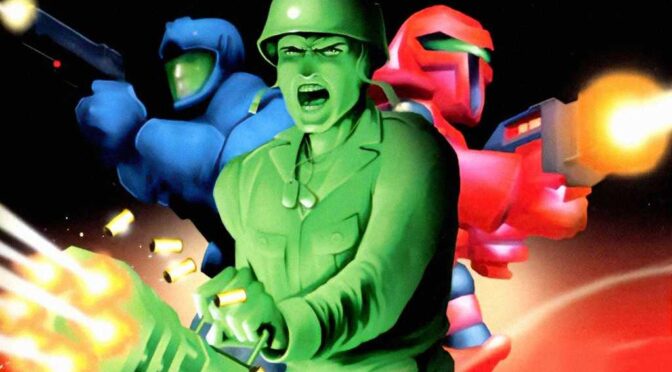
    • Color Identified Factions: Every faction across the series. The four most common are Green being good guys, Tan being evil, Gray being, well, gray (in some games they’re allied with the Greens, in others they’re against everyone), and Blue being spies, typically allied with the Tans.
    • Resource Management System: Army Men RTS, natch.
    • Story Restart:
      • The last two games, Major Malfunction and Soldiers of Misfortune, have an all new plot and characters.
      • Sarge’s Heroes was a lesser case – it’s still the same setting, with the same war and even the same bad guy, but all of the other characters were newly-introduced; even Plastro had his characterization played up more compared to the slightly more serious villain he was in the original two games.
    • Scary Roaches: Starting with Army Men II, they start appearing in the real world. Due to the limited graphics of the PlayStation games, they can be downright horrifying.
    • Grimmer and Harsher:
      • Sarge’s War, to a large extent. Sometimes borders on parody of the gritty war hero type film.
      • Before that were the World War games, which played war is hell devastatingly straight.
    • Dry Wit Commentator: Sarge in the Sarge’s Heroes games, when he isn’t being a dutiful soldier. Captain Blade meanwhile is in snark mode 24/7.
    • Aerial Attack: One of the power-ups invoked from time to time.

Sarge: This is Sarge, I need an air strike, over.

  • Programmer Prediction: In the mission where Capt. Blade has to pick up a squad led by either Sarge or Vikki to blow up a radar station, picking Vikki while Bombshell is your co-pilot causes her to get really jealous, to the point she will actually ask you to pick Sarge.
  • Craven Traitor:
    • Hoover, the team’s minesweeper, looks like he wished he called himself a conscientious objector, and will retreat in RTS if he takes even a little damage.
    • Though Plastro has his moments of villainous bravery, suicidal or otherwise, when he’s captured at the end of Sarge’s Heroes 2 and Sarge threatens to punch his lights out, his reaction is to shout “not the face!” and immediately faint.
  • Depressing Conclusion: Army Men: Sarge’s War is pretty much this for the whole series. Bravo Company, Grimm and Vikki are melted, Lord Malice was Major Gooding all along, and Sarge feels empty inside after killing him.
  • Sudden Death Offscreen: Them, if you may. The aforementioned Sarge’s War has every named character and series mainstay since Sarge’s Heroes, except for Sarge himself, killed off by an explosion hidden in a peace monument orchestrated by Lord Malice, the new villain.
  • Bland Reaction: Tina Tomorrow is not the most expressive person.
  • Last Words of Affection: Vikki’s last words to Sarge in Sarge’s War.
  • Initial Entry Oddities: The first game lean towards a top-down tactical shooter where your soldiers can easily die. Furthermore, the tone is more sombre and the plot is minimal, and the sequel hook ending where your soldiers enter the real world is treated as a surprise. The second game took the “toy soldiers fighting in the real world” plot and ran, becoming a denser and wackier increased action sequel as the soldiers fight other toys and insects over kitchen counters and gardens.
  • Laser Armament: The aliens in Toys In Space use them. Sarge can even find a laser rifle, an upgrade to the auto-rifle and Vulcan gun.
  • Protect Task: These have been around since the first game, they range from barely an escort (being able to just order your men to hold while you kill everything along the way and/or the VIP being almost as badass as Sarge) to almost controller-breaking frustrating.
  • Villainous Cackle: Plastro is a fan of this, even when so badly injured from being used as a literal chew toy, twice, that he can’t stop coughing every time he tries.
  • Hero to Villain Switch:
    • Colonel Blintz in the RTS after quite literally losing his mind.
    • Major Gooding in Sarge’s War. He becomes Lord Malice after a mission where he is nearly killed and blames Sarge for leaving him behind, although Sarge couldn’t have known he was still alive given the amount of damage he took.
  • Alignment Flip-Flop: Bridgette Blue, and all of the blue nation really. They’ll work for whoever pays best, whoever isn’t trying to kill them, or even whoever currently suits their own agenda.
  • Imaginary Equivalent Society:
    • The Green Nation is Type I or “The Great” Eagleland.
    • The Tan Nation is a combination of common media belligerents such as World War II Nazi Germany, the Soviet Union, or Ba’athist Iraq, complete with something of a mix of Saddam Hussein (the face) and Fidel Castro (the name and build) as their leader General Plastro.
    • The Blue Nation is an analogue of the various French sides in WWII that works out as a villainous version of cheese-eating surrender monkeys – they have an extensive spy network, but they also work with the Nazi Germany analogue and are very quick to surrender.
    • The Gray Nation, in turn, ends up as a heroic version of the Vietcong, essentially North Vietnam’s guerrilla warfare expertise (usually) combined with the South’s loyalty to the USA analogue.
  • Pretend Traitor:
    • Captain Blade spends half of Air Attack 2 on the run, after being court-martialed and then breaking out of prison for his actions almost getting his wingmen killed.
    • Vikki pulls this briefly in Sarge’s Heroes after getting captured, as part of a honey trap.
    • Bridgette Bleu is revealed to be this in Sarge’s Heroes 2.

(Note: This modified version is based on the original content from the link below, with trope names rephrased and order slightly adjusted for originality while preserving all original information, quotes, and details intact. Please, consider check the original link below)

Sources for this article:

https://tvtropes.org/pmwiki/pmwiki.php/VideoGame/ArmyMen

How Marvel’s Missteps Mirror the Fall of Army Men: A Lesson in Creative Oversaturation

When James Gunn (now the creative head of DC Studios) was recently asked what he believed had hurt Marvel, his words were both honest and damning: “Too much content. Not enough planning. It killed them.” His remarks, aimed at the overextension of Marvel Studios in the wake of Avengers: Endgame, could just as easily describe what happened to the Army Men franchise in the early 2000s.

Back in the late ’90s, Army Men stormed the gaming world with a simple yet irresistible premise: toy soldiers brought to life in an imaginative, war-torn plastic world. The original titles stood out with charming aesthetics, quirky humor, and solid gameplay. But the publisher, 3DO, quickly turned that initial success into a production frenzy. From 1998 to 2003, they pushed out over a dozen Army Men titles—a pace that left little room for refinement or reinvention.

Back in the heyday of 3DO’s rapid-fire release strategy, even those of us in the The Army Men videogames channel were caught off guard. Titles arrived so frequently that not even the fans seemed fully aware of what was launching (or when). By the time a new game crossed our radar, it was often already out in the wild, too late. In an industry where annual sports releases were considered the norm, Army Men shattered expectations by flooding the market with an unrelenting stream of entries. No amount of pre-release buzz could keep up. The public wasn’t just underprepared: they were overwhelmed.

Much like Marvel’s recent deluge of films and Disney+ series, 3DO’s Army Men games began to feel rushed, repetitive, and disconnected. Without a clear long-term narrative or gameplay evolution, fans began to lose interest. By the time fresh ideas were needed most, the brand had burned out… and 3DO filed for bankruptcy in 2003.

James Gunn’s criticism of Marvel’s strategy (greenlighting projects without finished scripts and saturating the audience with underdeveloped content) perfectly echoes the pitfalls of 3DO. Both cases show how creative properties, no matter how beloved, can collapse under the weight of rushed schedules and corporate overreach.

The Lesson? Sustainability in storytelling matters more than ever. The audience craves meaningful worlds, not just more content. In the age of ever-growing universes (cinematic, gaming, or otherwise) the smartest path forward is one paved with vision, patience, and purpose. Part of what was missing in those years was the breathing room—a chance for the audience to anticipate, absorb, and get excited. Great franchises don’t just drop content; they build moments. But with Army Men, there was rarely time to prepare the public or give each title its spotlight. Without that crucial window to inform and engage players, even solid ideas were lost in the noise.

Fake Army Men images

The Truth Behind the Famous “In-Game Screenshots” of the First Army Men Games

There are phrases that have become part of gaming folklore. One of the most common (and persistent) is:

“It was from a beta version…” —said with the tone of someone convinced they’ve uncovered a hidden development secret.

But when it comes to Army Men, many of those promotional screenshots were not beta versions of anything. In fact… they weren’t even screenshots.

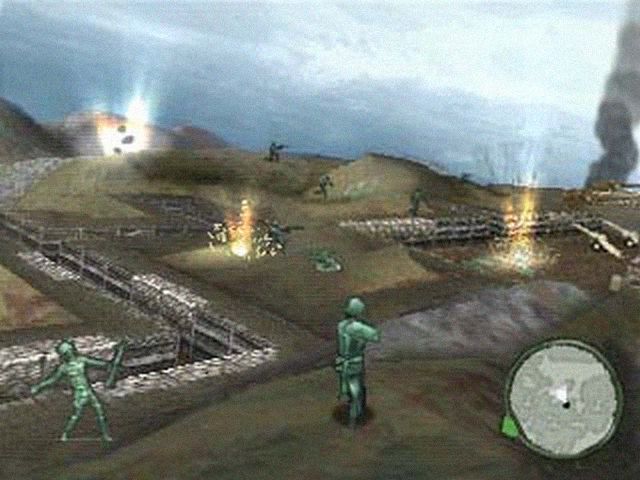
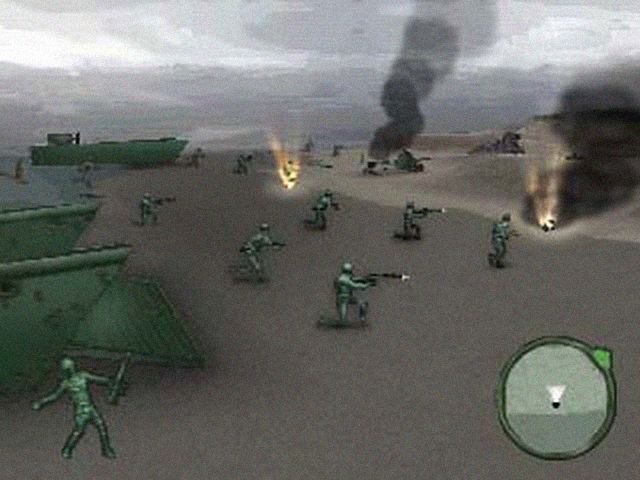
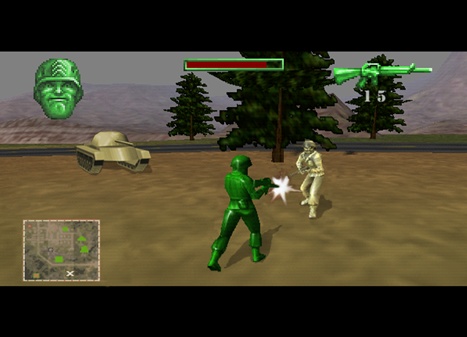
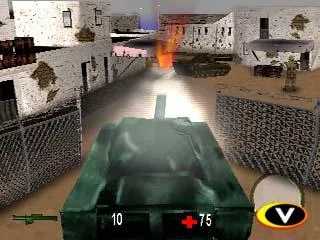
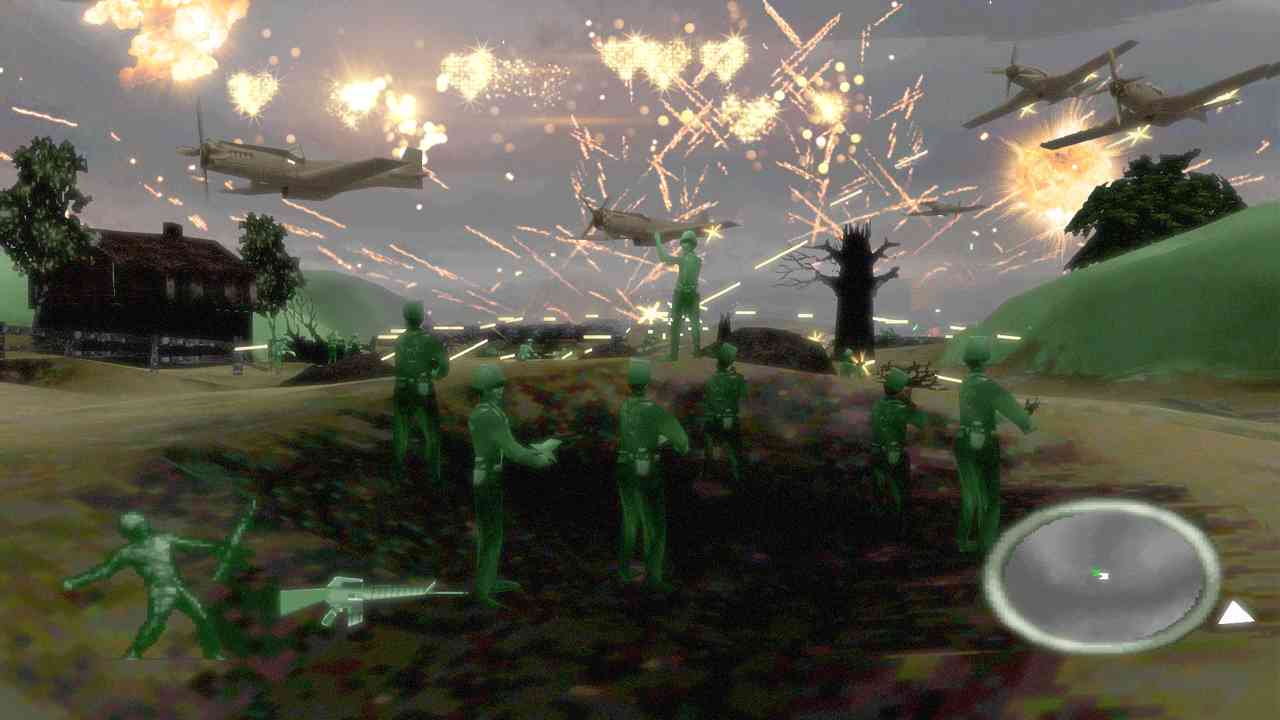
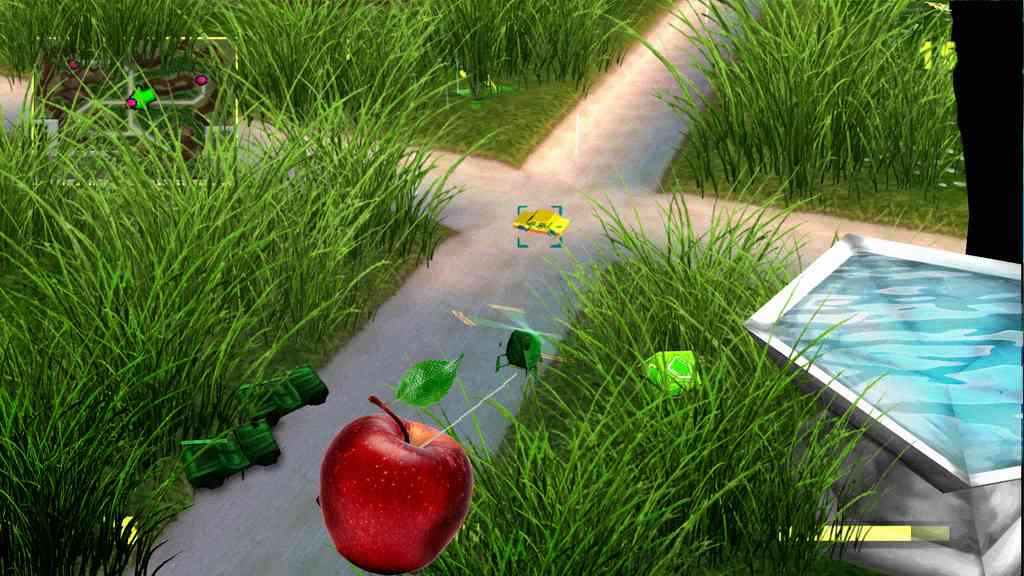
Slightly modified screenshot of PS1 Army Men: World War used in ads all over the internet at the time

What Looked Like In-Game… Wasn’t

Back in the golden age of 3DO, when Army Men was just beginning to take shape as a franchise, the creative team had a challenge: They needed a visual way to pitch the idea before the game was even fully designed.

Veteran developer Michael Mendheim, who played a crucial role in conceptualizing the Army Men universe, would put together digitally composed images to present the tone and feel of the project.

These images were a mix of:

  • Independently rendered 3D models.
  • Partial engine screenshots, when available.
  • Added effects like smoke, fire, and lighting.
  • And of course, a healthy dose of Photoshop.

They were never meant to be real gameplay footage: they were visual mockups, created to evoke the style, mood, and action the final product was aiming for.

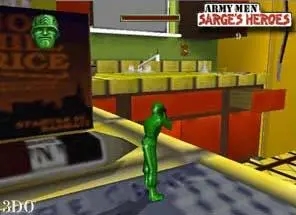
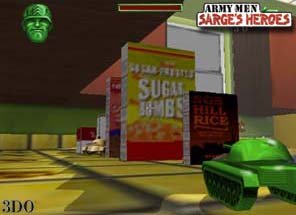
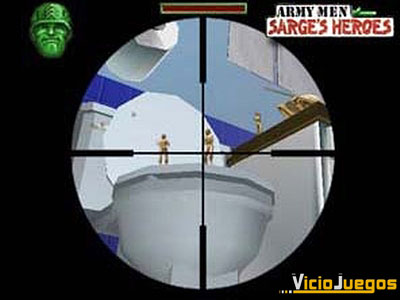
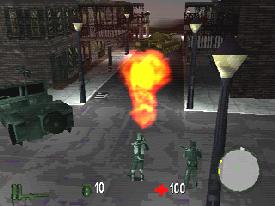
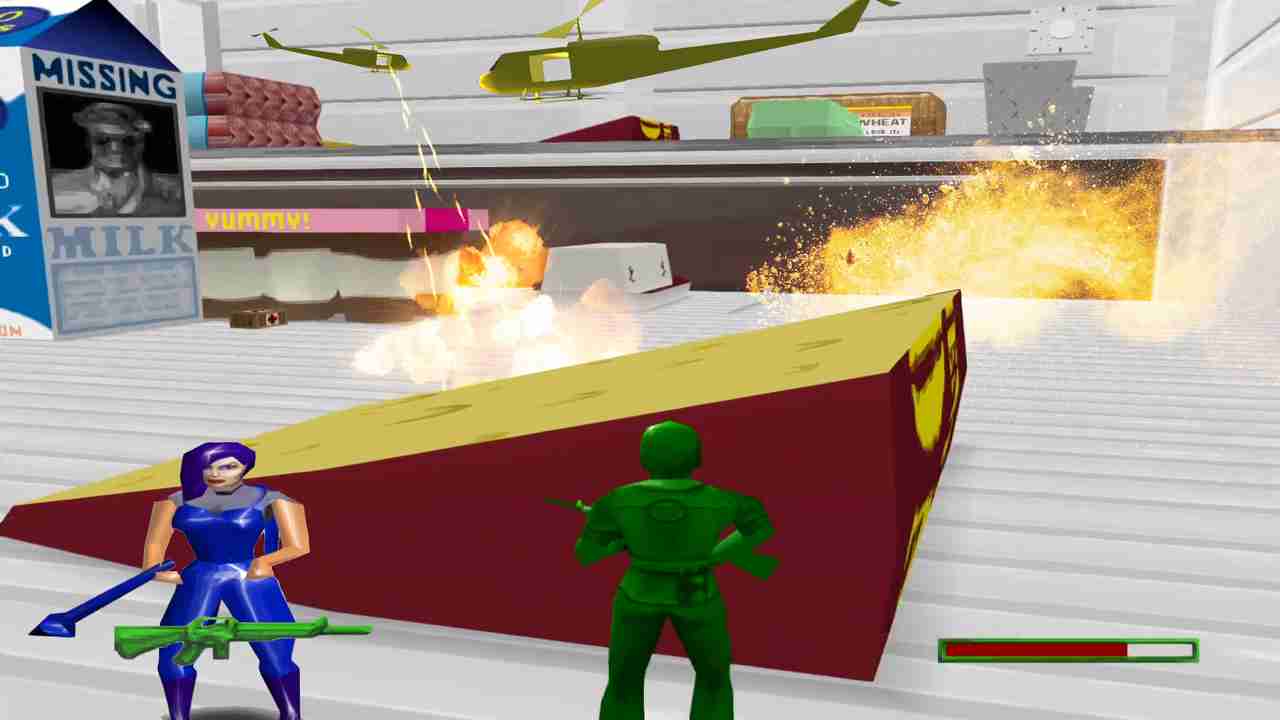
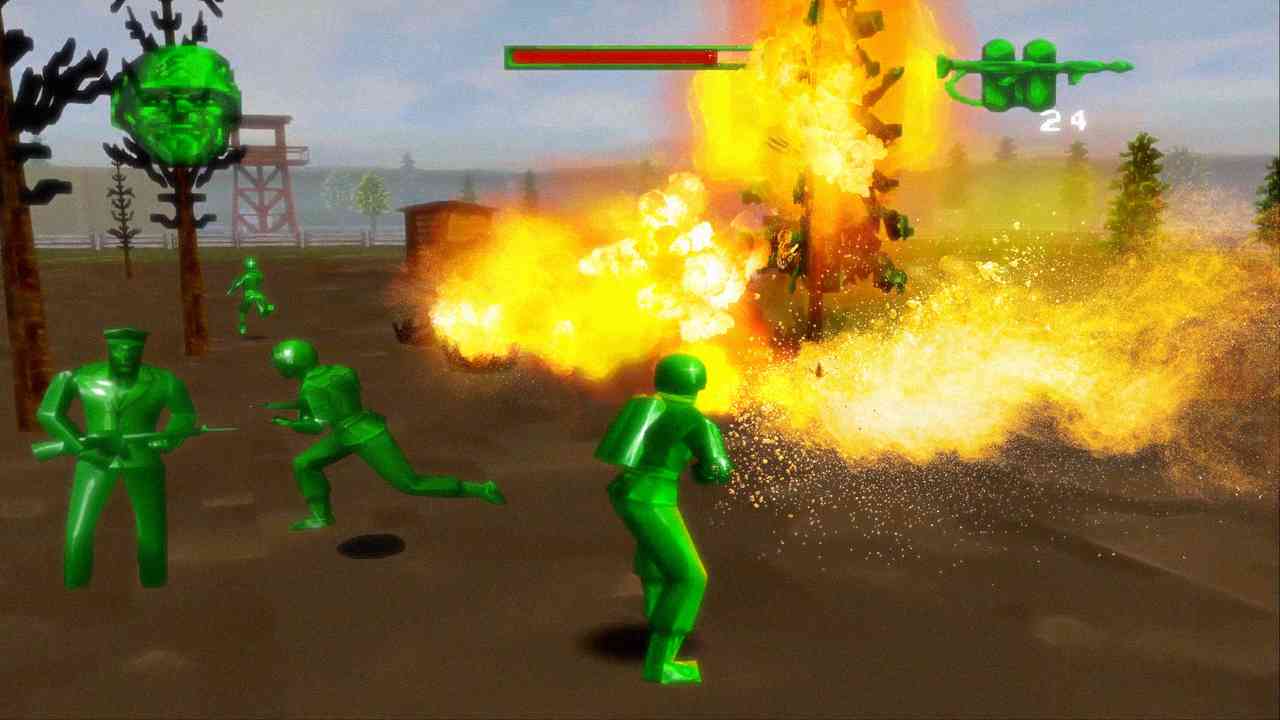
Slightly modified screenshot of N64 Army Men: Sarge’s Heroes used in ads all over the internet at the time

Although with minor modifications to the images, these are surely from the Army Men: Sarge’s Heroes engine for the Nintendo 64, but before going through the final version for the N64, it was actually a beta version of the levels and functions, not very different from the final version.

When Marketing Takes Creative Liberties

What’s interesting is that, even though the developers understood these images were purely conceptual, 3DO’s marketing team used them in advertisements as if they were actual in-game screenshots.

These images showed up in:

  • Magazines
  • Game boxes
  • Promotional flyers
  • Manuals
  • And even official press kits

The result? Players thought that’s how the game would look. And while that wasn’t exactly true… it worked. The hype exploded. The visual concept of Army Men (green plastic soldiers fighting battles in real-world environments) instantly captured players’ imaginations, long before the games were even finished, even a few years before 1998 Army Men.

The Speculation That Never Died

Even today, many fans still insist that those images came from early builds or beta versions of the games.

You’ll still hear comments like:

“This must be from a lost prototype…”

Or comments like:

“They had to downgrade the graphics later due to hardware limitations.”

And while it’s true that Army Men underwent plenty of visual changes during development (and yes, they had to scale things down to run on systems like the PlayStation 1 and Nintendo 64) those promo shots were not captured from actual working versions of the game.

People who worked with Photoshop or 3D Studio Max back then can clearly recognize the techniques used in these composites. If anything, they were stunning examples of concept art disguised as gameplay.

In a way, we wish they were real beta shots… it would’ve added an extra layer of mystique to the franchise’s development history. But no, it was just clever marketing. Fake… but effective.

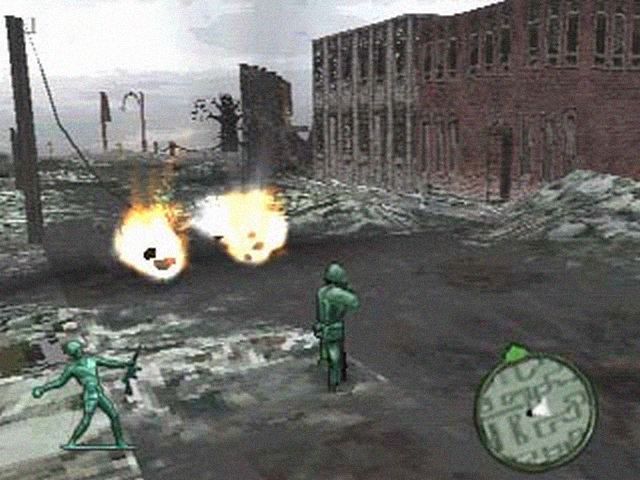
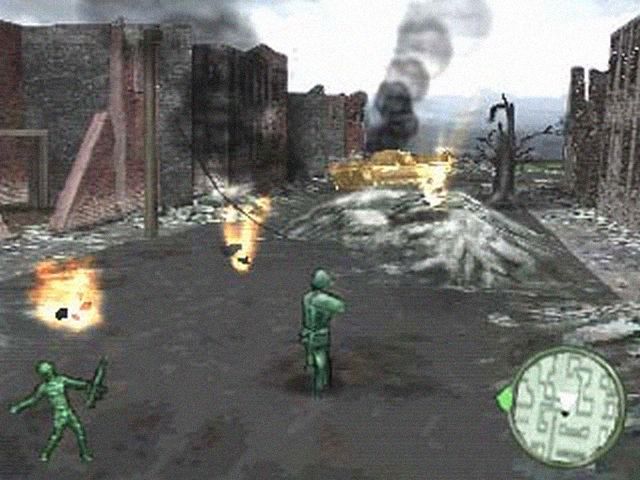
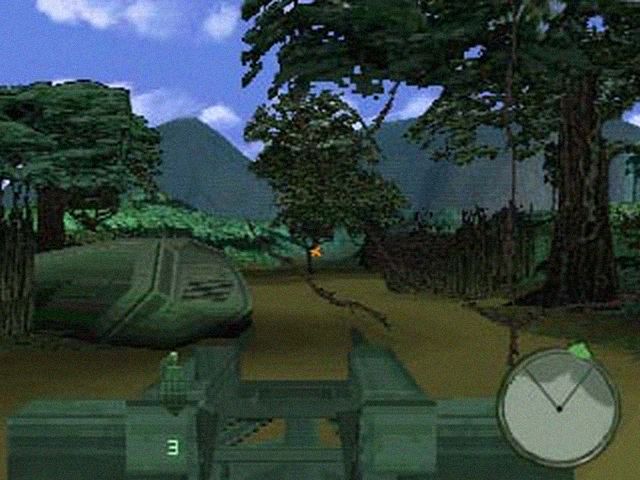
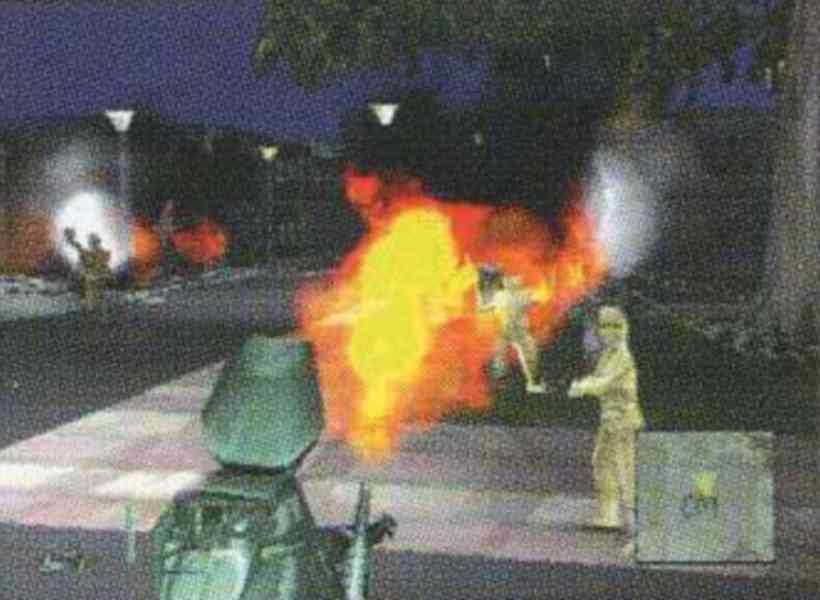
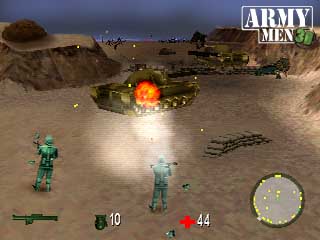
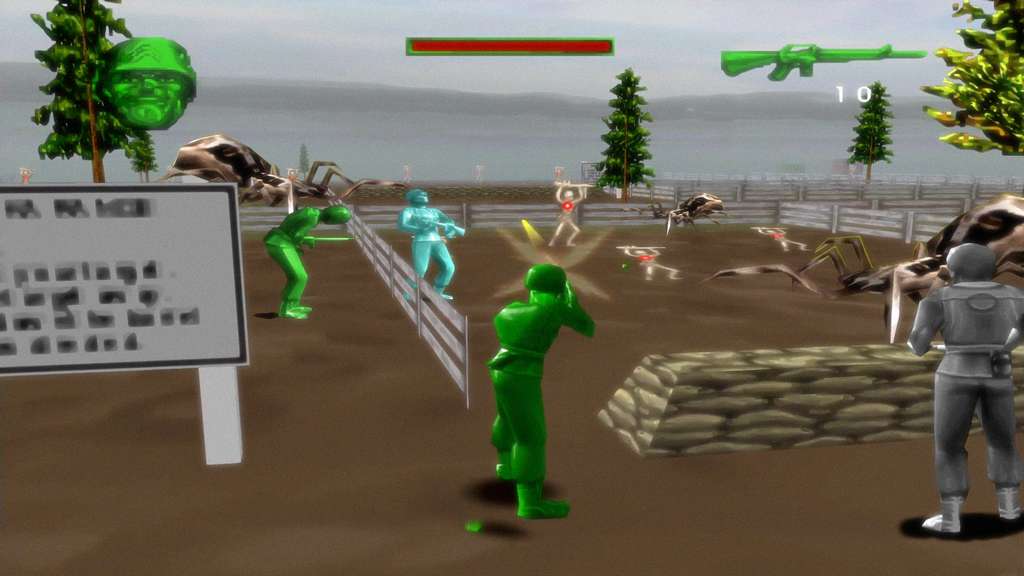
Modified screenshots of the “supposed” Army Men 3D beta version for PS1, used in promotional content all over the internet at the time

Deception or Strategy?

Today, in the era of frame-by-frame breakdowns and mandatory “not actual gameplay” disclaimers, this kind of tactic would get you dragged online in seconds. But in the ‘90s, with a franchise as visually unique as Army Men, it was a legitimate (and successful) marketing tool.

Some might call it deceptive. Others see it as an effective way of presenting an evolving creative vision.

Either way, those images weren’t beta builds, they weren’t unreleased versions, and they weren’t screenshots from a hidden dev console.

They were Photoshop. Plain and simple. And in context… they were brilliant.

What Does This Say About the Toyverse?

Like many good stories in the Toyverse, this one also carries a lesson. Just as molded toys become soldiers with names, stories, and purpose, a fake image can become the spark that brings an entire world to life.

Those visuals (however artificial) were the first real representations of the Army Men franchise. Before missions, before bugs, before battlefield chaos… there was a carefully crafted picture. And it worked.

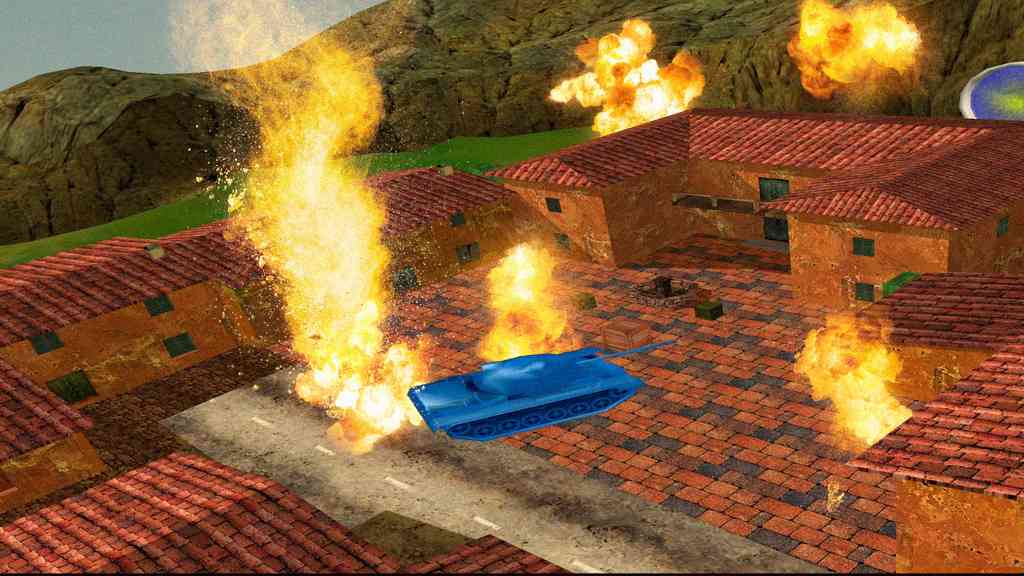
Heavily fake screenshots of Portal Runner (PS2) where they used heavy 3D CGI models to make concept screenshots that 3DO used in promotional content on magazines and all over the internet at the time

Bonus: Where to See These Images Today?

Many of these fake-but-iconic visuals still survive today in:

  • Archived game magazines (GamePro, EGM, etc.)
  • Scanned promotional material
  • Original manuals
  • The official 3DO websites via the Wayback Machine
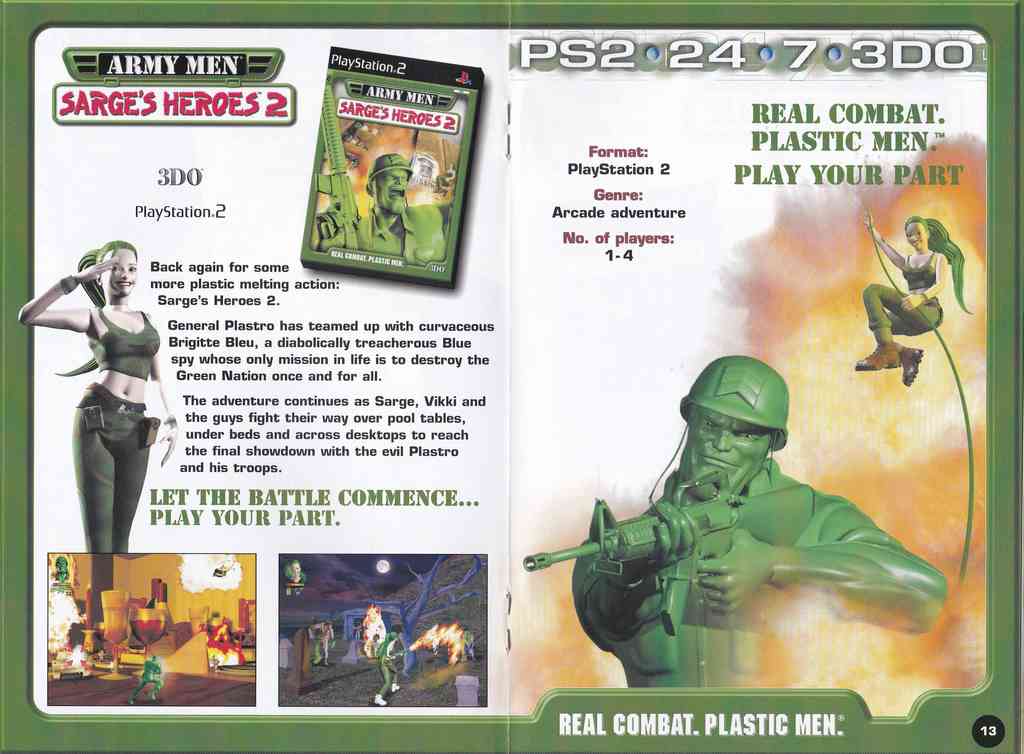
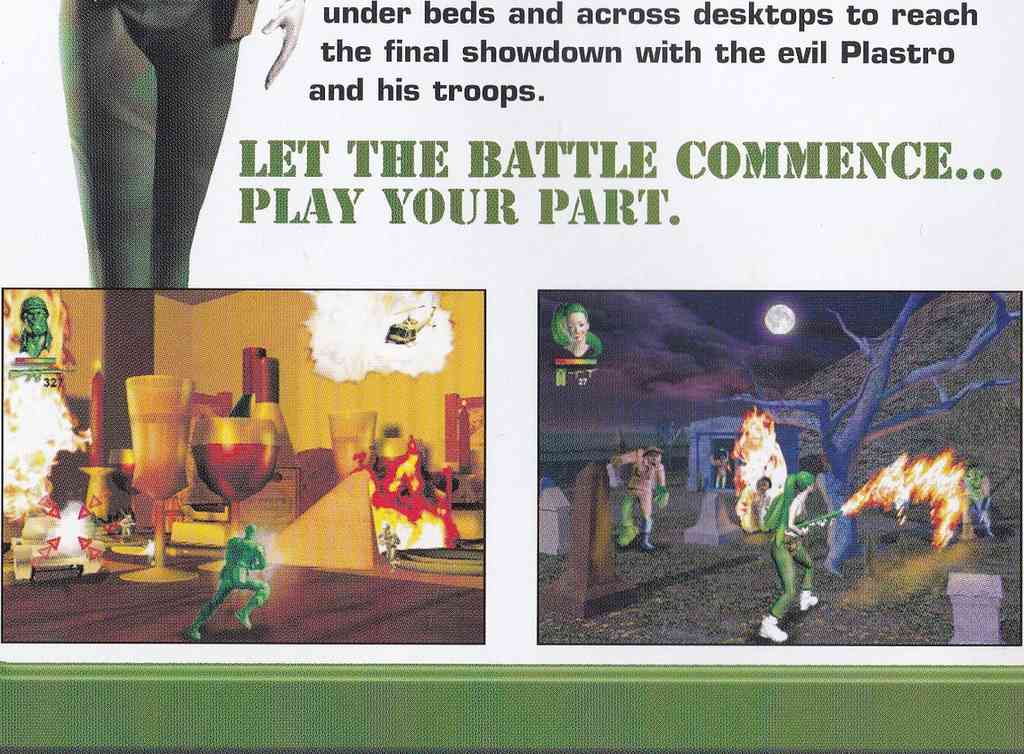
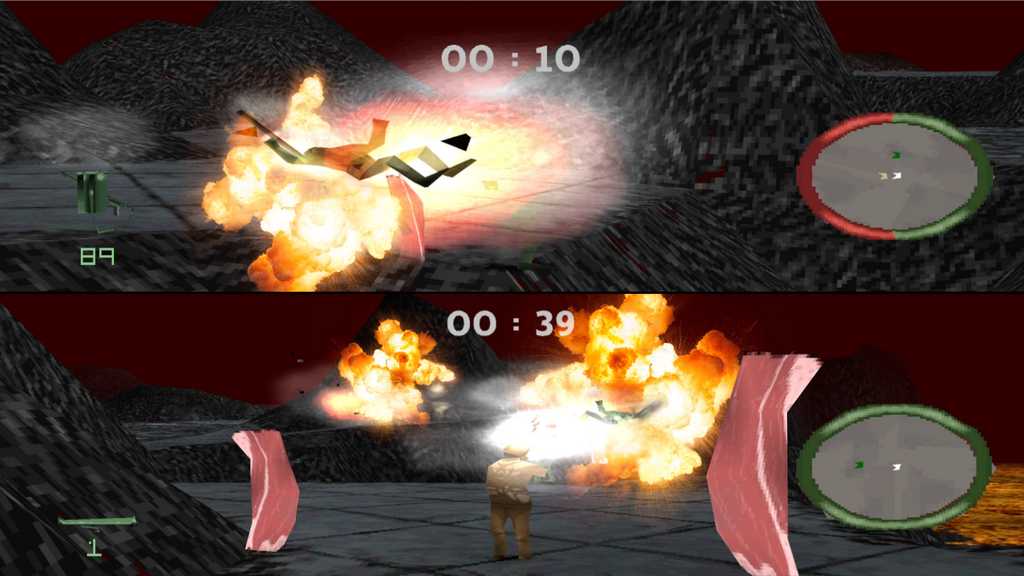
Heavily fake screenshots of the “supposed” Army Men Sarge’s Heroes 2 for PS2, used in promotional content on magazines and all over the internet at the time

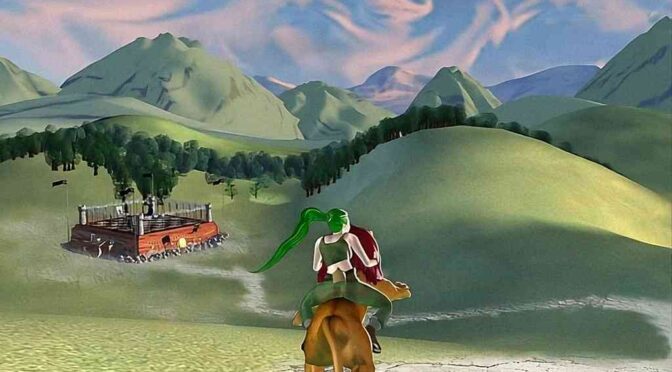
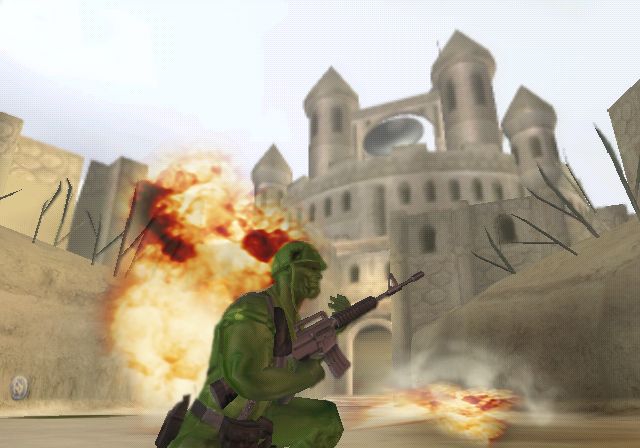
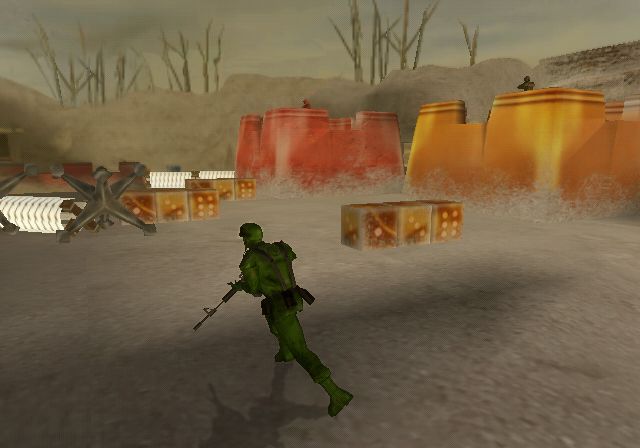
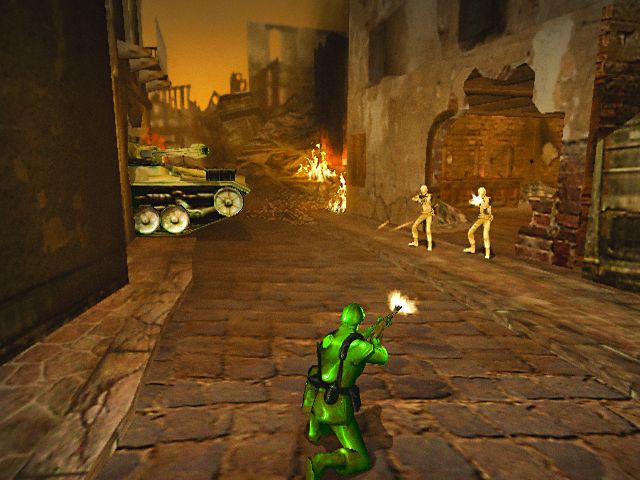
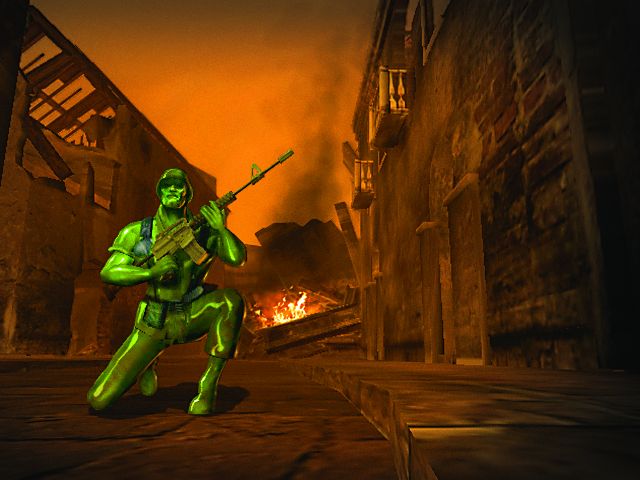
In the game’s different media promotional contents, these screenshots were used to show off the game in its Playstation 2 version. In reality, they are composites using partial images of the game’s actual stages generated in a different engine or stage editing program, along with CGI models of the protagonists and a lot of added effects, something impossible to do for the Playstation 2. These were most likely images made as concept art of how the game should have looked for its development.

And of course, at ArmyMen.com.ar, where fans are still collecting and preserving all official documentation and rare media.

True BETA with minor modifications

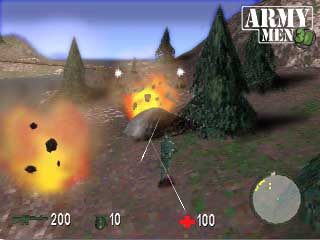
The last 3DO game wasn’t exempt from 3DO tactics. Although these are real in-game images from the game engine (Zero Engine), they have minor additions, such as some soldiers, tanks, and explosions. And these, as they didn’t report, are images from the actual beta, up to the point where 3DO worked on it, before Global Star Software took over and finished the game.

Epilogue: Not Real Gameplay, But Still Part of the Game

And óo players ever got to take control of Sarge.Because sometimes, a fake image contains a very real truth: The spirit of a franchise that helped shape an entire generation’s imagination.

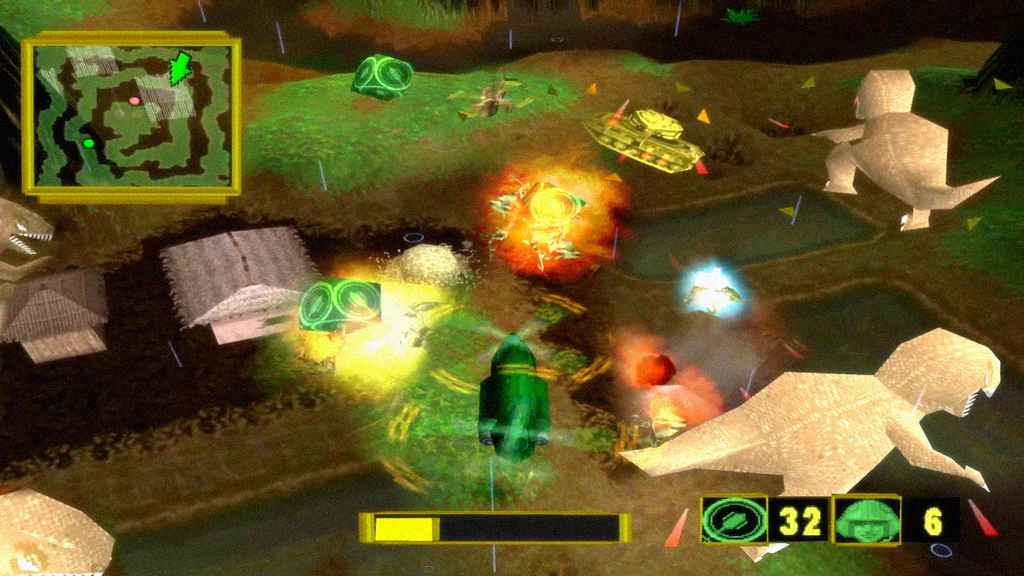
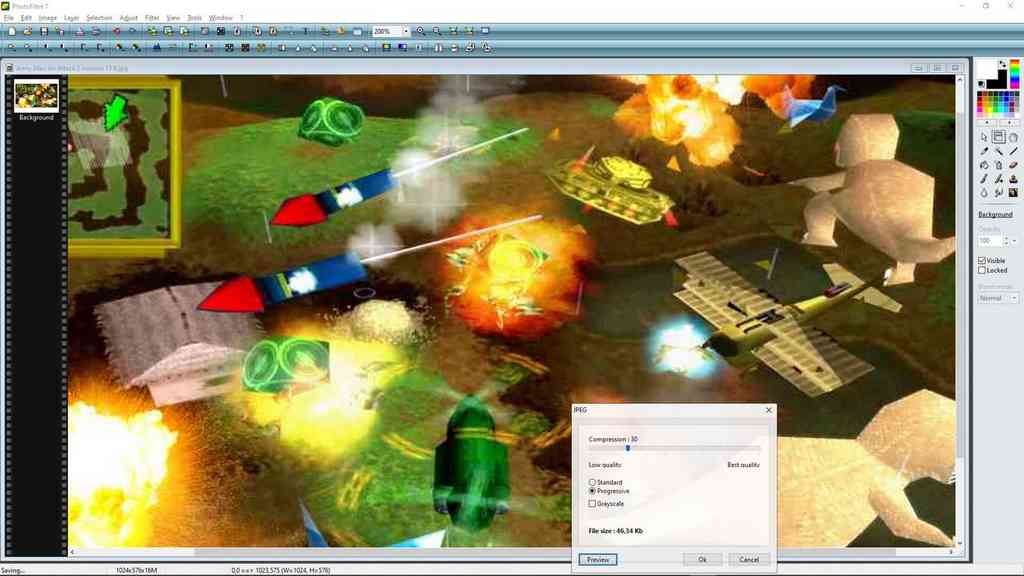
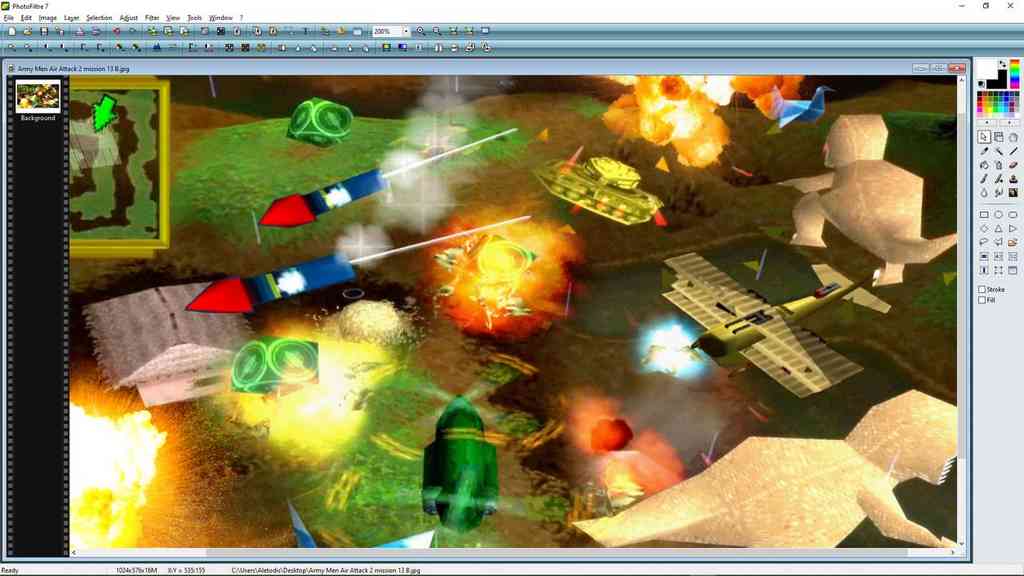
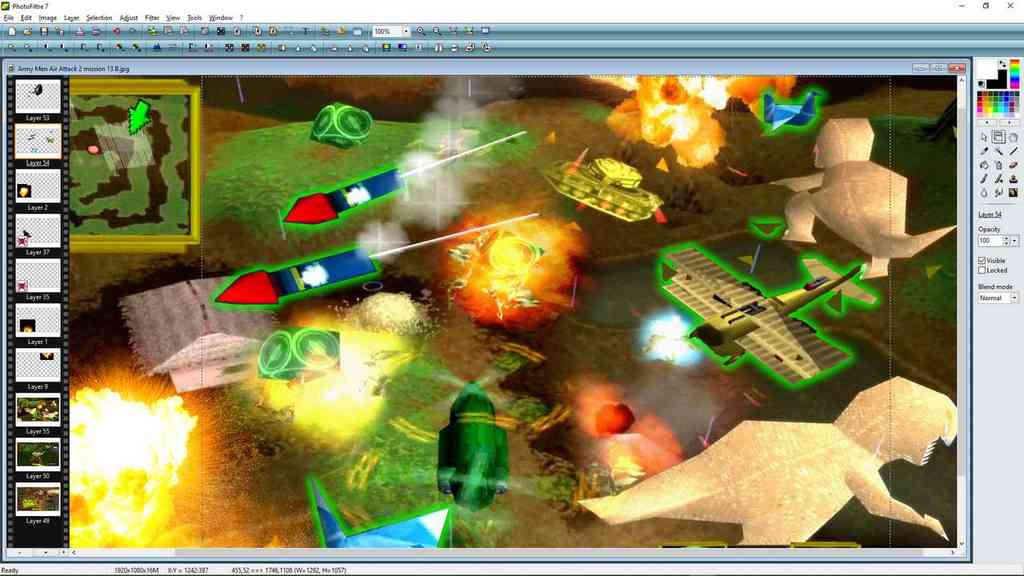
This are some of our own “fake” promotional images. We usually use them for our video thumbnails… but from now on we’ll be using them to promote older 3DO games a little… excessively.

Army Men video games: Manuals, Guides, Magazines, Printed Advertisements

Army Men is from a time before the Internet, a time of print ads, guide books, and physical games with instruction manuals (yes, believe it or not, they came with instructions!). The Internet was relatively new and not the main target market for consumers. So there was also TV advertising… imagine watching your favorite show or MTV and suddenly an Army Men game commercial comes on!

Manuals:

The manuals that came with all the games, CDs, DVDs, cartridges. Each and every one with their game instruction manuals.

Download Army Men PC Manual PDF

Download Army Men Official Strategies & Secrets PDF

Download Army Men Game Boy Color Manual PDF

Download Army Men 3D PS1 Manual PDF

Download Army Men 3D Prima’s Official Strategy Guide PDF

Download Army Men 2 PC Manual PDF

Download Army Men 2 PC Prima’s Official Strategy Guide PDF

Download Army Men 2 Gameboy Color Manual PDF

Download Army Men: Toys in Space Manual PDF

Download Army Men: Air Tactics PC Manual PDF

Download Army Men World War PC Manual PDF

Download Army Men: World War PS1 Manual PDF

Download Army Men: World War PS1 Prima’s Official Strategy Guide PDF

Download Army Men: World War: Land Sea Air Manual PDF

Download Army Men: World War: Final Front PS1 Manual PDF

Download Army Men: World War: Team Assault PS1 Manual PDF

Download Army Men: Air Attack PS1 Manual PDF

Download Army Men: Air Attack PC Manual PDF

Download Army Men: Air Combat N64 Manual PDF

Download Army Men: Air Combat N64 Prima’s Official Strategy Guide PDF

Download Army Men: Air Combat Game Boy Color Manual PDF

Download Army Men: Air Attack 2 (Blade’s Revenge) PS2 Manual PDF

Download Army Men: Air Attack 2 PS1 Manual PDF (Spanish Versión en Español)

Download Army Men: Air Combat: The Elite Missions GameCube Manual PDF

Download Army Men: Sarge’s Heroes PC Manual PDF

Download Army Men: Sarge’s Heroes N64 User Manual PDF

Download Army Men: Sarge’s Heroes N64 Prima’s Official Strategy Guide PDF

Download Army Men: Sarge’s Heroes PS1 Manual PDF

Download Army Men: Sarge’s Heroes PS1 Prima’s Official Strategy Guide PDF

Download Army Men: Sarge’s Heroes Sega Dreamcast Manual PDF

Download Army Men: Sarge’s Heroes 2 PS2 Manual PDF

Download Army Men: Sarge’s Heroes 2 N64 Manual PDF

Download Army Men: Sarge’s Heroes 2 PS1 Manual PDF

Download Army Men: Sarge’s Heroes 2 N64 PS1 PS2 Prima’s Official Strategy Guide PDF

Download Army Men: Sarge’s Heroes 2 Game Boy Color Manual PDF

Download Army Men: Green Rogue PS1 Manual PDF

Download Army Men: Green Rogue PS2 Manual PDF

Download Portal Runner PS2 Manual PDF

Download Portal Runner GameBoy Color Manual PDF

Download Army Men: RTS PC Manual PDF

Download Army Men RTS PS2 Manual PDF

Download Army Men: RTS GameCube Manual PDF

Download Army Men Advance Gameboy Advance Manual PDF

Download Army Men Operation Green Gameboy Advance Manual PDF

Download Army Men Turf Wars Gameboy Advance Manual PDF

Download Army Men: Sarge’s War PC Manual PDF

Download Army Men: Sarge’s War PS2 Manual PDF

Download Army Men: Sarge’s War XBoX Manual PDF

Download Army Men: Major Malfunction PS2 Manual PDF

Download Army Men: Major Malfunction XBOX Manual PDF

Download Army Men: Soldiers of Misfortune PS2 Manual PDF

Download Army Men: Soldiers of Misfortune Wii Manual PDF

Download Army Men: Soldiers of Misfortune Nintendo DS Manual PDF

Magazines: Reviews, editor guides, ads!

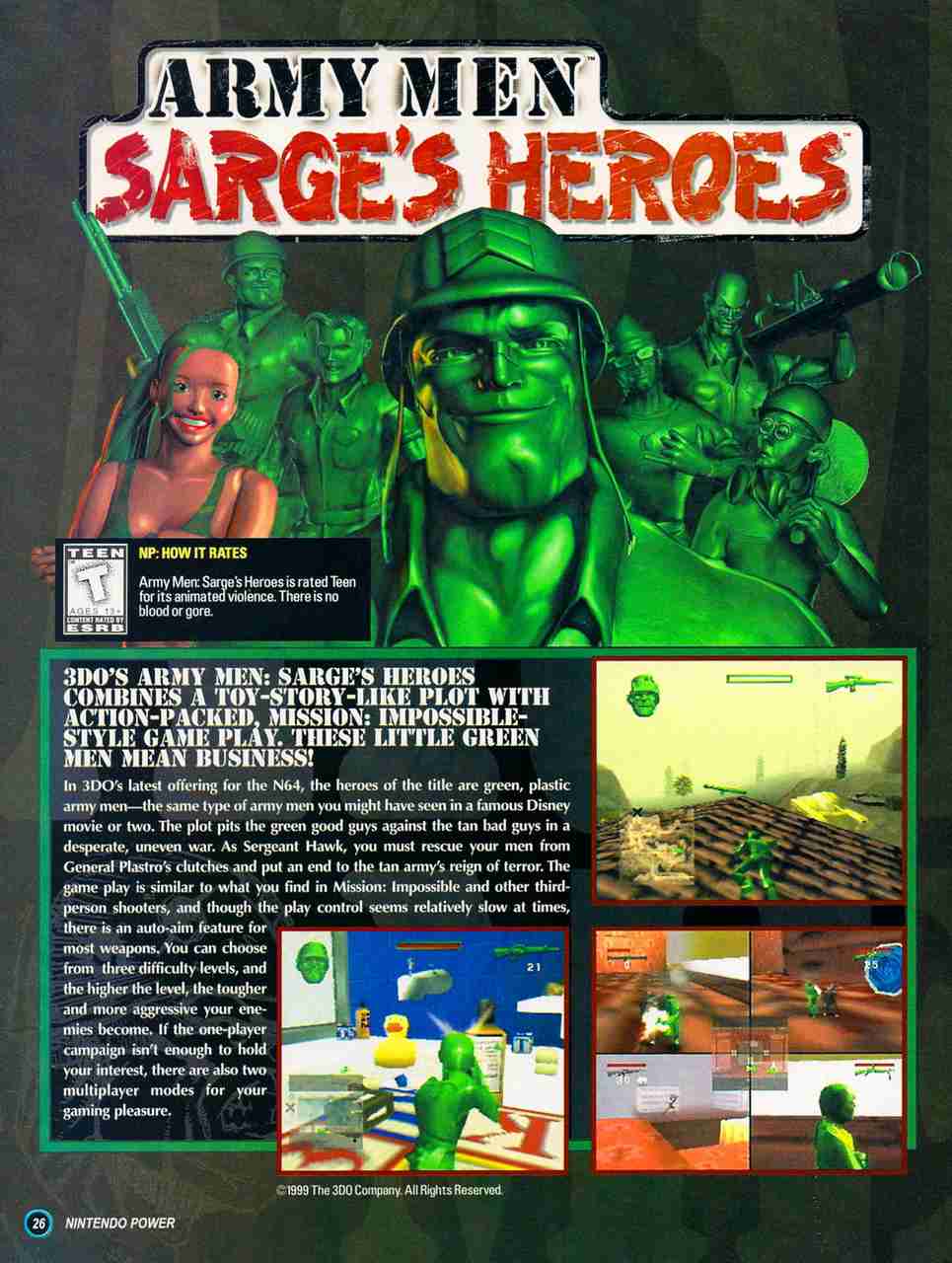
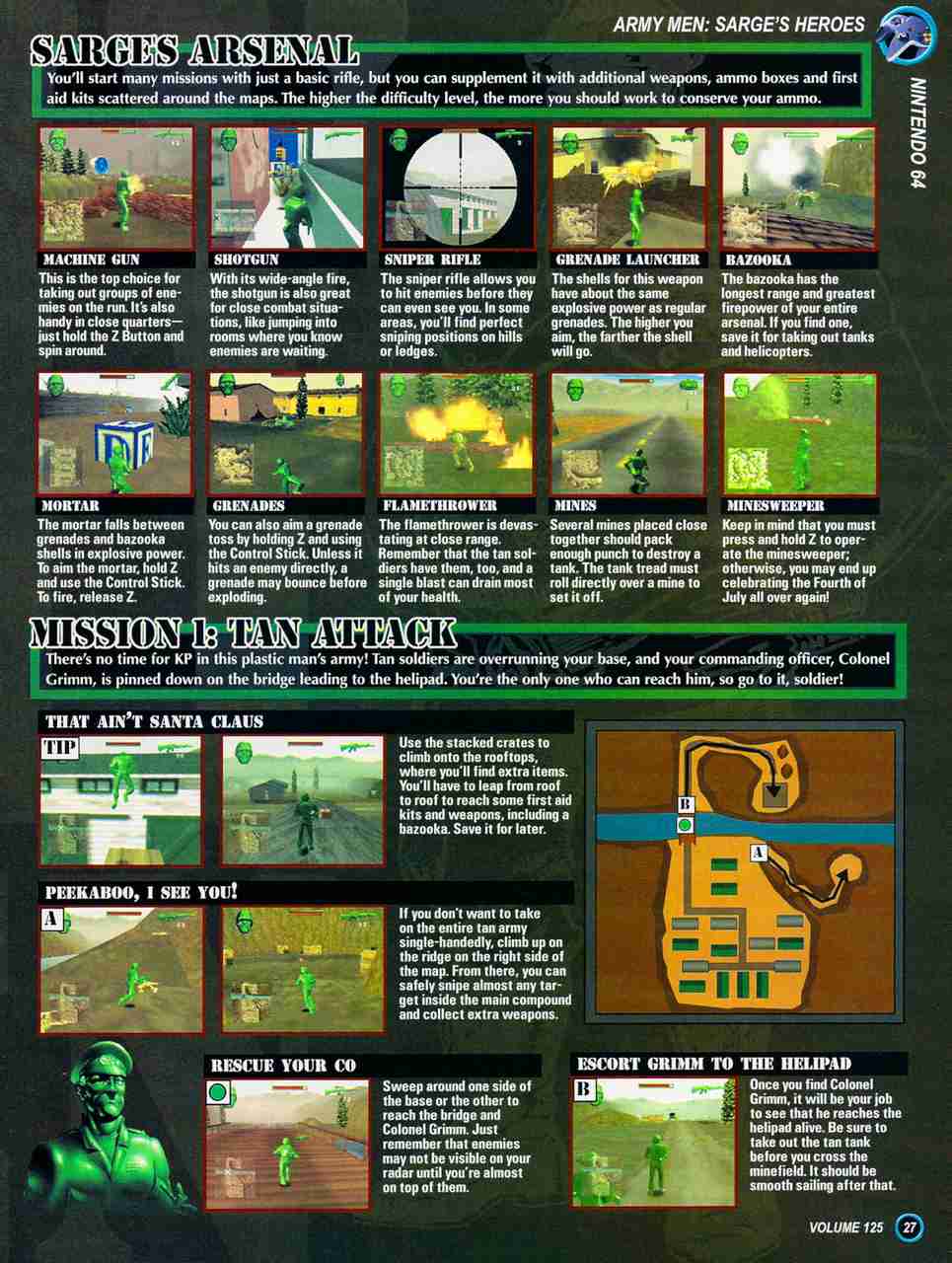
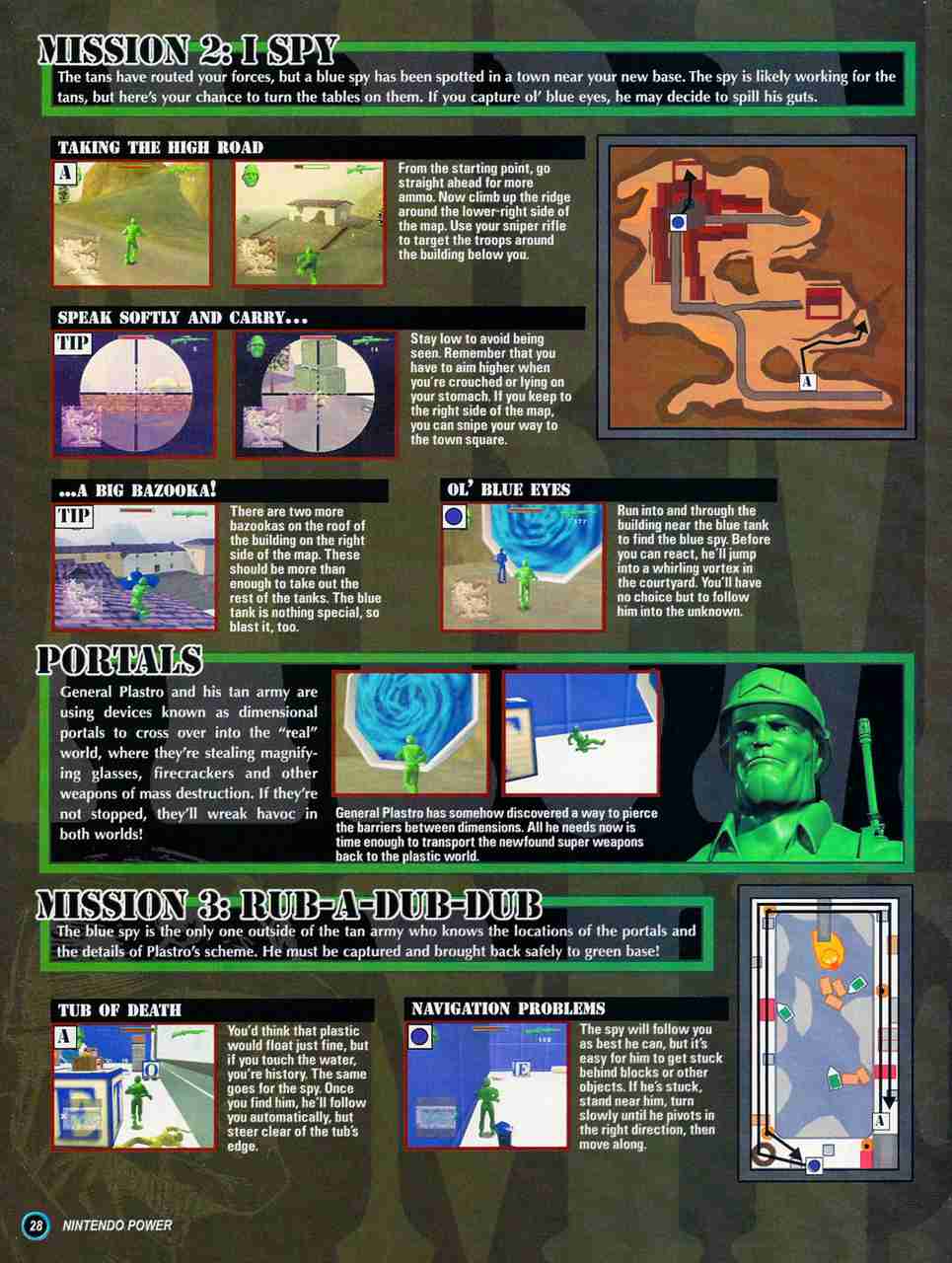
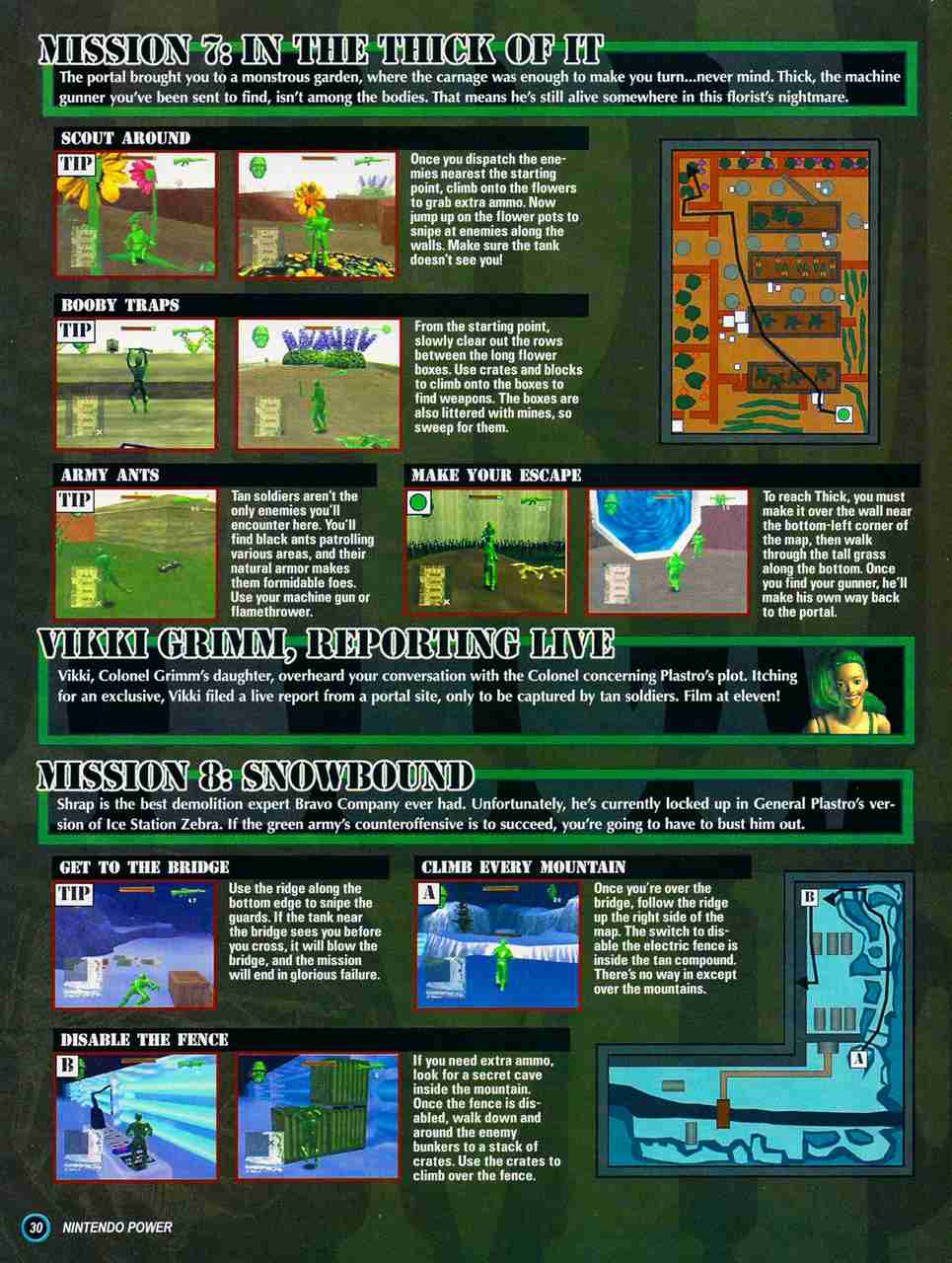
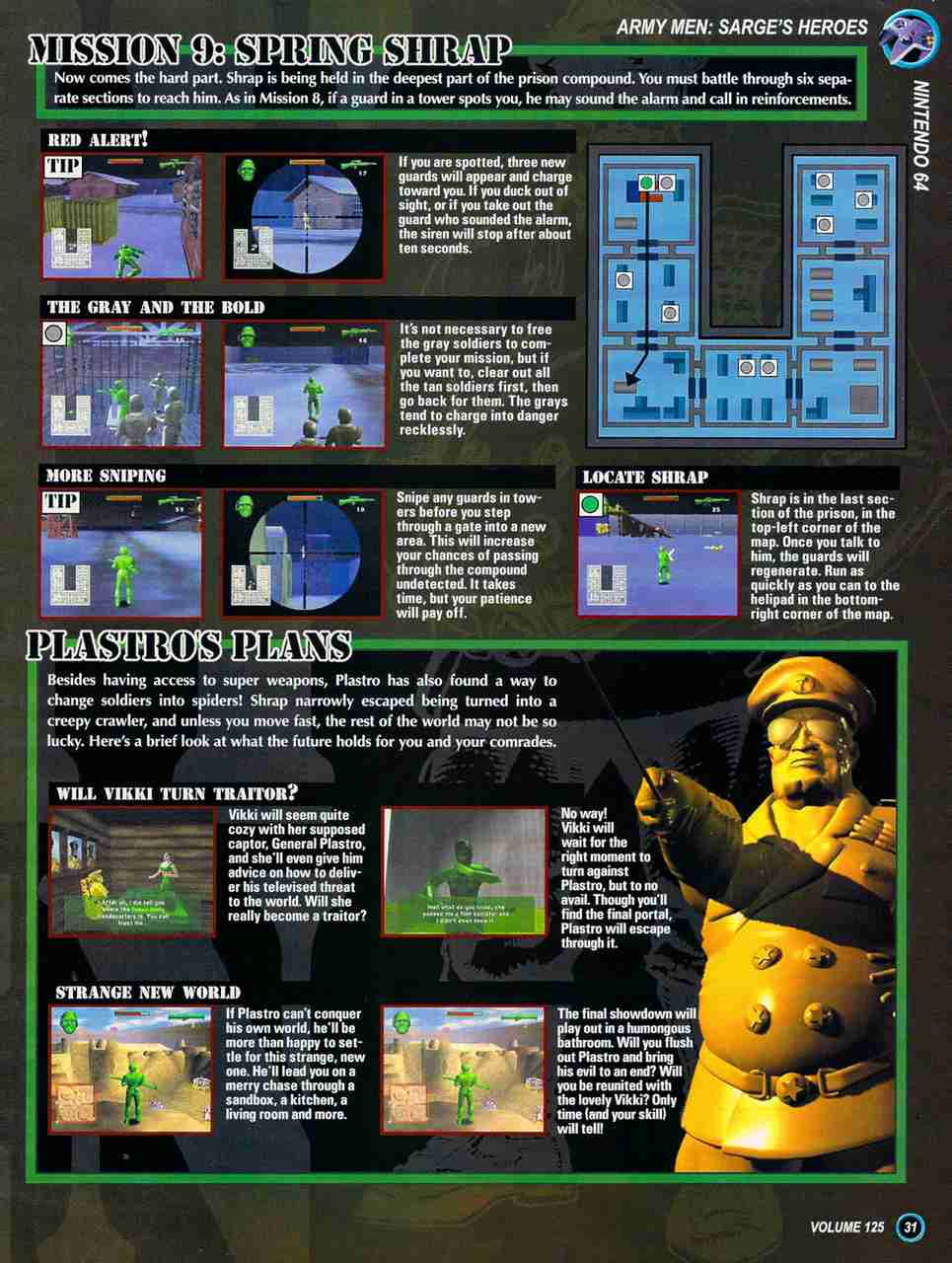
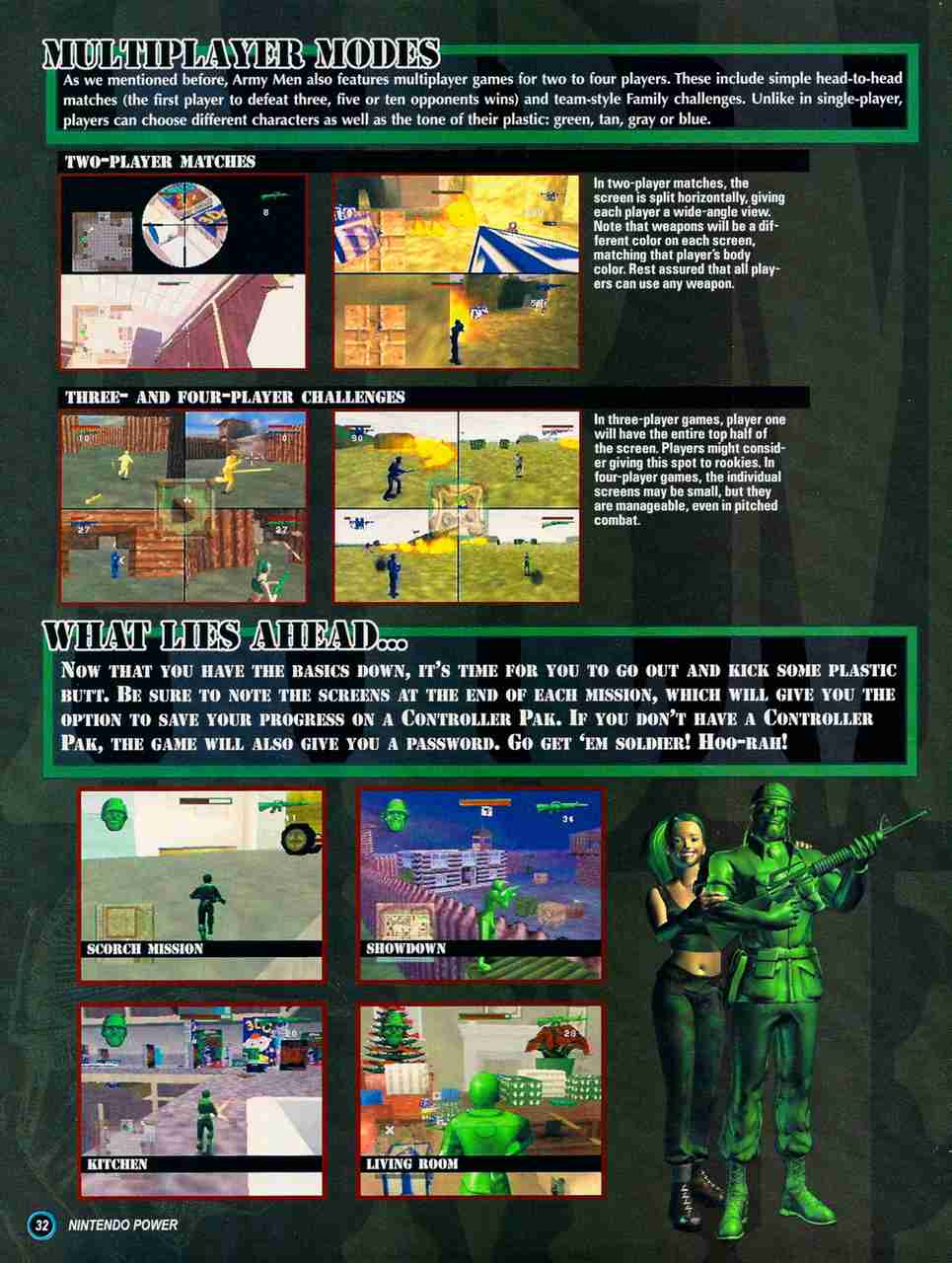
Army Men: Sarge’s Heroes (N64) section from the Nintendo Power magazine, issue #125 (October 1999)

One of the iconic video game magazines of the time, focused on Nintendo only and of course, mainly Nintendo 64, the console of the moment. Nintendo Power was a magazine dedicated to video game news and strategies, launched by Nintendo of America in July/August 1988. Initially, it served as Nintendo’s official print magazine for North America. The publication started as a monthly release by Nintendo of America and later became independent. In December 2007, Future US, a subsidiary of the British publisher Future plc, took over its publication.

In this case, a section with a guide to the first missions of Sarge’s Heroes for Nintendo 64, with some extras, such as tips for multiplayer mode.

Download Army Men: Sarge’s Heroes (N64) section from the Nintendo Power magazine, issue #125

The magazine had a remarkable 24-year run, making it one of the longest-running video game magazines in the United States and Canada. However, on August 21, 2012, Nintendo announced that it would not renew its licensing agreement with Future Publishing, leading to the magazine’s closure in December 2012. The final issue, volume 285, was published on December 11, 2012.

All Nintendo Power Magazines from Archive.org

In addition, a podcast version of Nintendo Power was launched on December 20, 2017, hosted by former Editor-in-Chief Chris Slate. The podcast continued until 2023 and is currently on hiatus as of 2024.

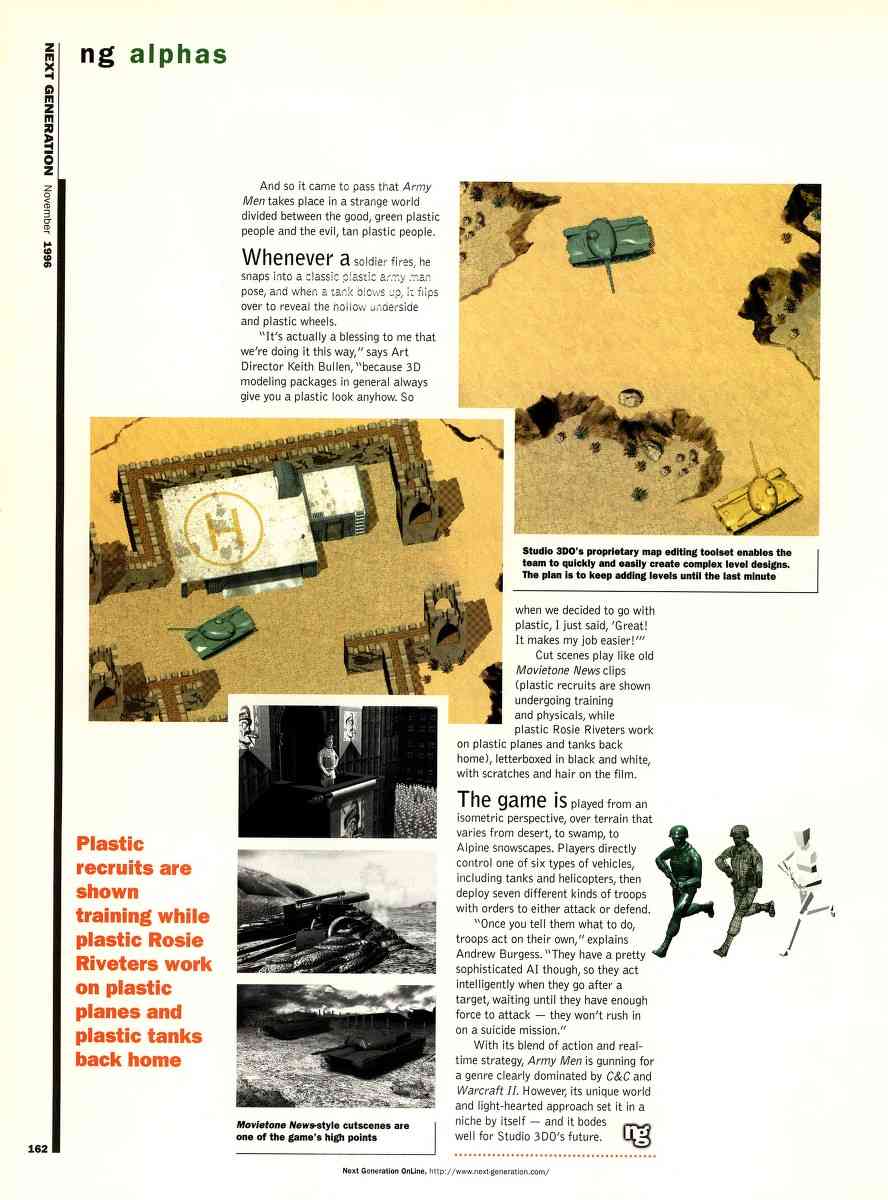
Army Men (PC) section from the Next Generation magazine, November 23, 1996 issue

Next Generation was a video game magazine published by Imagine Media from 1995 to 2002. It focused on the gaming industry, offering in-depth articles, interviews with developers, and reviews of upcoming games and hardware. The magazine was known for its professional tone and emphasis on the business and technical aspects of gaming, rather than just game reviews and cheats. It provided readers with insights into the future of gaming technology and trends.

Download Next Generation Magazine issue from 23 Nov 1996

In this case a sneak peek of Army Men, the then new 3DO game in progress, a year and a half before its release…

Next_Generation Magazine issue from_23_Nov_1996 in Archive.org

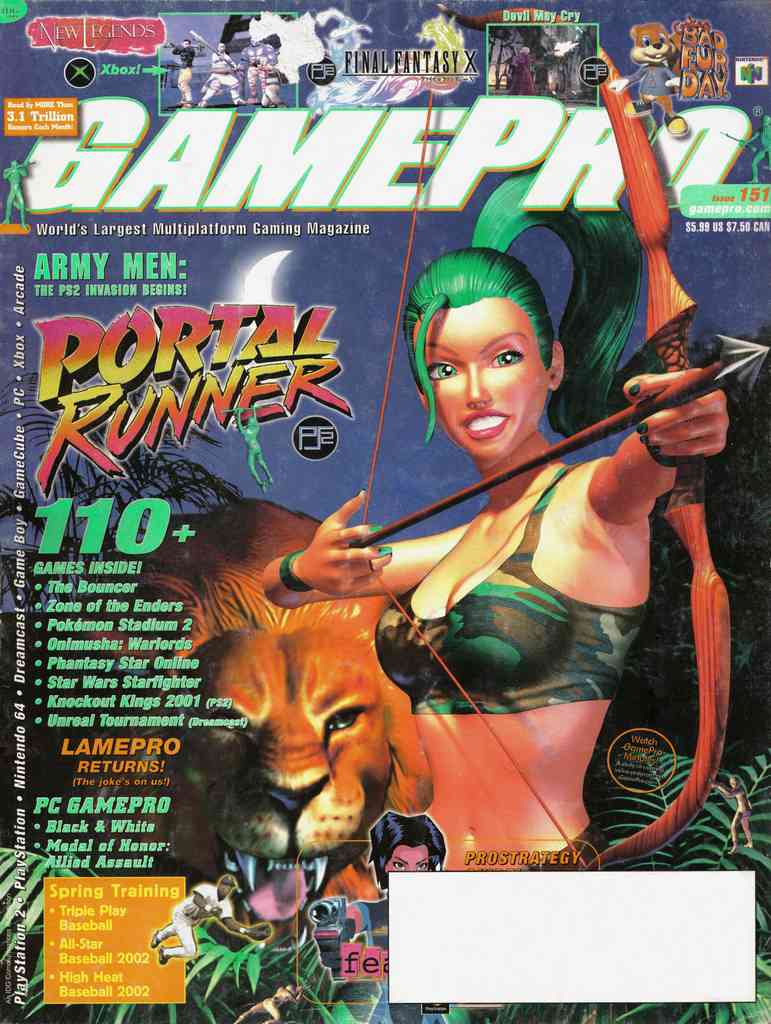
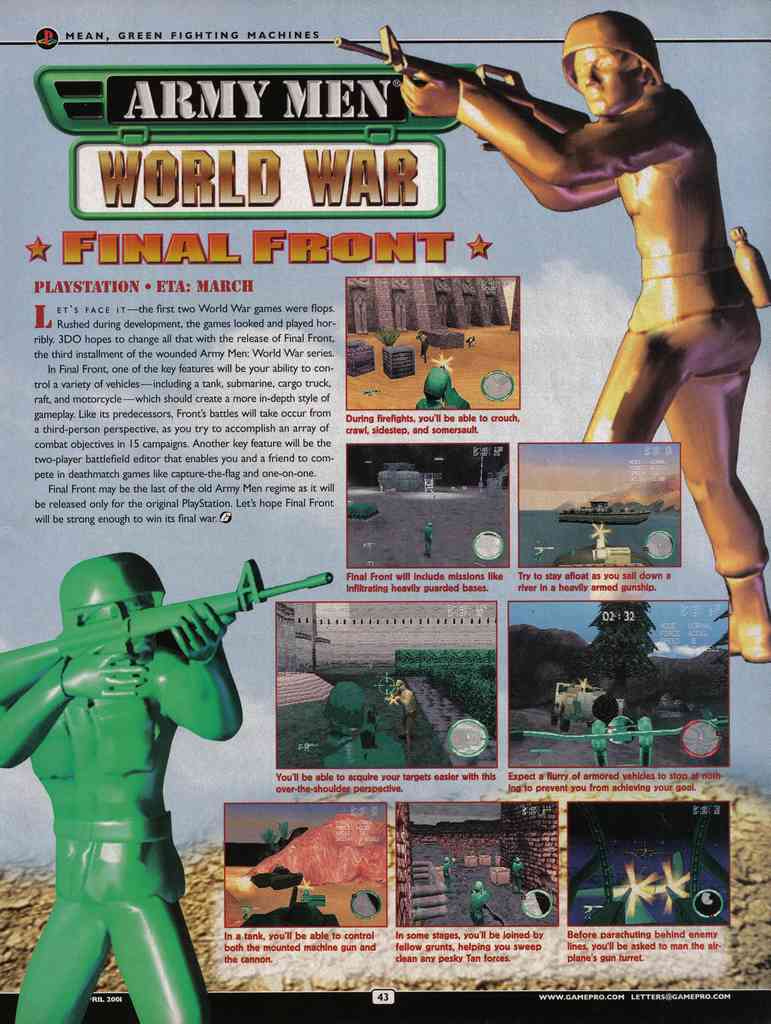
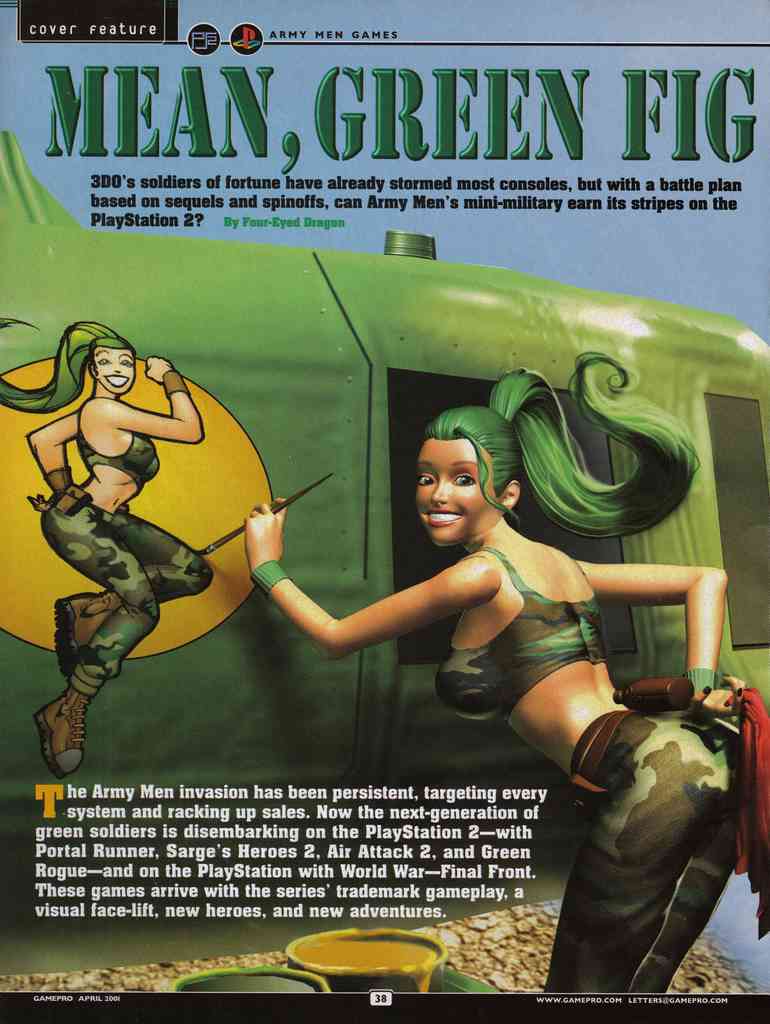
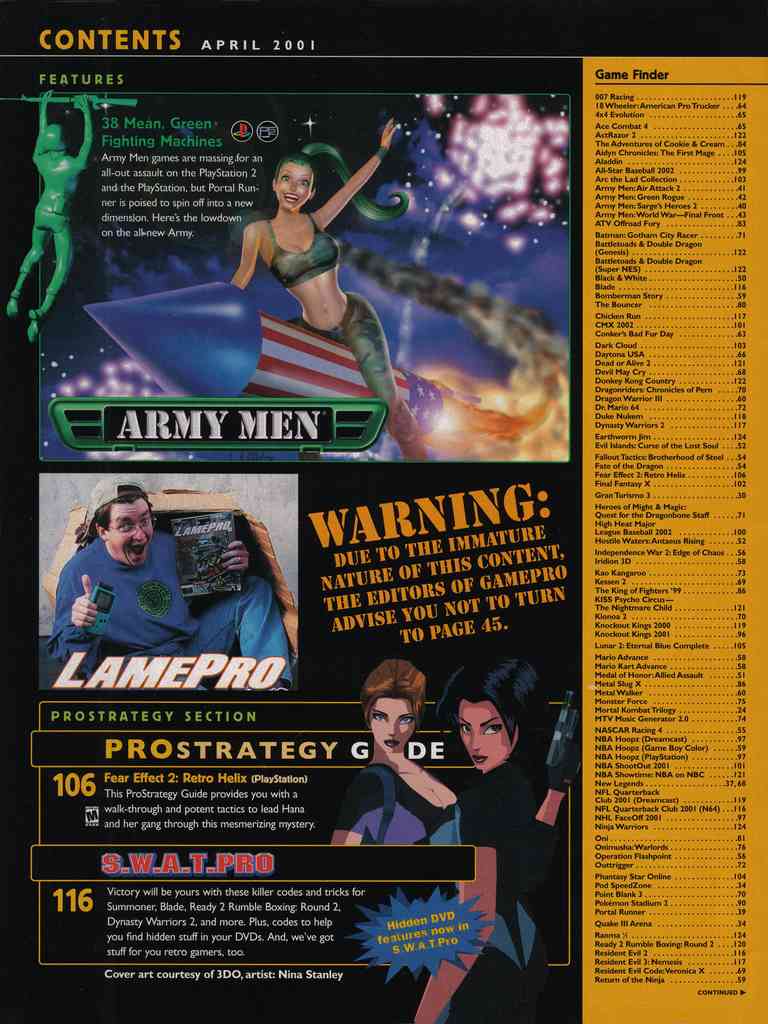
Army Men games on the GamePro Magazine Issue 151 (April 2001)

GamePro was a well-known video game magazine that ran from 1989 to 2011. It provided gamers with reviews, previews, tips, and strategies across various gaming platforms. The magazine was recognized for its vibrant layout and engaging content, including a unique rating system and helpful “ProTips” for improving gameplay. GamePro was a key source of gaming news and information during its publication years.

Download complete GamePro Magazine Issue 151 (April 2001)

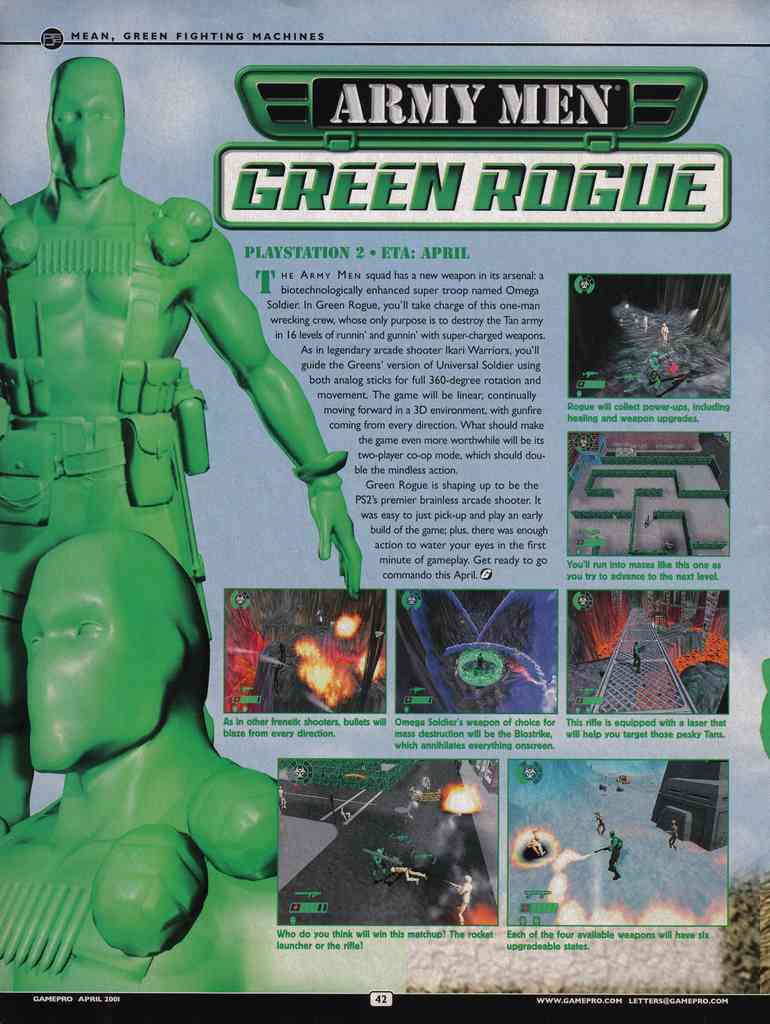
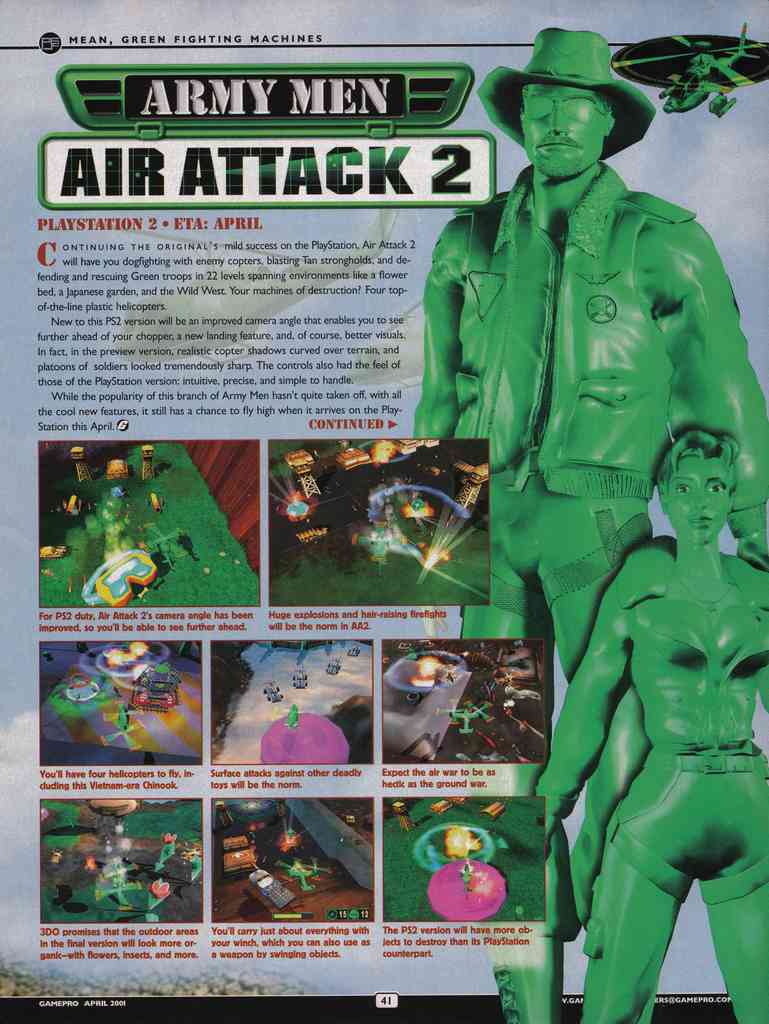
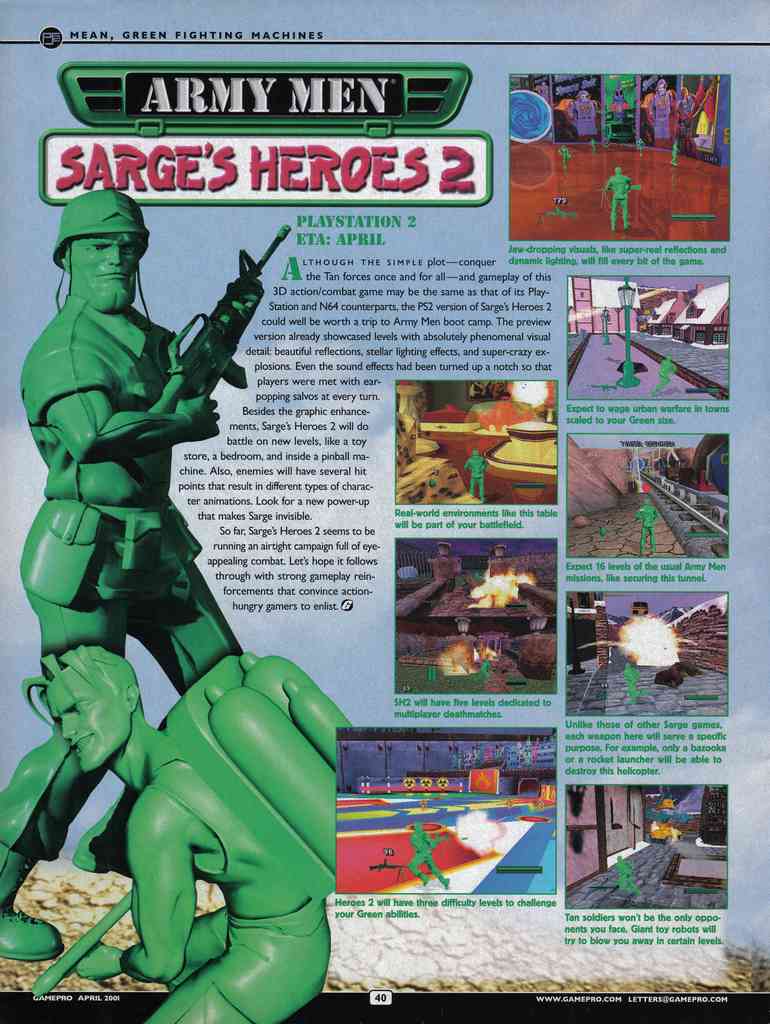
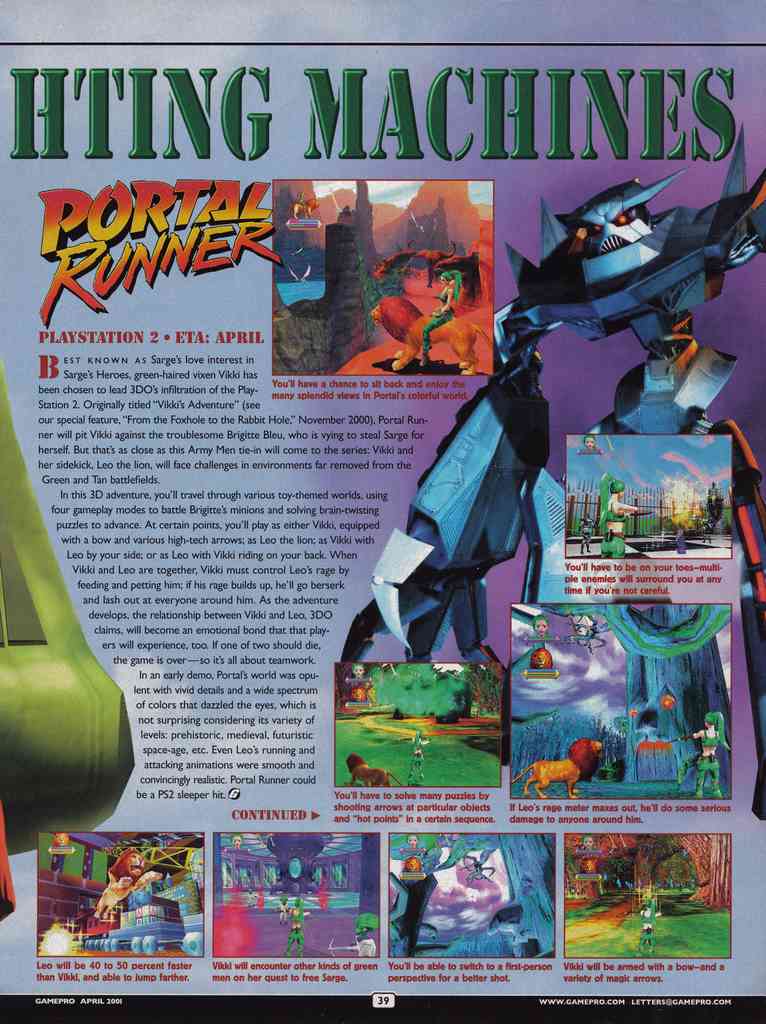
In this case a sneak peek of the Army Men Playstation 2 launches: Sarge’s Heroes 2, Air Attack 2, Green Rogue & Portal Runner. And for the Playstation 1, Army Men: World War: Final Front.

Toyverse project

Army Men Toyverse projects
Small graphic to explain the Army Men Toy Verse: Several projects under or in the same universe.

What is the Army Men Toyverse project?

Initially our project was going to be a video game only, Army Men Revolution. But currently we are thinking about something broader, not just a video game, but a series of MODs, animations and stories in different formats, mostly interactive, which together we will going to call “Army Men Toyverse”.

Why “Toyverse”? Because it’s not just about the plastic soldiers, but about the other different types of toys, here called “toykinds” which is equivalent to saying “species”, but in this case the “species” of toys. And by Toyverse we mean the entire world they live in, which is not only the Plastic World and the Human World (Real World), but all the other Toy themed worlds. For example the Medieval World, which is like a kind of medieval fantasy world with dragons and characters like Merlin, King Arthur, Dracula, Don Quixote de la Mancha, Frankenstein and Van Helsing, Robin Hood, etc. A world with a very attractive theme for that kind of particular sector of potential players, full of classic characters… copyright-free lol.

And the same thing happens with the Prehistoric World, Space world, Brick World (the world of Army Men equivalents for LEGO) and Action World, the world of action figures and superheroes, among many more. FINALLY, we think it’s better to focus our project on a universe of toys, the Toyverse, also called Microverse, to be able to collaborate with many more people. Without going any further, Attack on Toys is a game that combines Army Men plastic soldiers, action figures and LEGO figures fighting against each other.

It started out as a game of plastic soldiers very much in tune with the Army Men franchise, and after expanding by making Action Figures and LEGO figures playable, it did not lose its essence, its Army Men identity. And on the contrary, it is now played by those people who like LEGO figures and action figures.

But in our case the Real World will be the most important part of the project, which will also involve battles with animals. Anyway, you can read about all these things on this website.

This website is the first step into this Army Men Toyverse project. Is written from the perspective of the Army Men, as if they were the ones describing their historical events and classifying the components of their world and everything related to their Toyverse. Each of the video games is taken as stories of historical events.

We reached an agreement between developers regarding the audience of our fan game:

During all this time, working with other people related to the Army Men videogames fandom, we came to the conclusion that a game just for Army Men fans would not be worth our time and hard work, because there are very few of them. It is not a popular topic. And although there are people interested and potentially interested in plastic soldier games, they are not hard fans of this franchise, but rather “normies”: They liked the games or like the theme, but they are not die-hard fans.
So although it will be a sequel to the 3DO’s Army Men franchise, involving its characters, it will be first a game for new audiences, focused on the “new audience” perspective. So no “only hard Army Men content”. And we are going to make new players have to play the old games to discover key things in the story of Revolution, getting the new audience retroactively interested in playing the old game classics.

Army Men Logo Real Combat Plastic Men

The story:

The story will progress over time, possibly with the release of DLC in the format of campaigns, seasons or chapters (whatever name we will going to use). It will also be developed on this website, and the players will shape that story, interacting with us and throwing out ideas (Maybe you will know how to solve the “mystery boxes” better than us).

At some point our idea is that each player will be a unique character in this universe, even if they look the same than the rest of the plastic soldiers. They can all be made from the same mold, right?.

Our personal mission:

What are our intentions in all this? In addition to wanting to continue the original Army Men franchise and give it a better closure than that bittersweet ending it had in Army Men: Sarge’s War and Army Men: Major Malfunction, we want to use this story to reflect some current issues that are really important for us. Because, why make a hollow game or story with nothing to say or communicate?
Among some of our intentions are to raise more empathy for the environment & fauna of our planet and other humanity planetary issues in general. For the youngest or the smallest kids, the simple intention of teaching new and interesting things. For this reason we will going to introduce certain things like animals into the game and the ability to collect data about our world. Anyway, stuff like that.

The game universe:

Army Men Classic Logo

Everything will take place in a universe we called “Toyverse” that has clearly existed for a long time for us (the spectators) with past events, old known characters, known places, etc. But not that long. Something like the first Star Wars movie, which was implied to be set in a large universe that had already existed for a long time, in a story that have a long time background (from original movies to the time of the prequels).
The main universe will be the Real World (Big World) and you can travel to all types of worlds via Portals. Our idea is to dedicate ourselves to the worlds that people most want us to develop. So it will depend on the interest of the players where the game goes. That does not mean that the Plastic World will be left aside. But at least initially, if no one is interested on it, it will be the last thing to be developed further.

These Army Men (plastic soldiers) come from a world different from ours, as the introduction of Army Men: Sarge’s Heroes says “A world exists quite different from our own (…)” and for them our world, the Giant World which they now call “Real World” is an equivalent for us to what would be another planet. And the same regarding with other worlds to which they can travel via the mysterious Portals.
And what would we do, humans, if we went to other planets?: Study them. For this reason, the Army Men study these strange and new worlds (from their perspective), collecting data and trying to solve the mysteries of their existence, since the Plastic World already suspects that their world of origin is the Other World, the Giant World, which they now call “Real World” because they think it’s the real world they come from (all clues point to it). Who created the Army Men? Who put those mysterious Portals?, with what intention?

But at the same time, it’s been a while since the Army Men plastic soldiers are studying these other worlds, and they have already made the mistake of interfering and changing them. We can quote Plastro and all the chaos that broke out when he arrived to the Real World. The same with Brigitte Bleu, who conquered and commanded with her fatal charm several other worlds (or at least they both tried).
But beyond these 2 known examples, in the time between that and Revolution, other events happened, which, like the Plastro and Bleu examples, always brought Plastic World to the brink of extinction. Therefore, in addition to studying the Real World, the Army Men alliance has created rules not to interfere and do not change these worlds, as much as possible, and even restore the natural order in them. For this reason, some missions for players will range from preserving a giant tree intact, to rescuing and healing an injured animal (even defending it to the death).

To finish with this point, what about humans? Well, nobody knows for sure. Everything indicates that this was their world and their species are no longer here, or at least there are not as many as before. This is a really big world, so that’s hard to check. There are reports of sightings, but none can be truly verified.
Gathering the information they left behind, theories suggest that they self-destructed. That is why the alliance of nations created the rules that apply to the exploration and respect for the preservation of other worlds, as well as their own. Balance will make natural progression harmony reign. The imbalance will cause some worlds to disappear, including the Plastic World.
There are other theories, based on the ideas left by humans, that say that everything is a computer simulation or that it is a parallel world. But these are not taken into consideration by the Alliance’s science division.

But to make this a reality, we need you…

Files from 30 years of work at 3DO found!

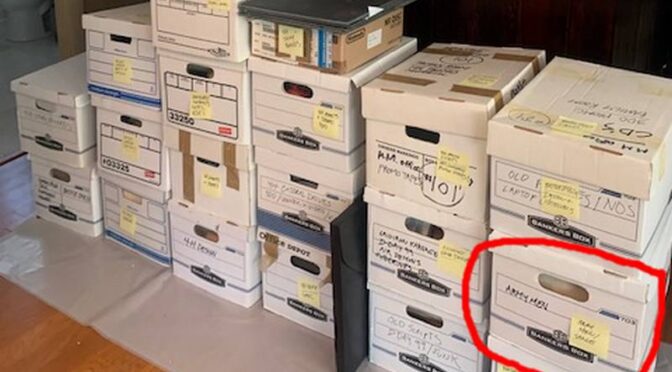
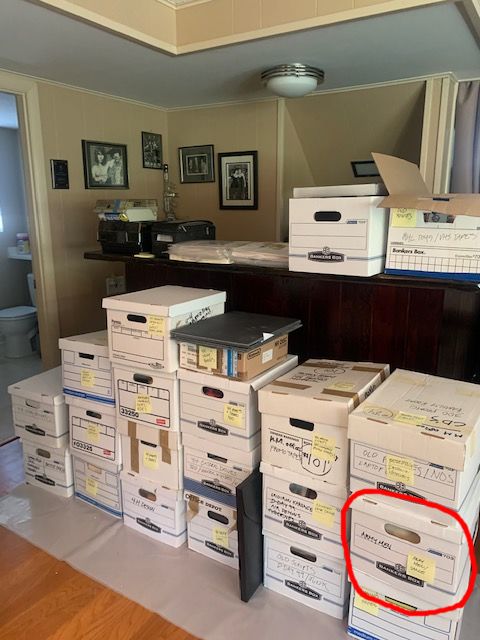
We learned from Michael Mendheim’s Twitter account that there are a series of files on paper and, possibly, on some digital medium, of Army Men, as can be read in one of the photos. We’ll keep you posted if any of that ever comes to light.

3DO files
3DO files at the Game History Archive, where we can read Army Men in a box!

The Making Of: Army Men – RetroGamer magazine. May 16, 2019. By Hareth Al Bustani

Exclusive interview with Trip Hawkins and Keith Bullen

During the mid-to-late 1990s, as video games began branching out beyond traditional genres, a surprisingly simple idea sparked the birth of one of gaming’s most memorable franchises. That spark was to bring the iconic green plastic toy soldiers (the Army Men) to digital life. What followed was a mix of action, strategy, and tongue-in-cheek satire that would grow into a universe of its own: the early foundations of what we now call the Toyverse.

The project emerged from The 3DO Company, founded by industry pioneer Trip Hawkins, who had already changed gaming history with Electronic Arts. At that time, 3DO was primarily focused on software development and searching for its next big concept… something that could blend strategy, humor, and accessibility. The result went far beyond expectation, shaping not just a game, but a world of plastic warfare and nostalgic imagination.

Origins of the Idea

It all began in 1996, when Keith Bullen, an art designer from Electronic Arts, was hired by 3DO to direct the visuals for a new project, then tentatively called War Sports. The goal was to create something in the spirit of Return Fire, 3DO’s popular vehicular shooter, but with stronger squad-based mechanics. Marketing wanted an “E for Everyone” rating, an idea ironically tied to the ESRB system that Trip Hawkins himself had helped establish.

“I remember various marketing meetings when ideas like green blood and making the soldiers robots were brought up as ways to get the game a friendly rating. I didn’t like any of these ideas.” – Keith recalls

Army Men Plastic Soldiers

Months passed without a clear direction, until Bullen had a eureka moment. He thought back to his childhood days, setting up tiny armies in the backyard and taking turns throwing rocks with his brother to knock them down. That memory (of creativity, chaos, and fun) became the emotional core of Army Men.

The toy soldiers had long been a universal symbol of imagination. From the Louis Marx playsets of the 1950s to Toy Story in 1995, these little green figures had stood the test of time. By centering the game around them, Bullen found a way to capture both nostalgia and originality, something fun for players who wanted a break from the gritty realism and machismo of other war games.

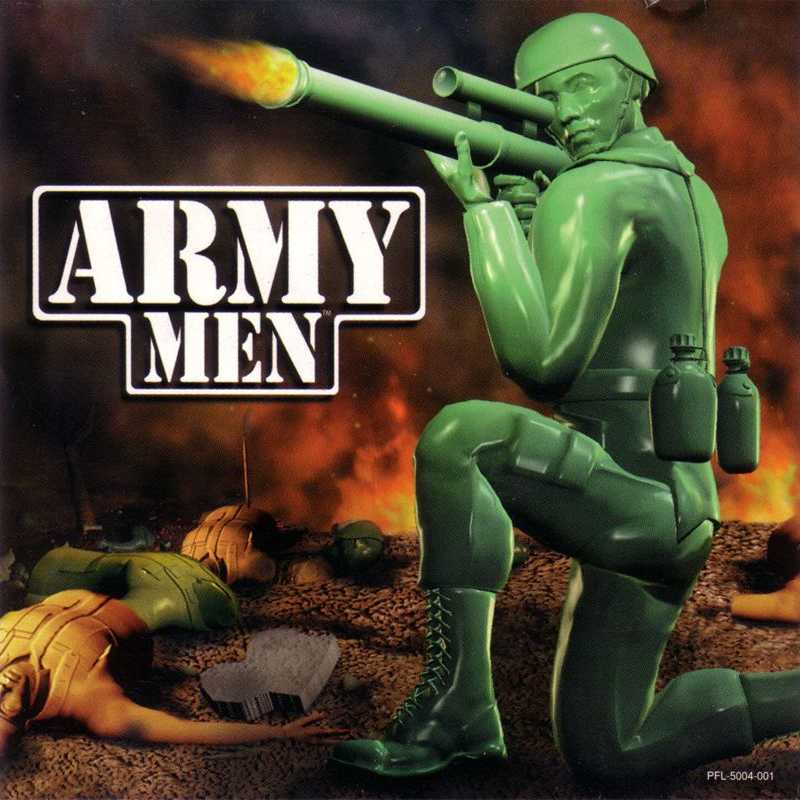
Army Men PC
Army Men PC (1998)

Building the Plastic World

Once the toy soldier idea took hold, Keith’s role evolved from art director to lead designer.

“Once the soldiers became plastic, we had to come up with a universe with real terrains and plastic soldiers,” he says. “We wanted the world to feel serious to the Army Men characters’ point of view but fun and nostalgic for the player.”

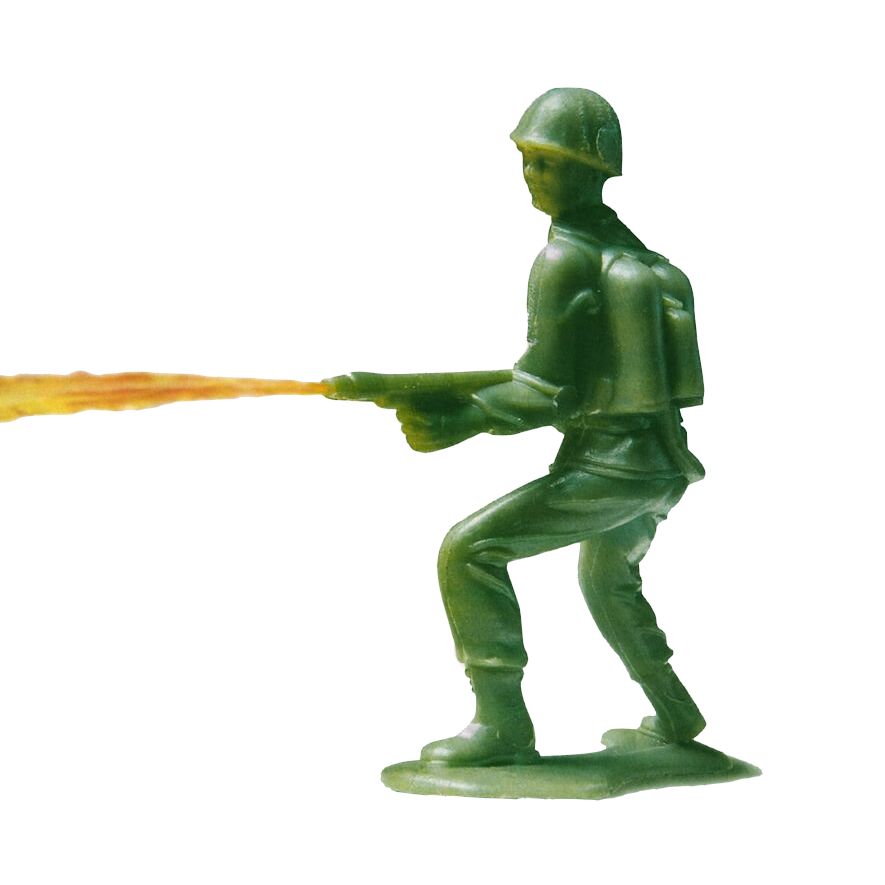
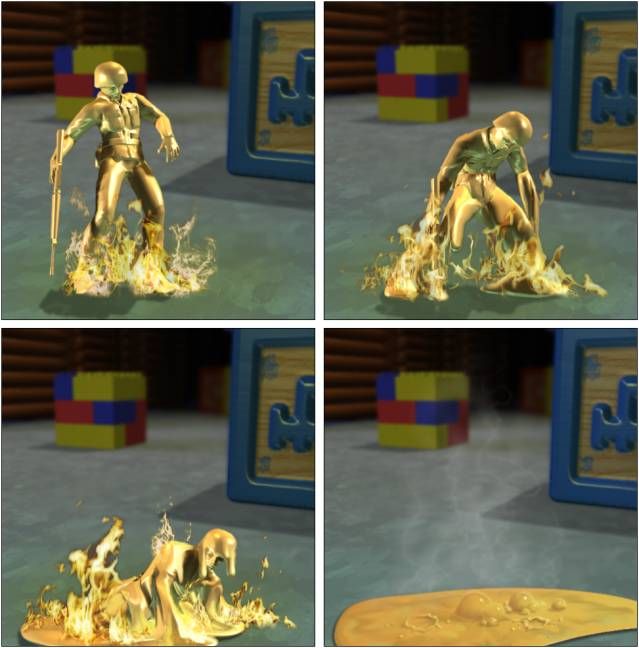
The team paid careful attention to the way plastic behaved in real life, how light hit its glossy surface, how it bent, shattered, and melted.

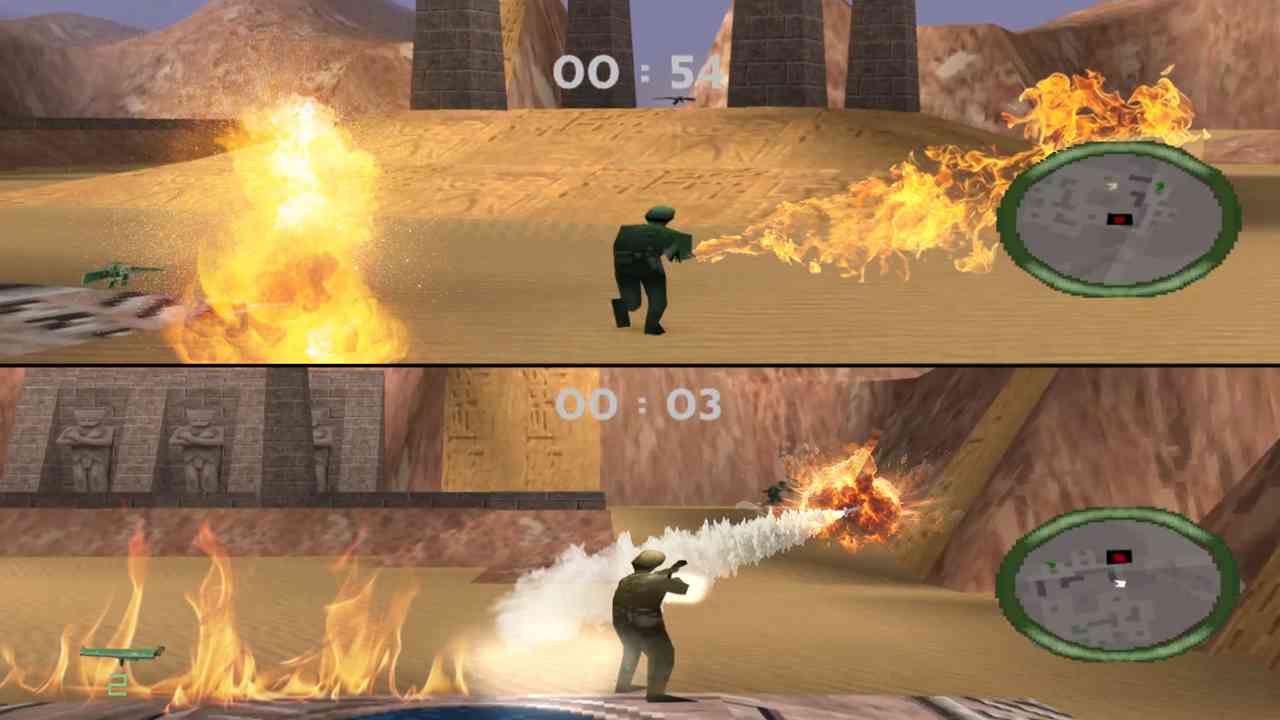
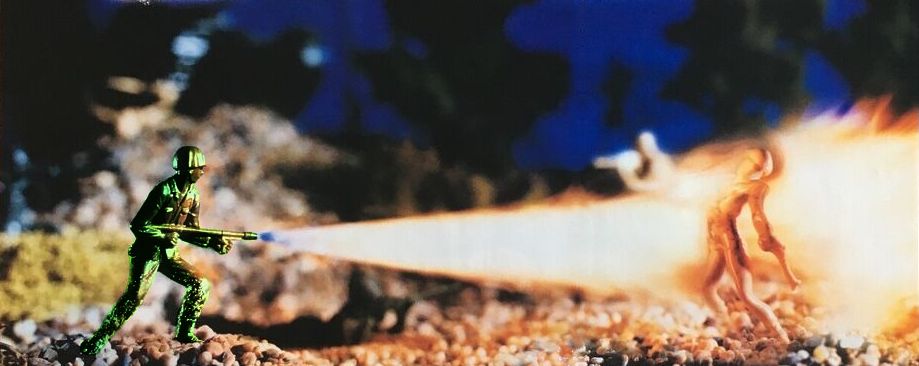
Green Army Men flamethrower

“We paid close attention to the physics in the animations. It was very important to me that the plastic pieces reacted to the world as if they were made of the same light plastic as the original figures.”

But turning that idea into a finished product wasn’t easy. The small team of six soon grew to more than ten as Bullen became creative director.

“It was very challenging convincing the team to adopt my new gameplay ideas… It took several months to finally get everyone on board.”

Executives were another obstacle. Early pitches for Army Men were dismissed as childish, “too young” some said. RTS fans, they argued, wouldn’t take seriously a game about toys. Yet Bullen persisted, finding clever ways to win people over.

Green Plastic Soldier
The “bought” generic soldier 3D model

“I then bought a 3D model of a generic Army Man and brought in some classic toy green and tan Army Men to use as pose references,” he remembers.
“For several weeks, many people from every department in the company would stop to discuss the posed 3D model… Soon after, the momentum switched from the product being perceived as too juvenile to being an awesome nostalgic experience.”

Sarge with rolled up sleeves, a modified version of the original 3D model

That was the turning point. Nostalgia had done its job.

From the Backyard to the Battlefield

The next challenge was translating the tactile world of toy soldiers into an interactive one. The developers recreated classic units like riflemen and bazooka troopers, while experimenting with how plastic would melt or break apart.

“We destroyed many plastic Army Men in the 3DO parking lot for the sake of realistic plastic physics,” Keith admits.
“The enhanced fear of fire when you are made of plastic was a theme we relied on throughout the series.”

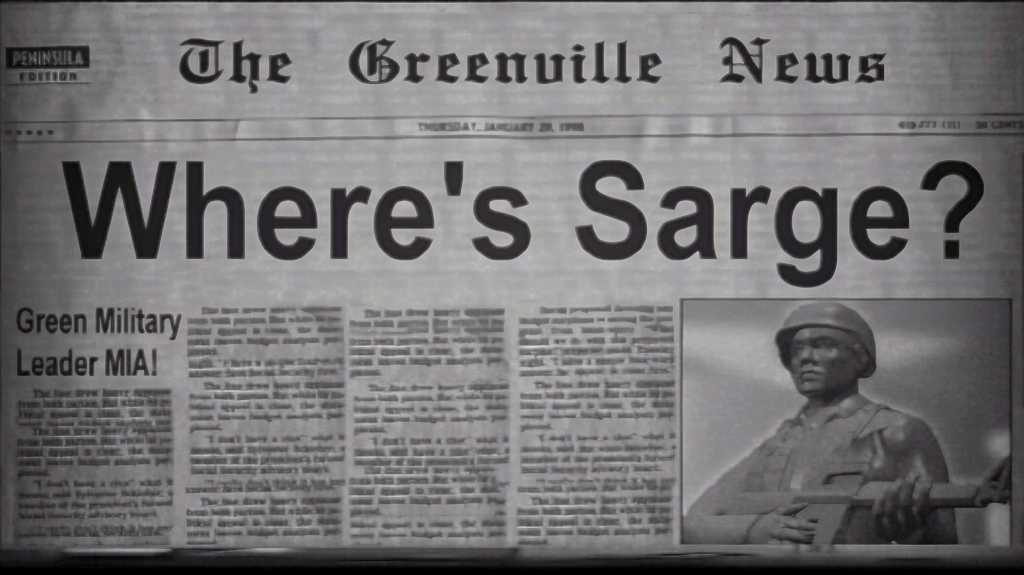
To tie everything together, Army Men adopted a satirical tone. The game opened with a mock newsreel showing the totalitarian Tans preparing to invade the Greens.

Army Men News reel Introduction
Plastro from Army Men
The Mussolini Tan leader

“We watched many hours of authentic old reels… The Tan leader gesturing like Mussolini was one of my favourite segments.”

Originally planned as a real-time strategy game, Army Men evolved into something more direct and personal. Players would take control of Sarge, a Green Army hero.

“I’ve always preferred arcade-like action games over strategy games,” says Keith.
“So I redesigned the game around the central character of Sarge… as in games like Ikari Warriors.”

The final product blended tactical movement with fast-paced action.

“The gameplay became more about tactics, rather than strategy,” Bullen notes, crediting Crusader: No Remorse as an influence.

Trip Hawkins’ Perspective

One of the concept’s earliest champions was 3DO founder Trip Hawkins himself.

“Toy soldiers were my dominant play pattern as a child and I’d always invented strong storylines and adventures around them,” he says.
“Besides all the World War soldiers, I had Swoppets from the Wars Of The Roses, Roman centurions, and others – including cowboys, of course.”

Hawkins immediately recognized the blend of nostalgia, humor, and design potential behind Army Men.

“It inspired me to do something more central with humour in the genre and a stronger narrative.”

To him, the plastic theme wasn’t just an aesthetic choice: it was a creative platform.

“We were focused on the US market… nobody cared about them, because they’d not grown up with those toys.”

Despite the game’s playful tone, Hawkins insisted that warfare and destruction were essential to the experience.

“Creatively, we also wanted to have fun repeating some of the famous play patterns from childhood… It allowed us to cast our villains with a bit of sadism, that is still funny because… they’re just toys.”

Colonel Grimm and Sarge from Army Men
Colonel Grimm with Sarge

A Legacy Beyond Plastic

The development cycle lasted just over a year, despite several restarts. Once the formula clicked, Hawkins knew they had something special.

“This is what we live for in game development and publishing… to do something we really believe in and love.”

Across three themed terrains (desert, alpine, and swamp) Army Men culminated in a memorable twist: Sarge crossing into the Real World, a scene that would directly lead into Army Men II. The franchise quickly exploded, selling over 7 million copies across every major platform and generating more than $300 million in revenue.

The Greenville News
The Greenville News 01/29/1998

Looking back, Bullen reflects on the impact of that first title:

“I never would have imagined that it would spawn 23 sequels and spin-offs… My goal was to create a game that I would want to play and not a clone of a game I had played before.”

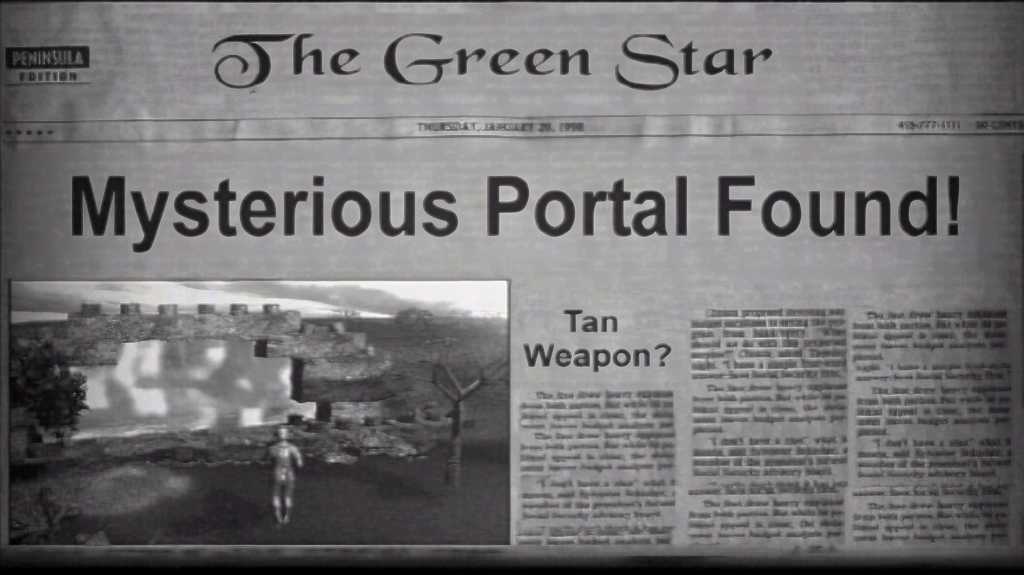
The Green Star
The Green Star 01/29/1998

Indeed, Army Men defied easy classification. It was part shooter, part strategy, part parody… a digital sandbox that reimagined childhood battles through the eyes of living toys. Beneath the surface, it captured something universal: the creative spirit of play itself.

From Sarge’s Heroes to the ever-expanding Toyverse, the legacy of those little plastic soldiers continues to march on.

Army Men PC inside
Sources for this article:

Original source: Retro Gamer (2019), “The Making Of: Army Men” by Hareth Al Bustani.
https://www.pressreader.com/uk/retro-gamer/20190516/281672551382117
Edited and adapted for armymen.com.ar

Behind the scenes: Army Men: Major Malfunction

Original sources:
  1. Team17 source: https://www.team17.com/team17s-100-games-part-nine-2005-2006-lemmings-worms-army-men

This proves that canonically, Sarge died.

The first very revealing article was Team17’s recalling history of their first 100 games, when celebrating the release of game number one hundred, PLANET ALPHA. In this chapter, they’re heading to 2005 & 2006, a time of both 2D and 3D Worms games and their first foray into work-for-hire projects on both Lemmings and Army Men.

In an unexpected twist, Team17 was granted creative freedom while working on the Army Men franchise. This allowed them to introduce a new main character and even eliminate the recurring character, Sarge, in the opening sequence (Sarge or Sarge Hawk. In any case, it seems they never knew, they really confused the franchise canon). This bold move highlights the unique creative liberties Team17 enjoyed during the development process. You can read the complete article in: https://team17.com

1. Team17’s 100 Games – Part Nine: 2005-2006 (Published: Nov 7, 2018)

(…)

48/100
Army Men: Major Malfunction

Army Men Major Malfunction
Year: 2006 | Developer: Team17 | Publisher: Global Star | Format: PlayStation 2, Xbox

When Team17 was founded in 1990 it was entirely possible, thanks to open platforms like the Amiga, for a small group of programmers and artists to make and release their own game. But times changed. As next generation consoles took over, team sizes grew and budgets ballooned. Releasing a game was virtually impossible without publisher support and this meant you had a limited number of ways to get a game made. Either own a best-selling IP or develop for somebody else’s. In this climate, Team17 found itself pitching to publishers for “work-for-hire” projects. Sometimes this led to us working on a game like Lemmings, other times it led to Army Men: Major Malfunction… Perhaps the most surprising game in our entire history.

Recruited to Team17 after a 10-year stint at Rare, Gavin Hood found himself in command of the Army Men project and worked on the pitch. “I had literally only joined the company a few months before and was sitting opposite the head of design,” says Hood. “I remember most of the designers were working hard on a Worms title as it neared the end of production so I was asked to come up with something to pitch. I guess it went okay because we got the deal and I got the chance to lead it.”

Working on someone else’s franchise, you’d think that the publisher would have final say on any creative decisions but actually, as Hood explains, Team17 were given free rein on Army Men and even got away with a few unexpected choices. “We wanted to use a different main character to many of the other Army Men games and not only did we not meet resistance to this, but we even microwaved recurring main character Sarge in the opening sequence to set up the introduction of our own character. I’m actually proud that we were able to melt a series character in the opening of a game and everyone concerned be okay with that!”

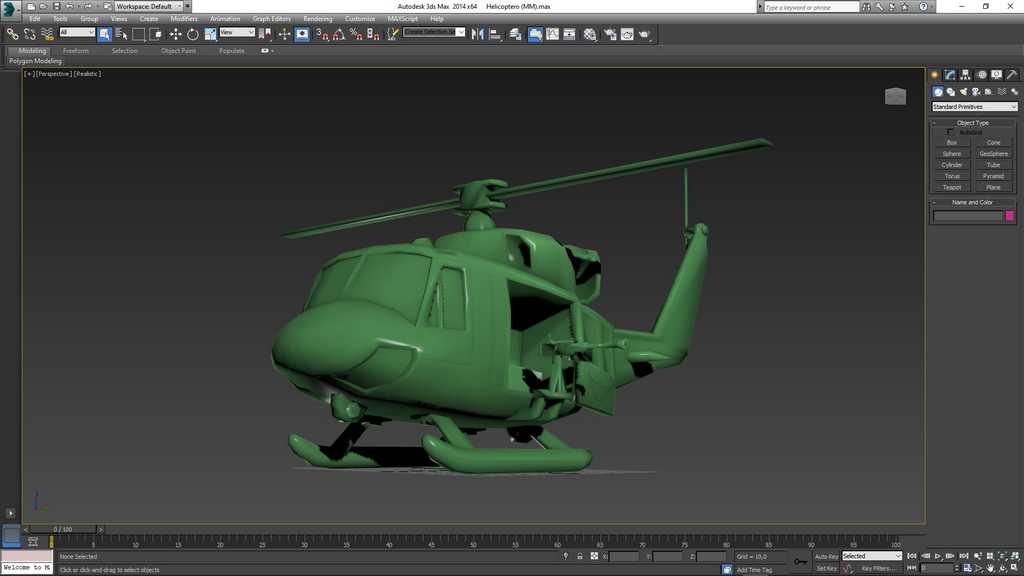
Major Malfunction Huey
Army Men Major Malfunction Huey Helicopter

Every game has its unique challenges and for Army Men it was designing a 3D world in the era before off-the-shelf game engines made the process more streamlined. “The programmers wrote a set of tools that, because of the limited time we had, were made to work on development kits using the Xbox Controller,” Hood explains. “We had to place enemies, assign A.I. to them and set their patrols all using an Xbox Pad, even the cutscenes were done in the same way. Using those tools was a nightmare but the advantage was we could throw a load of stuff into a level and just hit play. It was awful to use with a pad but the speed at which we could test ideas and get something into each of the environments is probably the only reason we hit deadlines.”

Army Men Major Malfunction WIP
A WIP CG animation from the Escape From Precinct 17 mission

“It was an interesting game to work on,” concludes Hood. “I remember having grand ideas about what the game would end up being and although it might not have exactly reached those heights there are some things I think we got right. There are a lot of pop culture references in there that I still think we handled well .” Even the subtitle, “Major Malfunction”, was a reference to a line from Stanley Kubrick’s Full Metal Jacket!

“Looking back, the game obviously wasn’t a masterpiece but everyone on the team got everything done in a very short development time with makeshift tools! It probably won’t go down as Team17’s finest hour or be the game I’m proudest of, but I did at least get to buy a lot toy soldiers and put them all over the office!”

(…)

3DO Ships Army Men(TM) — Air Attack(TM) for PlayStation(R) Game Console – News Release November 1, 1999

Original source

https://web.archive.org

Plastic Combat Takes to the Skies

The 3DO Company (ticker: THDO, exchange: NASDAQ)

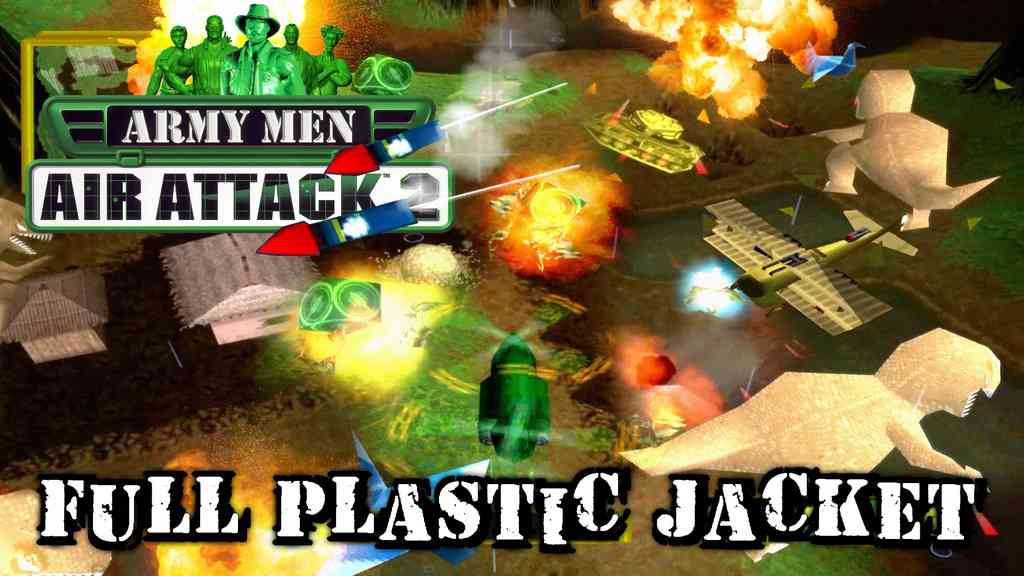
REDWOOD CITY, Calif., Nov. 3 /PRNewswire/ — The 3DO Company (Nasdaq: THDO) today announced the release of the Army Men — Air Attack game for PlayStation(R) game console. The immensely popular Army Men series now launches into the great blue yonder as helicopters take center stage in a game that evokes fond memories of playing with plastic soldiers. An all-new hero, the brash young Captain Bill Blade, and his Alpha Wolf Squadron take up the Green Army’s cause from the air to sabotage the Tan Army’s nefarious plans.

The Army Men — Air Attack game leads players on a ride through six new worlds ranging from a cold mountain fortress in Their World to cheery battles among sandcastles in Our World. Through 18 missions players may choose from three different co-pilots to help Captain in his crusade to disable the plastic-melting hot iron, extinguish deadly firecrackers, and most importantly, fight the evil Tan nemesis. Missions play homage to classic helicopter game play, and everything in the levels, from weapons and troops to pine cones and snack food, may be manipulated to achieve mission goals, just like playing with toys in your back yard.

Multiplayer options add endless hours of fun. The cooperative mode, in which players combine tactical skills to bring down the Tan menace, is especially suited for players of different skill levels. For example, one player may utilize an arcade action style of play while the other player uses a tactical play style. In Flag Nab-it mode, players face off to infiltrate the other’s base.

“This is a game that gets people’s imaginations fired up,” says Trip Hawkins, chairman and CEO of The 3DO Company. “The Army Men — Air Attack game evokes the magic of playing with toys, using whatever is at hand, whether it’s a bottle rocket or a pine cone, to carry on the fantasy, a fantasy everyone seems to love.”

A multi-million dollar marketing campaign for the Army Men brand features television advertising through the holiday season and a seven-month print campaign in both consumer and gaming magazines and point-of-purchase promotions.

Other upcoming games from the Company include Army Men(TM) — Sarge’s Heroes(TM), Crusaders of Might and Magic(TM), and BattleTanx(TM): Global Assault(TM) for the PlayStation game console, Crusaders of Might and Magic, Family Game Pack(R) Royale, and High Heat Baseball(TM) 2001 for the PC, and Army Men, Vegas Games(R), and BattleTanx for the Game Boy(R) Color.

The 3DO Company, headquartered in Redwood City, Calif., develops, publishes and distributes interactive entertainment software for personal computers, the Internet and advanced entertainment systems such as the PlayStation game console and the Nintendo(R) 64 console. 3DO markets and publishes its products worldwide under multiple brand names including Army Men, BattleTanx, Heroes of Might and Magic(TM), High Heat Baseball, Might and Magic(R), and Meridian 59(TM). More information about 3DO’s products can be found on the Internet at www.3do.com .

This release contains forward-looking statements, which are subject to risks and uncertainties. Potential risks and uncertainties include, without limitation, the Company’s ability to develop and ship future products, market demand and acceptance for the Company’s current and future software products, and the consequences of competitive factors in the marketplace. Further information on potential factors which could affect these forward looking statements and the Company’s financial results are included in the Company’s filings with the Securities and Exchange Commission, including the Company’s Annual Report on Form 10-K for the fiscal year ended March 31, 1999 and the Company’s Reports on Form 10-Q for the fiscal quarters ended December 31, 1998 and June 30, 1999.

3DO, Air Attack, Army Men, BattleTanx, Crusaders of Might and Magic, Family Game Pack, Heroes of Might and Magic, High Heat Baseball, Meridian 59, Might and Magic, Sarge’s Heroes, Vegas Games, and their respective logos, are trademarks and/or service marks of The 3DO Company in the U.S. and other countries. New World Computing is a division of The 3DO Company.

PlayStation and the PlayStation logos are registered trademarks of Sony Computer Entertainment Inc.

Nintendo, Nintendo 64 and Game Boy are registered trademarks of Nintendo of America Inc.

All other trademarks and tradenames belong to their respective owners.

SOURCE The 3DO Company

Trip Hawkins, The 3DO Company and other interviews: Army Men highlights!

Original sources:
  1. https://futuregamez.net/3do-interview

1) Trip Hawkins 3DO Interview, September 23, 1999 on futuregamez.net by David Warner ~ Dreamcast Australia

The games industry can be tough at times. Trip Hawkins should know. He built Electronic Arts from nothing to become the largest gaming company in the world. Several years later he left Electronic Arts to form the 3DO company. 3DO designed a console architecture which was developed by Panasonic. Unfortunately the system lacked software support and coupled with a high price ($US700) the system died soon after the Playstation’s and Saturn’s launch. After another failed hardware bid with M2, Trip Hawkins decided that 3DO was better off as a software company. Once again Trip is aiming to create a major software company, and the games so far have proven themselves as world class titles. I thought it would be nice to have a chat to one of the most powerful men in the gaming industry.

Here are the Army Men highlights from this interview you can read in this link: https://futuregamez.net/3do-interview

Trip Hawkins 3DO Interview, September 23, 1999 on futuregamez.net by David Warner ~ Dreamcast Australia
Young Trip Hawkins
Young Trip Hawkins at 3DO

(…)

– What are your thoughts on technology in regards to gaming and gameplay?

Trip: My mission at 3DO is to turn people into lifelong gamers. That’s why I have been making games for over 25 years. That’s also why I have on occasion in the past made forays into the hardware side of the business when I felt it needed to be moved forward in the interest of gamers.

Sony and others have done a great job moving the hardware to where it is now. It’s very exciting to see the capabilities of these systems getting where they are. The medium is the message, after all. I have always felt that great games need to be simple, hot and deep. That’s how I built EA and EA Sports in particular.

And that’s the same philosophy with 3DO’s game brands like Army MenBattleTanxHeroes of Might and Magic, and High Heat Baseball.

(…)

– Can you explain a little about your major 3DO games titles?

Trip: Army Men is a best-seller because people are emotionally enthralled with the idea that some of their favorite toys have come to life in a way that lets their imagination run wild. Our new lines, Army Men: Sarge’s Heroes and Army Men: Air Attack, add new dimensions to this fantasy world. The first is a terrific character adventure action game with a great story. The second is a charming helicopter action game. (…)

(…)

Would you like to see any other 3DO games ported to the Dreamcast?
Trip: Army MenHigh Heat Baseball, and BattleTanx are great brands that would do well on any platform.