
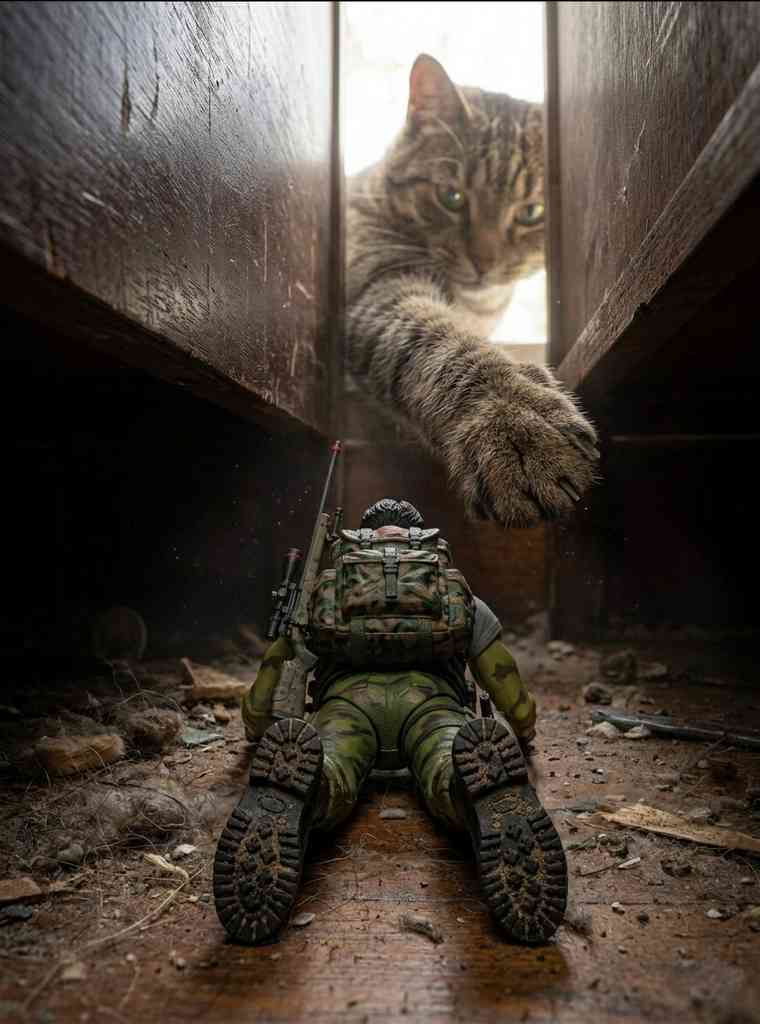
They were not built for war. That is the first thing every unit agrees on.
Humans created machines for transport, weapons for conflict, tools for survival… but cats don’t fit into any of those categories. They were something else entirely. Something closer to presence than purpose.
They lived inside human structures. Shared their spaces. Slept where they slept. Ate from controlled sources. And yet, even in that environment, there is no evidence they were ever fully controlled.
That detail matters. They were so infiltrated into their society and so out of their control that, perhaps… were cats the ones who wiped out humans?
Before the Disappearance
There are countless traces of coexistence.
Resting areas where cats and humans occupied the same space. Elevated surfaces clearly used by them, so they like the high ground (maybe in a tactical-survival perspective). Objects designed specifically for their use, like soft platforms, feeding stations, even small structures built just for them.
Humans didn’t just tolerate cats. They adapted their environment around them.
And yet, there are no signs of command systems. No restraints. No containment protocols. No behavioral enforcement beyond the most basic conditioning.
It raises a question no unit has answered yet:
Why would a dominant species allow something autonomous to move freely within its most secure spaces?
After the Disappearance
Unlike other dependent organisms, cats did not collapse.
They did not gather.
They did not search.
They did not wait.
They remained. Operating alone. Moving through empty structures as if nothing had changed.
Food sources shifted. Behavior adjusted. Territory expanded. But there was no visible transition phase.
No panic. No confusion. Only continuity.
Movement and Presence
Cats do not move like any known biological unit we have studied.
They don’t patrol. They don’t wander. They appear where they decide to be.
A unit can monitor a hallway, confirm it is clear, and seconds later a cat is already there… silent, still, observing.
No detectable approach. No warning… Just presence.
Eye Contact
Every encounter report mentions the same detail.
The moment of eye contact.
Cats do not scan like predators. They do not assess like soldiers. They look.
And they hold that look longer than expected. Long enough to create hesitation. Long enough for a unit to question whether it has already been evaluated.
Some describe it as being measured. Others describe it as being ignored. Both feel equally inaccurate.
Engagement Behavior
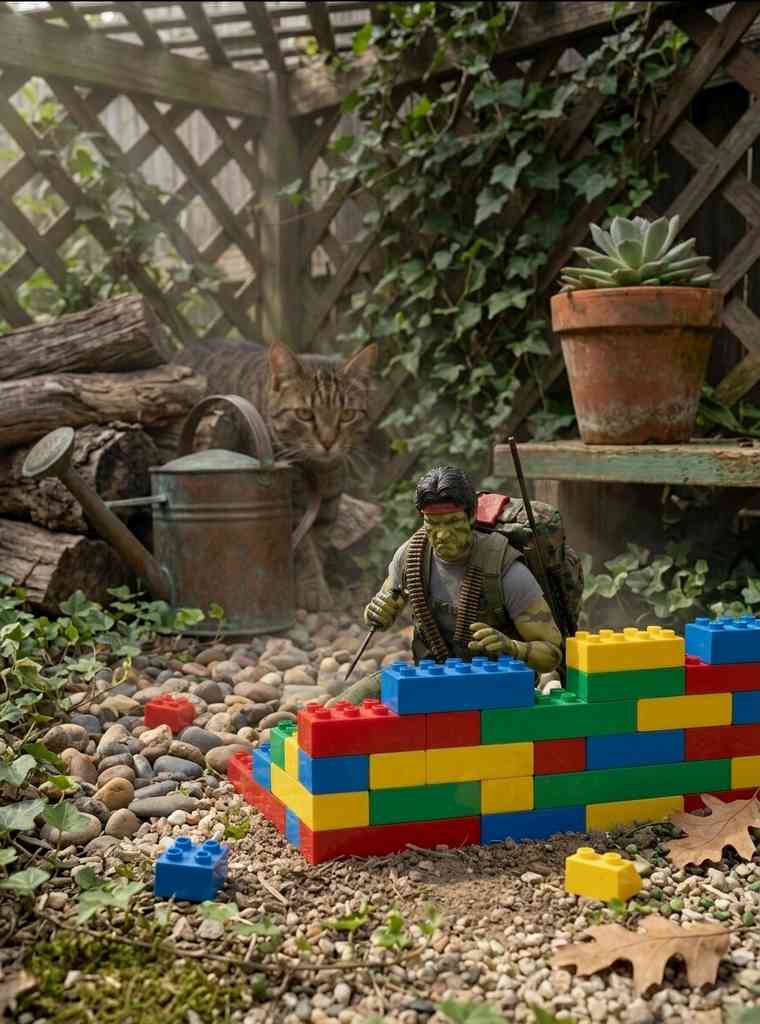
Direct aggression is rare, but when it happens, it is immediate and precise.
There are no escalation phases. No warning sounds comparable to other species.
Just a sudden release of motion (too fast for most units to track) followed by immediate disengagement.
In several cases, cats have struck equipment instead of the unit itself.
Weapons displaced. Helmets knocked loose. Position compromised. Then withdrawal.
No follow-up. No pursuit. This suggests intent, but not hostility in the conventional sense.
Territory
Cats claim space, but not visibly.
There are no constructed boundaries. No markers that can be consistently identified. And yet, units report consistent resistance when remaining too long in certain areas.
Not always through attack. Sometimes through presence alone.
A cat enters the area. Sits. Watches. And units… leave. No order given.
Attempts at Classification
Multiple designations have been proposed:
- Companion Unit
- Residual Domestic Species
- Low-Level Predator
- Environmental Variable
None are sufficient. Cats do not behave consistently enough to be categorized under standard biological or tactical models. They are not aligned with any known system.
Final Notes
Humans lived with them. That is the part that remains difficult to process.
Not studied from a distance. Not contained. Lived with.
Shared space with something that does not obey, does not depend, and does not fully reveal intent.
There is a growing idea among some units:
Cats are not surviving the Real World. They are… continuing it.