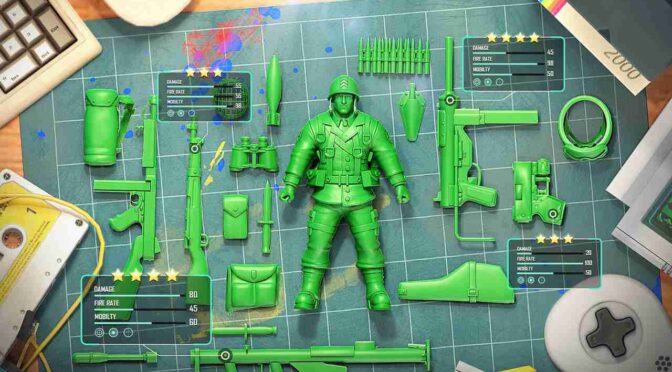
Tools of war: Now for the good stuff!
Like dentists need a drill, Army Men need weapons. There’s an entire arsenal of weaponry in the Army Men Universe, not only from the Plastic World, but all the other. Here is a breakdown of what each weapon does and how to use them.
Weapon categories
These sorts of categorizations are often ‘soft’ meaning that there are many guns that could be argued to be in more than one category. In addition, the terms have ‘shifted’ in usage over time.
Metal Weapons
Appearing on the scene approximately in 2001, and being mass manufactured on the Real World in 2002-2004, metal weapons were molded from one of the most powerful materials extracted from the Real World: Metal.
The metal alloys and their relationship of structural integrity and weight made these weapons the most lethal in the worlds. But not everything is so simple and rosy with these plastic devourers: they don’t work so well in the Plastic World. Everything that comes from another world tends to lose effectiveness in other worlds. Therefore, although this materials do not lose their power, the weapons that use them do.
The nerfing effect: a reality check on weapons/materials
Within the Army Men Toyverse, the dynamics between plastic, metal and other kinds of weapons are fascinating, governed by the unique physical / reality laws of their respective realms.
In fact, these laws inherent to different realities govern all kinds of objects and special characteristics, such as magical objects.
Plastic Weapons in the Plastic World: In the Plastic World, plastic weapons are enough powerful, matching the effectiveness of metal weapons from the Real World. This power is derived from the inherent properties of plastic within this dimension, where the plastic material’s nature enhances maneuverability, lightweight and speed, allowing for swift and precise attacks. The energy that powers these weapons is a form of plastic-based kinetic energy, seamlessly integrated into the plastic soldiers’ physiology.
Metal Weapons in the Plastic World: When metal weapons from the Real World are brought into the Plastic World, they quickly lose their potency. The theory of the nerfing effect occurs due to the incompatibility between metal and the Plastic World’s energy matrix. Metal, being foreign to the Plastic World’s physics, cannot efficiently channel or maintain the energy required for sustained use, causing these weapons to deteriorate or malfunction after a short period.
Plastic Weapons in the Real World: Conversely, plastic weapons transported to the Real World experience a significant drop in their effectiveness. The dense and rigid nature of the Real World’s physics diminishes the energy that powers these plastic weapons. They become fragile and unreliable, unable to generate the same level of impact as in their native realm. In the Real World, metal is one of the most powerful materials in that world.
Uncompromised Weapons: Melee weapons, regardless of their origin, logically maintain their functionality across both worlds. These weapons rely purely on physical force rather than energy projection, making them immune to the dimensional discrepancies. However, special powered weapons like Thor’s Hammer, Mjölnir, exhibit a dependence on their mythological world’s unique energy source. In the Real World, Mjölnir loses its supernatural abilities and functions merely as a handheld weapon.
This intricate balance ensures that each world retains a level of authenticity and challenge for its inhabitants, reflecting the distinct nature of their respective realities.
- Assault Rifle
- Auto Rifle
- Bazooka
- Carbine
- Excalibur
- Explosives
- Flamethrower
- Grenade
- Grenade Launcher
- Heavy Machine Gun
- Luger
- Martian love gun
- Mines
- Mjölnir (Thor’s Hammer)
- Mortar
- Rockets and Missiles
- Shotgun
- Sniper Rifle
- Vikki’s Bow
Behind the scenes
To work or not to work, that is the question
Weapons will work in a very particular way in Army Men Revolution. They will work normally in the worlds they come from, but will stop working in other worlds, or will be nerfed. In this way we ensure that the seemingly weak plastic weapons can compete against the new metal weapons. And we also make sure that you must use swords, axes, hammers, bows and arrows in the Medieval World. So in every world you must behave “in-universe”.
Functionality and materiality, not composition
The materials composition are not modified, but the shapes of some objects are, as is the case of Vikki and her bow in Portal Runner. These unique and exceptional cases allow us to make visual skins that change depending on the universe being visited. But it’s not discarded that in some way the materials may also change in the future, or that some world may produce this effect.
Composition is the proportion of the different constituents of the material (chemically and physically different). Structure, on the other hand, refers to the spatial distribution, orientation and association of the constituents. Characterizing a material is determining the parameters necessary to identify and describe it. In simpler words, it is impossible for a world different from where a weapon comes from to transform its plastic into metal. But you can modify a banana-shaped plastic weapon to an apple-shaped one, always maintaining the same composition and proportion. The characteristics for the most part, although this can change radically to the point that, for example, a bow becomes a bayesta (which is almost the same, just seen differently by the Army Men).
Sources for this article:
https://reddit.com/r/H3VR/comments/7lsiij/whats_the_difference_between_carbines_assault